Tinley Park Epoxy Flooring has spent more than 20 years on epoxy flooring in Worth and the surrounding suburbs, and restroom floors are the jobs where a seamless resin system earns its keep fastest. A tiled restroom can look clean on the day it is mopped and still smell by the next afternoon. That gap between how a floor looks and how it behaves is what this page is about.
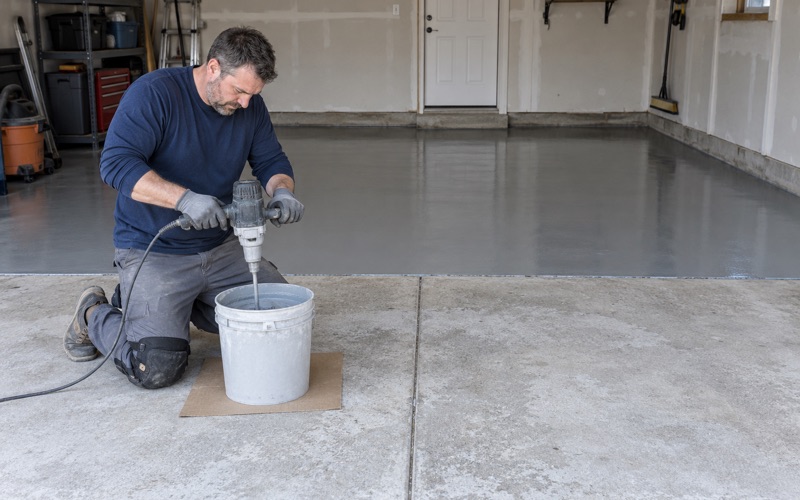
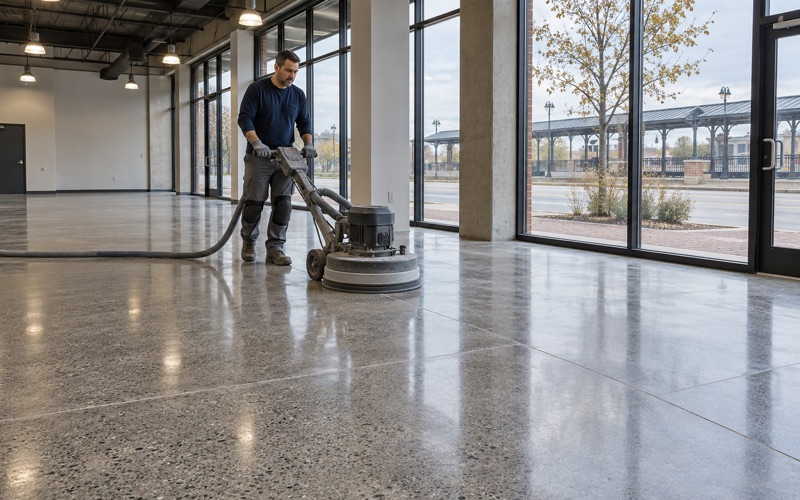
Our approach holds whether the room is a commercial washroom, a basement bathroom or the utility corner beside a washing machine. We open the concrete with a diamond grinder or a shot blaster rather than an acid etch, and a moisture test goes into the written scope before a price is final. The proposal names the product line, the coat count and the finished thickness, so you can hold the finished floor up against the quote.
Restrooms also ask for detail work most floors do not. The coating has to turn up the wall, close the joint where floor meets base, and leave a surface that a mop actually cleans instead of one that just spreads residue around. Below we explain why the building code singles out these rooms and what that means for the floor you choose.
Worth Elementary’s Addition and the Code’s Restroom Sentence
In 2022, Worth School District 127 finished a $5.5 million addition and renovation at Worth Elementary on South Oak Park Avenue. Troop Contracting’s project record lists a 12,900-square-foot addition with classrooms, a music room, a cafeteria and a media center. It also lists a 3,300-square-foot renovation of the existing school that included new restrooms.
A School That Kept Teaching
The contractor’s summary notes that the school remained operational during construction, so restroom work went on in a building full of Pre-K through fifth-grade students. The same record lists multiple flooring finishes without naming them, and we have not seen what went down in those restrooms. What the project does show is how much attention a rebuilt restroom gets, even inside a much larger addition.
Commercial restrooms that cannot close get the same kind of planning from us. We phase that work into overnight and weekend windows and sequence rooms so one set stays open while another cures. Nobody should have to post a sign sending people to a building across the lot.
The One Sentence the Code Writes About Restroom Floors
The International Building Code, in the 2021 edition adopted in Illinois, has a section that reads almost like a floor specification. Section 1210.2.1 says that outside dwelling units, toilet, bathing and shower room floors must have a smooth, hard, nonabsorbent surface. It goes on to require a smooth, hard, nonabsorbent base where the floor meets the walls, extending up the wall not less than 4 inches.
That is the model code’s language, not a statement about which edition governed any one project, and Worth’s own adoption is listed as the 2006 International editions. Still, few floors anywhere get a sentence that specific. The reason behind it is worth understanding before you pick a finish.
Who Signs Off in Worth
Work in the village runs through the Village of Worth Building Department. Contractors register with the village for $110 a year, carry insurance naming the village and post a $10,000 surety bond. The permit list covers remodeling work without naming flooring either way, so we ask the Building Commissioner before a job is booked rather than guess.
Illinois licenses no flooring or coatings contractor at the state level, which makes the village’s own rules the ones that count. We bring the registration, bond and insurance paperwork into the proposal so an owner or facility manager can see it before anything is scheduled.
Looking for epoxy-flooring closer to Palos Hills? See Epoxy-Flooring Services in Palos Hills.
Why a Restroom Smells Again After It Is Mopped
The odor that comes back in a tiled restroom usually is not a cleaning failure. Cleaning-industry sources describe urine reaching porous cement grout around toilets and urinals, soaking in and drying there. Once it dries, the residue sits below the surface where a mop never reaches.
Uric Acid Crystals in Porous Grout
CloroxPro’s restroom guidance puts it plainly: urine odors occur when uric acid crystals become trapped in porous damp surfaces and are fed on by naturally occurring bacteria. Cement grout is porous by design, and the joints closest to a toilet base take the most splash. Each mopping rewets those crystals, which is why a smell can return within hours of a wash.
That is a trade-level explanation rather than a standard, but it matches what the code is reaching for. A surface that cannot absorb gives the crystals nowhere to lodge, and bare concrete without a sealed finish behaves much like grout.
What a Coating Does and Does Not Do
A resin floor is not a disinfectant, and we do not sell one as germ-proof or as something that kills bacteria. What it does is remove the porous places where residue collects, so the cleaning products already in use can reach the whole surface. The cleaner still does the cleaning; the floor simply stops hiding anything from it.
That distinction matters when you compare quotes. A proposal that promises the floor alone will end odor is promising something a coating cannot deliver. A proposal that closes the joints and seals the slab is describing what actually changes.
The Wall Joint Nobody Mops
Grout lines are only half the problem. The joint where the floor meets the wall, or where a vinyl base has pulled away from it, collects the same splash and is almost never reached by a mop head. The 4-inch base in the code exists because that corner is where a restroom floor most often fails to stay clean.
A wall tile base helps only until its own grout line opens up. Then the base becomes a second row of joints at exactly the height a mop splashes, and the corner behind the toilet is the hardest place in the room to reach.
A Seamless Floor With an Integral Cove Base
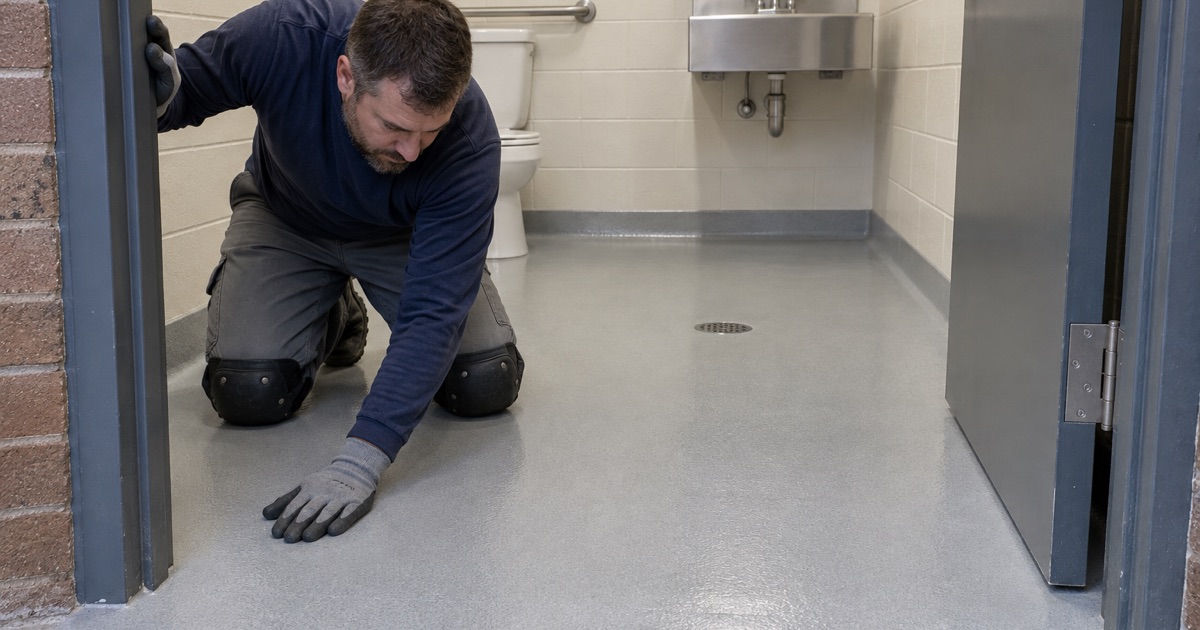
The answer to both problems is a floor with no grout lines and no open wall joint. A seamless resin system runs as one continuous surface across the room. An integral cove base carries that same material up the wall in a curved radius, so the corner becomes part of the floor.
Building the Cove
We form the cove with a trowelable epoxy mortar over a cove strip, bring it up the wall past the 4-inch line, and finish it in the same body coats as the floor. Around toilet flanges, floor drains and partition posts, the coating is worked tight to each penetration. No ring of exposed concrete is left behind for splash to find.
The radius is the point. A mop or a squeegee follows a curve but skips a square corner. With the cove in place, the base and the floor clean in a single pass.
Choosing the System and the Texture
Most restroom floors we specify use a 100% solids epoxy body coat with a quartz aggregate or vinyl flake broadcast, sealed with a polyaspartic or urethane topcoat that stands up to daily cleaners. A wet floor still has to be walked on safely. Slip resistance is set by the broadcast size and the topcoat we name in the proposal, not promised as a slogan.
Where a restroom also sees hot water washdowns or heavy chemical cleaning, urethane cement is the option we raise. It tolerates thermal shock and constant moisture better than a thin epoxy film does.
Preparing the Slab Underneath
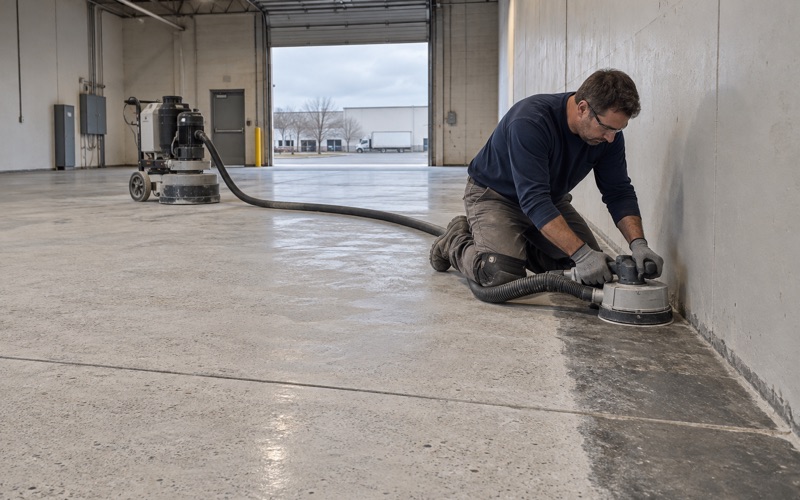
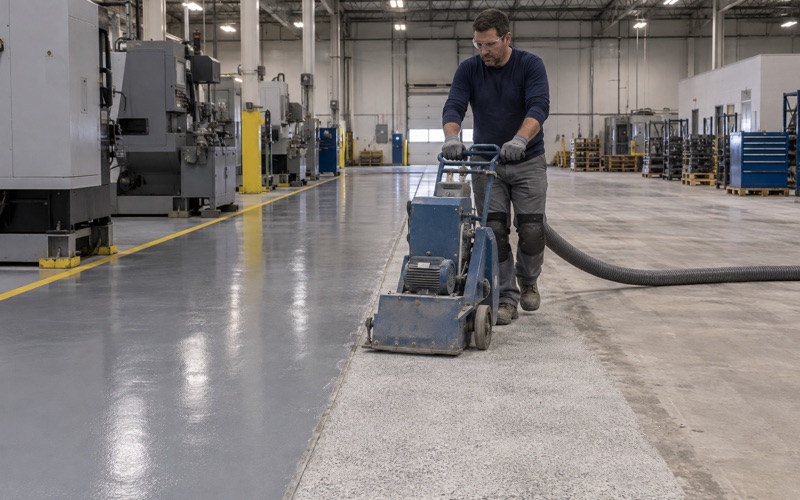
A restroom slab carries years of cleaner, wax and sealer that an acid etch would not cut. We grind or shot blast to an ICRI concrete surface profile the primer can grip, map every crack and spall, and tell you when a section needs repair before it should be coated. Old tile and thin-set come up completely, because coating over them only moves the grout line down a layer.
Basement Bathrooms and Laundry Corners in Worth Homes
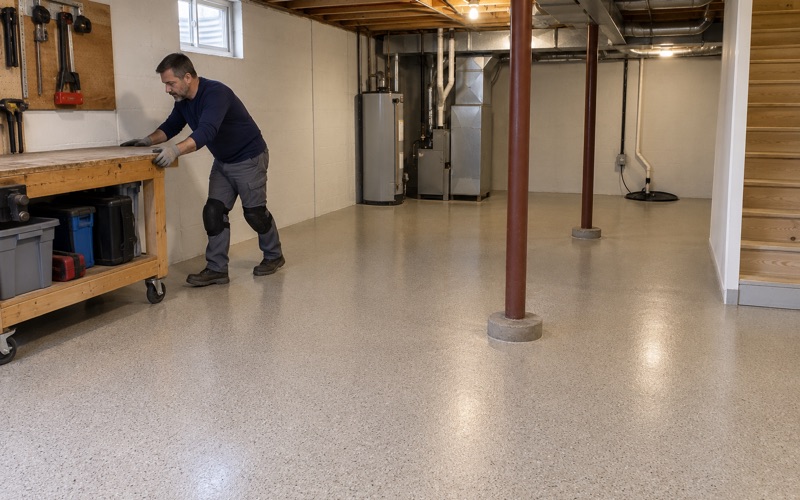
The code’s restroom sentence does not apply inside a dwelling unit, but the physics does. A basement bathroom with a bare cement floor, or the corner by a washer and utility sink, collects water and residue in the same porous joints a commercial restroom does.
The fix at home is the same smooth, hard, nonabsorbent surface, sized to the room. A basement bath rarely needs a commercial system, but it benefits from the same coved corners and the same honest look at the slab before anything is mixed.
Moisture Comes First
Basement slabs sit against the ground, so the moisture test is written into the scope before a price is final. Depending on the slab, that means an ASTM F2170 in-situ relative humidity probe or an ASTM F1869 calcium chloride test. A high reading points to a moisture-mitigation primer rather than a straight coat.
Moisture is also the first exclusion we name when we explain what the coating warranty does not cover. It is better to hear that before the job is sold than after a blister appears.
Dust, Drains and the Utility Corner
Laundry areas usually have a floor drain, and grinding dust does not belong in it. We capture dust at the grinder with a vacuum, then cove the floor up the walls behind the washer and sink. A leaking hose or an overflowing tub then stays on a surface you can wipe dry.
The same detail works in a basement half bath. Coving behind the toilet and along the vanity closes the corners that a tile floor leaves open.
Contracts and Radon
For home jobs over the state threshold, we provide a written contract and the Illinois Home Repair: Know Your Consumer Rights pamphlet before any grinding starts. That paperwork spells out the scope, the price and the moisture terms in one place.
We also do not sell a basement coating as radon reduction. In Illinois that is licensed mitigation work, and a sealed floor is not a substitute for it.
- 20+ Years Coating Floors
- Moisture Test in Every Scope
- Free Written Estimates