Tinley Park Epoxy Flooring has spent more than 20 years on epoxy-flooring in Summit and the villages around our hub, and a good share of that work lands in garages where somebody actually turns wrenches. A floor in a working garage takes a different beating than a floor that only parks a clean daily driver. We plan the coating around the fluids that will end up on it, not around a color chip.
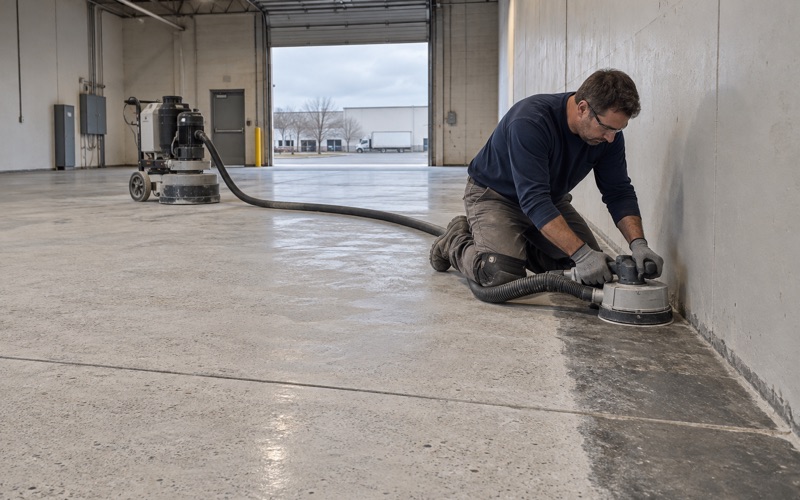
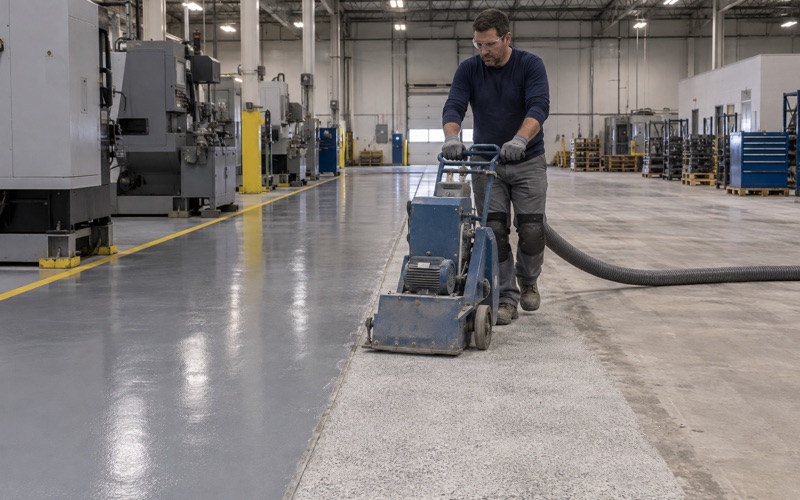
Every job starts with a diamond grinder or a shot blaster rather than an acid wash, because a coating needs a real profile to bite into. Before the price is final, a moisture test goes into the written scope, whether the slab sits in a basement or a garage. The proposal then names the product line, the number of coats and the finished thickness, so you can hold the finished floor up against the quote.
Cracks, spalls and old failing coatings get mapped before anything is sold. When a slab needs repair or replacement first, we tell you that plainly instead of coating over the problem. The rest of this page covers what we have learned about garages where cars get fixed, and why the jug of washer fluid deserves more respect than the oil pan.
A Parts Yard on West 61st Place and the Garages It Feeds
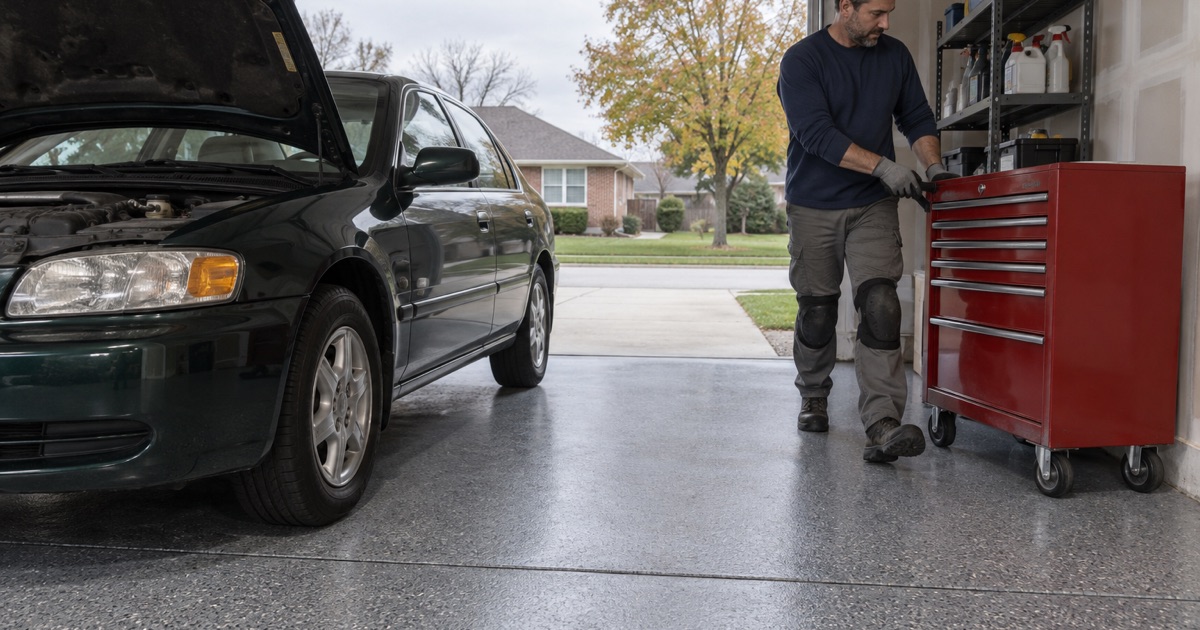
Summit has a self-service used-auto-parts yard inside the village: Pick-n-Pull, part of Radius Recycling, at 7800 West 61st Place. It is open seven days, from 9:00 a.m. to 6:00 p.m. on weekdays and from 8:00 a.m. to 6:00 p.m. on Saturday and Sunday. We have no connection to the yard and sell no parts, but its presence says something about how garage floors in this corner of Lyons Township get used.
Pulled parts come home with something still inside
A part pulled from a donor car rarely arrives clean. Radiators, washer reservoirs and wiper motors drip whatever was left in them, and they usually get set down on the garage floor before they ever reach the bench. That puts small, repeated spills of mixed automotive fluids exactly where a coating has to live.
In a California matter unrelated to Summit, Pick-n-Pull acknowledged that some vehicles had reached its customer yard without being properly drained of fluids. We mention it only to make a practical point. Assume anything carried home from a donor car still holds some liquid, and give it a tray before it gives you a stain.
Project cars stay put for weeks
A project car is not parked for a night and driven away. It sits on stands for weeks while hoses come off, reservoirs get swapped and lines get bled. Every one of those jobs ends with a few drops on the floor, and the coating sees them over months rather than once.
That is the use pattern we design for when a home mechanic calls us. The real question is not whether the floor will get wet with shop fluids, but which ones and for how long. The answer decides the topcoat far more than the color does.
Looking for epoxy-flooring closer to Dyer? See Epoxy-Flooring in Dyer.
Not the Oil: What One Chemical Chart Says About Plain Epoxy
Most people picture motor oil when they imagine a garage floor getting damaged. On a properly installed epoxy, oil is rarely the fluid that does the harm. One manufacturer’s published resistance chart makes that point clearly, and then points somewhere less obvious.
How the chart was built
The chart comes from Flowcrete, dated December 2021, and it rates coating samples cured for ten days and then immersed in pure chemicals. A rating of 5 means no harmful action after long-term contact, 3 means unaffected after a month, and 0 means attacked on contact or within two to three hours. Immersion is the most extreme case, harsher than a spill on a floor, and these are one company’s products rather than every epoxy on the market.
Fuels, oil and antifreeze hold up
On that chart, the solvent-free epoxy coating rates 5 for petrol, diesel oil, Shell Rotella engine oil and ethylene glycol antifreeze. Those are the fluids most people expect to cause trouble. In that test, they did not.
That fits the general reputation of a well-built epoxy system. A drip of gasoline or a puddle of green coolant on a cured floor is a cleanup job rather than a repair, as long as it gets wiped up instead of left to sit.
Methanol rates zero
The same solvent-free epoxy rates 0 for methanol, meaning attacked on contact or within two to three hours. Ethanol at 96 percent fares better with a 3, while several glycol ethers on the chart also rate 0. The polyurethane coating on the same chart rates 5 for both methanol and ethanol.
Methanol is not an exotic shop chemical. Safety data sheets for windshield washer fluid list it as the main active ingredient, at 25 to 35 percent in one product and around 30 to 34 percent in others. The chart tested pure methanol, not diluted washer fluid, so it cannot tell you how a given blend behaves, but it does tell you which ingredient to watch.
Washer Fluid, Alcohols and Mixtures: Choosing the Topcoat
When the people using a garage swap reservoirs, top off fluids and work on cars for fun, we choose the topcoat for alcohol exposure first. The base coat still matters for build and bond. The topcoat is the layer a spill actually touches.
A urethane-family layer on top
Where alcohols are a real risk, we put a polyurethane topcoat or another urethane-family finish over the epoxy base rather than leaving plain epoxy as the wearing surface. On the chart above, polyurethane rated 5 against methanol where the epoxy rated 0. Polyaspartic and polyurea topcoats are other options we weigh, and we check each product’s own resistance data rather than assuming a whole family behaves alike.
The proposal names that topcoat by product line, alongside the coat count and finished thickness. If a manufacturer publishes no methanol or alcohol rating for a product, we say so, and that gap counts against it when we make a recommendation.
Why a mix can be worse than its parts
The Flowcrete chart carries a note worth reading twice: mixtures of chemicals can be more aggressive than the individual components alone would suggest. A garage floor rarely sees one clean fluid. Washer fluid, coolant, fuel drips and winter brine all meet in the same low spot by the door or the drain.
The chart also notes that some chemicals concentrate as they evaporate and grow more aggressive, and that higher temperatures reduce resistance. A puddle left under a warm engine on a summer afternoon is a harsher test than a cool splash wiped up at once. We treat those notes as reasons to plan for cleanup, not as reasons to panic.
Salt season still counts
A working garage in Summit also takes on brine and rock salt every winter, riding in on tires and dripping off rocker panels. We pick garage systems to hold up to those deicers as well as to shop fluids. A topcoat that shrugs off alcohol but wears poorly under salt is not the right answer for a Cook County garage.
Salt matters to the base layer too. Brine that works into a crack or a worn edge can lift a coating from underneath, which is one more reason we map cracks and spalls before the first coat goes down.
Wipe-Up, Drip Trays and a Spot Test With Your Own Fluids
No coating makes a floor maintenance-free, and we would rather tell you that before the job than after it. The habits around the floor do as much as the product on it. These are the ones we go over with every home mechanic.
Wipe it up while it is fresh
The 0 rating for methanol on plain epoxy is measured in hours, not days. That makes prompt wipe-up the cheapest protection a working garage has. Keep absorbent pads near the bench and clean up a washer fluid spill when it happens. Do not leave it for the weekend.
Drip trays under a car on stands and under pulled parts do the same job more passively. A tray catches the slow leak from a reservoir that was never fully drained. It also keeps a mixed puddle from sitting on one patch of floor for a week.
Spot test with the fluid you actually use
Because washer fluids differ and the chart tested pure chemicals, the honest check is a spot test with the exact product on your shelf. We can leave a sample panel coated with the same system, and you can set a few drops of your washer fluid, coolant and cleaners on it. Watch for softening, dulling or tackiness over a few hours and again the next day.
If a product marks the sample, we would rather learn that on a panel than across the whole floor. The test also shows you which spills need immediate attention and which can wait a few minutes.
Cure timing and what the warranty leaves out
Cure times on every one of these systems follow slab temperature and dew point rather than the calendar, and the topcoat chemistry adds its own recoat window. In an unheated garage in deep winter, we will tell you to wait for warmer slab conditions rather than rush a cure. Grinding dust is collected at the machine by vacuum instead of being rinsed toward a floor drain or a storm inlet.
Before you sign, we also walk through what a coating warranty does not cover, and moisture is the first exclusion we name. Damage from a fluid a product was never rated for is another conversation worth having up front. For a home job over the state threshold, you get a written contract and the Illinois consumer-rights pamphlet before any grinding begins.
- 20+ Years Coating Floors
- Moisture Test in Every Scope
- Free Written Estimates