Tinley Park Epoxy Flooring has spent more than 20 years on epoxy-flooring in Palos Hills and the surrounding southwest suburbs, and the question we hear most is not about color or flake. It is about time: how long until the floor can be walked on, mopped, driven on or reopened to the public. Our answer always starts with the slab and the schedule, not with a product we happen to like.
Every slab we coat is opened with a diamond grinder or a shot blaster, never an acid etch, and a moisture test is written into the scope before the price is final. The proposal names the product line, the number of coats and the finished thickness. It also names the cure schedule we expect, along with the conditions that would stretch it, so nobody plans a move-in or a reopening around a number that was never realistic.
That way of working matters most when a floor has a fixed date to meet. A resin floor does not finish all at once; it passes through several stages, and each one opens the room to a different kind of use. Choosing a system means choosing which of those stages has to land before the deadline.
Nine Days on the Second Floor of the Green Hills Library
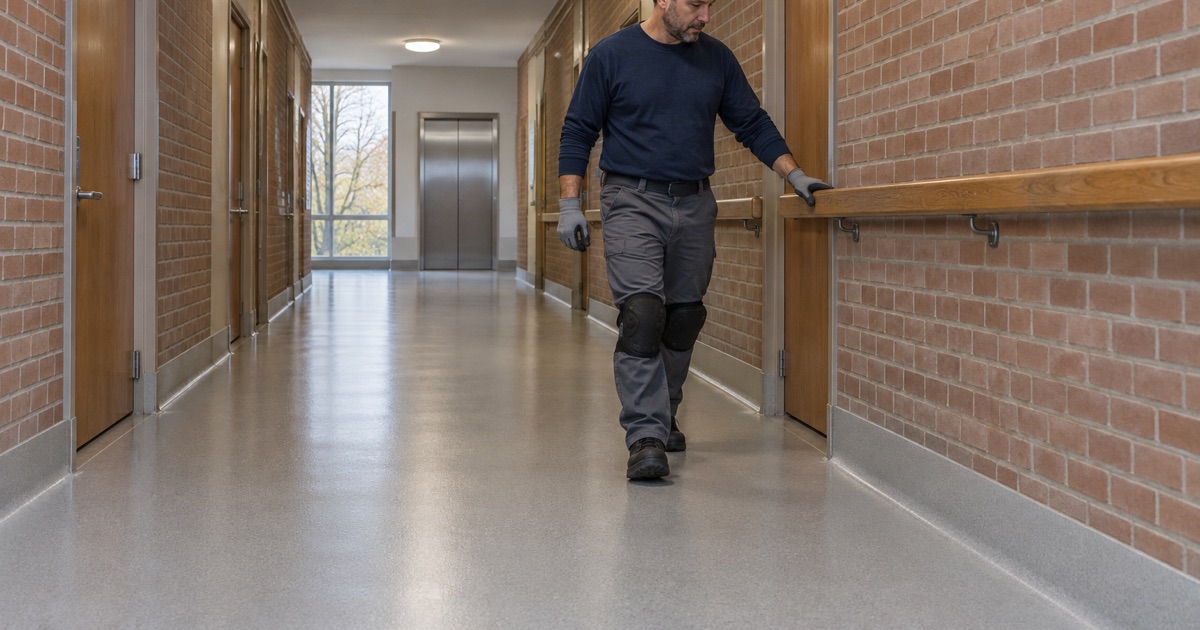
Palos Hills is a southwest suburb of Chicago in Cook County, established in 1958. Its public library, run by the Green Hills Public Library District at 8611 W. 103rd Street, offers a clean local example of a floor working to a deadline. In late February 2026, Patch reported that the library’s second floor would close from March 9 to March 17 to complete floor repairs.
The library reported nearly 112,000 visitors the previous year, and the district kept much of the building open. Programs in the ground-floor and first-floor meeting rooms continued, and the 24-Hour Library kiosk outside the main entrance stayed available. The second floor was set to reopen on Wednesday, March 18, at 9:00 a.m.
A Polling Place the Day Before
The date had a second constraint. The library served as a polling place for the Illinois General Primary Election on March 17, from 6:00 a.m. to 7:00 p.m., the last day of the second-floor closure. Whatever happened upstairs, the building was hosting voters that day, and the floor had to be ready for the public the next morning.
We did not do that work, and Patch did not say what material went down or how much of the floor was involved; it may not have been a resin system at all. The report described necessary repairs under a building maintenance plan, nothing more. What the dates show is how a public floor gets scheduled: the reopening is fixed first, and everything else is worked backward from it.
Working Backward From 9:00 a.m.
If a resin floor were going down in a space like that, the question would not be which product is best in general. It would be which product reaches the needed stage by the opening hour, with a margin for a cold slab or a damp week. That is the planning step we put in writing before any public or commercial job is priced.
Looking for epoxy-flooring closer to Chicago Ridge? See Chicago Ridge Epoxy-Flooring.
Three Cure Clocks, and the Slowest One That Matters
Manufacturers publish cure in stages, and the stages are separate clocks. Walk-on time is when people can cross the floor on foot. A later time covers rolling carts, equipment and wet cleaning, and full cure, often measured in days, is when the coating reaches its rated hardness and chemical resistance.
What the Data Sheets Say
Figures vary by product, so these are examples rather than promises. One polyaspartic topcoat lists walk-on after 2 to 4 hours, rolling equipment or wet cleaning after 8 to 12 hours, and vehicles after 24 to 48 hours. One epoxy lists 24 hours to foot traffic, 4 days to light wheeled traffic and 7 days to full strength cure.
Polyaspartic full hardness is commonly given as 5 to 7 days, so even the fast system is not finished when people start walking on it. The fast clocks open the room; the slow one decides how hard the room can be used.
Which Clock Governs a Building
A public floor with a fixed reopening has to ask what the first day actually involves. If the answer is foot traffic only, walk-on time sets the deadline. If book carts, wheeled chairs and a wet mop arrive that first morning, the cart-and-cleaning clock is the one that has to clear, and that can be several hours later.
Full cure rarely blocks a reopening, but it limits what the floor should face in its first week. We tell owners which chemicals, heavy rolling loads and harsh cleaners to hold back until it is reached, and we write those limits into the handoff.
Matching the System to the Date, and the Slab to the Weather
Once the governing clock is known, the system follows from it. A tight window favors a fast-cure polyaspartic or polyurea topcoat, and a longer one leaves room for a 100% solids epoxy build with a separate topcoat. Neither is better everywhere; each fits a different calendar.
Fast-Cure Systems
Polyaspartic topcoats reach walk-on and wet-cleaning stages quickly, which suits a room that can close for days rather than weeks. The tradeoff is a short working time in the bucket, so crews mix smaller batches and work in sections. The fast clock also depends on a properly ground slab, because a quick cure does not rescue a weak bond.
We still map cracks, spalls and old coatings before choosing it. If a slab needs repair or replacement first, we say so, and that repair time goes on the schedule ahead of any coating clock.
Standard Epoxy
A standard epoxy body coat gives a thick, forgiving build and longer working time, which helps on large rooms and broadcast floors. The cost is calendar: roughly a day before foot traffic and several days before wheels, on the example sheets above. Where a building can stay closed for a week, that slower clock is often the better buy.
Cold, Damp March Slabs
Published schedules generally assume about 70 degrees and 50 percent relative humidity. A March slab in a building that has been closed or lightly heated can sit well below that, and cold or damp conditions lengthen every clock on the sheet. A floor that would be walkable by afternoon in a warm room may not be by the next morning in a cold one.
Humidity adds a second risk. If the slab surface sits too close to the dew point, moisture can condense on it and an epoxy can develop amine blush, a waxy film that weakens the bond of the next coat. We read slab temperature and the dew point spread before each coat rather than trusting the forecast.
When the readings are wrong for the product, we say so and move the date or change the system. A missed reopening is a nuisance, but a coating that cured poorly in a cold room is a floor that has to be ground off and done again.
Scheduling a Palos Hills Garage or Basement Around the Household
A household runs on the same three clocks as a library, only with different names. In Palos Hills, the Census counts 3,123 owner-occupied detached homes, and most of the city’s housing went up in the 1970s and 1980s. At a kitchen table the question is plainer: when can the kids, the mop and the car come back?
When the Kids Can Walk on It
Foot traffic is the first clock. On a fast topcoat the data sheet may allow it within hours, though a cool slab stretches that, and on a standard epoxy plan on staying off for about a day. We write the expected time on the handoff sheet rather than guessing out loud at the end of the job.
Socks and clean shoes come first; bikes, wagons and toys with wheels wait for the rolling clock. A basement used as a playroom is a good place to rope off a doorway for an extra day.
When the Mop Can Come Back
Wet cleaning sits on the middle clock, the same one that governs carts in a public building. Mopping too early can dull a topcoat or leave marks in a surface that has not hardened. We tell homeowners which cleaner to start with, and which harsh products to hold until full cure.
In a basement, the cleaning clock is rarely the real risk; moisture from below is. A slab that tests high on ASTM F2170 relative humidity probes is a slab we address before coating, and moisture is the first exclusion we name when we explain what a coating warranty does not cover.
When the Car Can Come Back
Vehicles wait longest among the everyday clocks: 24 to 48 hours on the example polyaspartic, and longer on a standard epoxy. Hot tires on a coating that has not fully hardened can cause hot tire pickup, where the coating lifts with the tread. We would rather a car spend two extra nights in the driveway than have a new floor peel in the first week.
Winter adds its own condition. Our garage systems are chosen to stand up to the brine and rock salt that ride in on tires, and an unheated garage in deep winter is told to wait for warmer slab temperatures rather than coated on a cold calendar date.
Attached Homes and City Registration
The Census counts 945 owner-occupied attached units in Palos Hills, where one garage slab can sit against a neighbor’s wall line. We grind with vacuum dust capture at the machine and agree on cure times up front, so a shared driveway or entry is not tied up longer than the schedule says.
Illinois licenses no flooring or coatings contractor, so the city’s rules are the binding ones. The City of Palos Hills Building Department registers general contractors for $50 with a $25,000 surety bond and a certificate of liability insurance, and commercial properties need registered contractors. We confirm that registration before a job is booked. Home jobs over the state threshold also get a written contract and the Illinois Home Repair: Know Your Consumer Rights pamphlet before grinding starts.
- 20+ Years Coating Floors
- Moisture Test in Every Scope
- Free Written Estimates