Tinley Park Epoxy Flooring brings more than 20 years of epoxy-flooring work to Palos Heights, and on this page we take up a question most coating buyers never ask: can you find something tiny on the floor you are about to choose? Color and pattern settle that answer long before the first coat goes down. A floor that hides dirt also hides the things you are actually looking for.
That trade-off matters in treatment rooms, sewing rooms and home workshops alike. A busy flake finish is forgiving to live with and unforgiving to search, while a solid, light, low-glare finish shows almost everything that lands on it. We walk owners through both options before anyone picks a chip blend from a sample board.
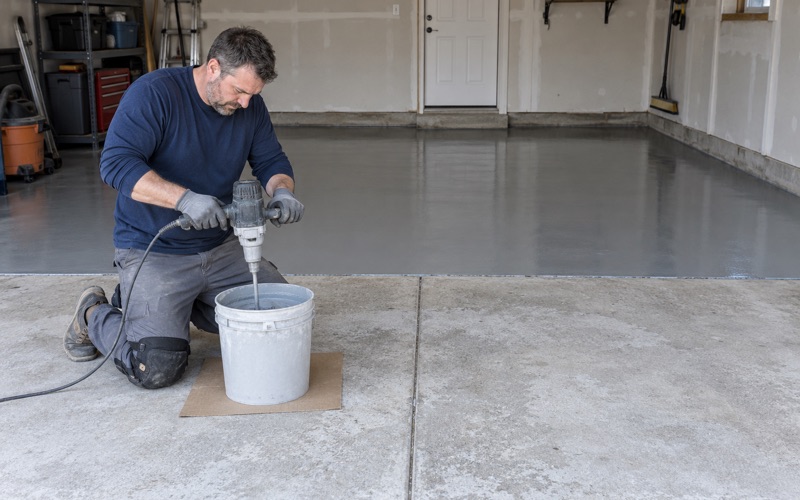
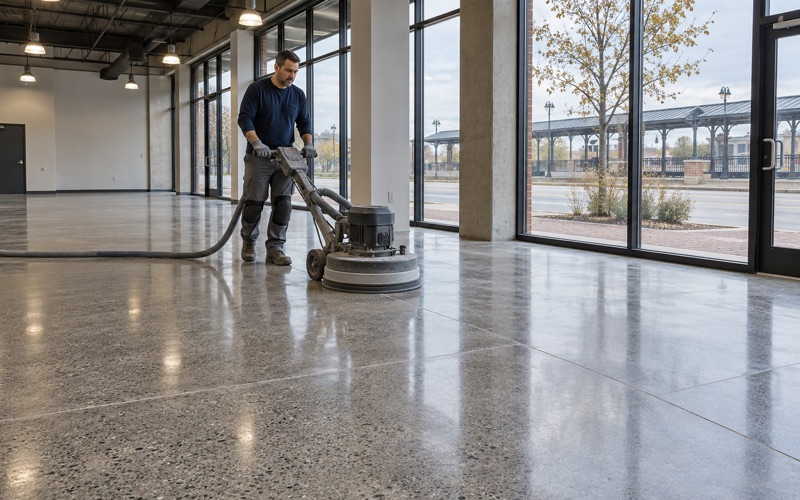
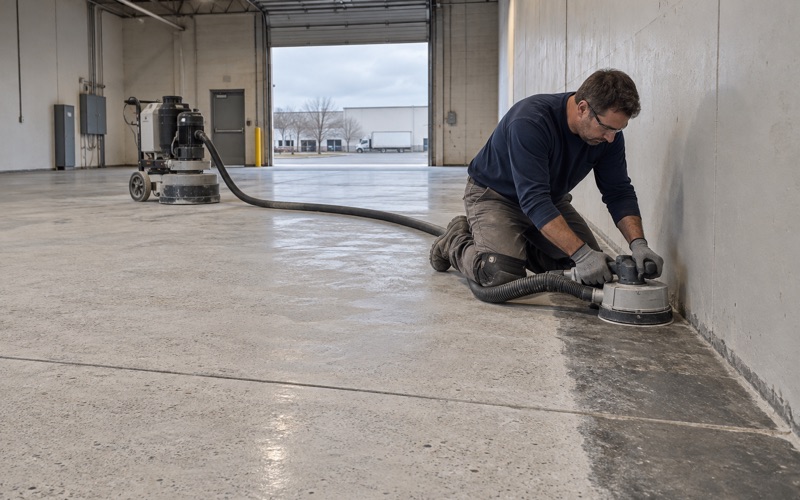
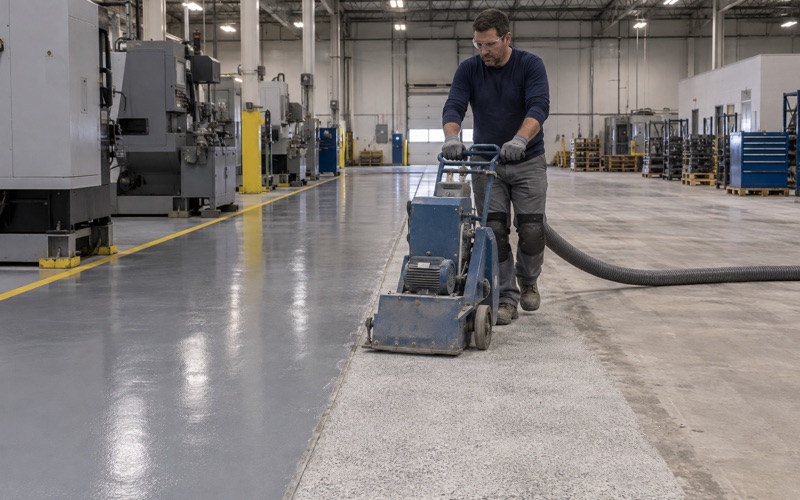
Underneath either look, the groundwork is the same. Every slab we coat is opened with a diamond grinder or shot blaster rather than an acid etch, tested for moisture as part of the written scope, and quoted by product line, coat count and finished thickness. The finish you choose sits on top of that work, and below we explain why it deserves more thought than it usually gets.
Acupuncture, Needle Counts and the Floor Under the Table
A Harlem Avenue Practice That Offers Acupuncture
Palos Animal Hospital at 11917 S. Harlem Avenue has been caring for pets since 1958 and has held AAHA accreditation since 1978. Its listed services run from wellness exams, dental care and surgery to pet acupuncture and laser therapy for dogs and cats. That places a needle-based therapy inside a general animal practice right here in Palos Heights.
We have no relationship with the clinic, and we have not seen its floors or its treatment routine. We mention it because it shows acupuncture is a real local service, and any practice offering it can fairly ask what its floor does when something small goes missing.
The Clean-Needle Counting Rule
The Clean Needle Technique Manual, published by the Council of Colleges of Acupuncture and Herbal Medicine and revised in January 2024, strongly recommends counting and writing down the number of needles used. It then calls for confirming that the same number was withdrawn and discarded. The manual is written for human patients, not for animals.
Its reasoning is plain. Prospective studies since 1999 have found a small but persistent number of patients who leave the treatment room with a needle still in place, and a careful needle count is the check meant to catch that before anyone walks out the door.
When the Count Comes Up One Short
A count that does not reconcile starts a search, and in our view that search naturally includes the floor around the table and the bed or mat. That is our reading of how such a hunt goes, not a description of any clinic’s own practice. The floor is simply where a dropped needle tends to end up.
At that moment the floor either helps or gets in the way. A finish picked years earlier purely for looks now decides how long the search takes and how confident anyone can be that it is truly finished. A plain, even surface lets a person scan the floor once and trust the result.
Looking for epoxy-flooring closer to Richton Park? See Richton Park Epoxy-Flooring.
Why Hair Hides a Needle, on a Patient and on a Floor
What the Manual Says About Hair
The same manual notes that retained needles are more common where the small needle handle is partially or fully covered by hair. On a person that means the scalp or a hairy limb. Carrying that point over to a dog or cat, a patient that is almost all hair, is our own inference rather than the manual’s claim.
The lesson travels straight down to the floor. A fine steel needle disappears against anything that breaks up its outline, whether that is a thick coat of fur or a scattered field of colored chips.
Camouflage on a Flake Broadcast
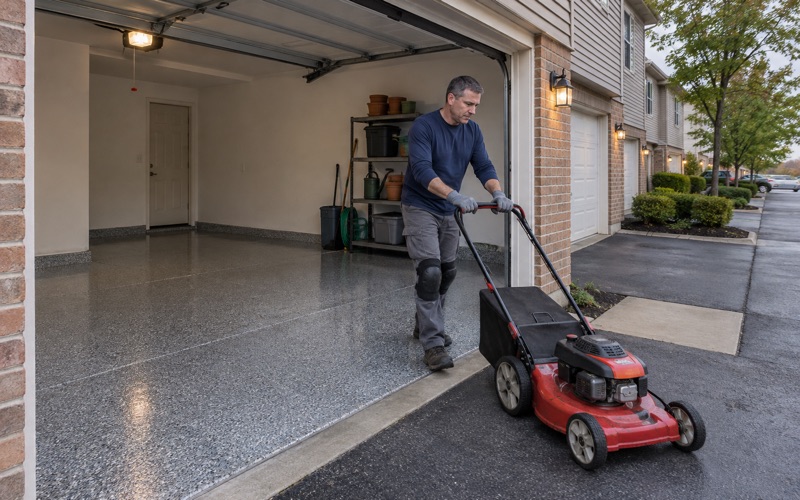
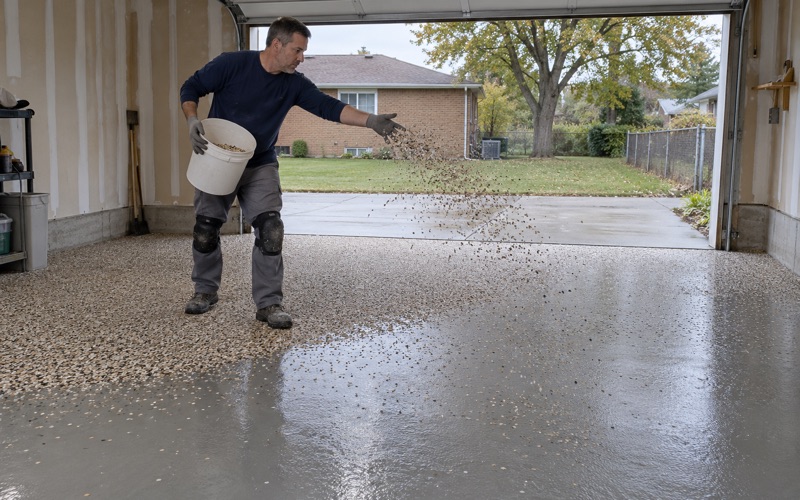
A vinyl flake broadcast is designed to be busy. Thousands of chips in two or three colors scatter across the surface so that dust, scuffs and tire marks blend in, which is exactly why it is so popular in garages. A hair-thin needle lying across that pattern reads as one more fleck. That is a fair trade on a parking floor and a poor one in a room where every needle has to be accounted for.
Quartz aggregate broadcasts and speckled blends behave much the same way. Their texture and color variation are the selling point on a heavy-traffic floor, and they turn into a drawback the moment someone needs to spot one thin line of metal.
Outline Matters More Than Anything Else
A needle is found by its outline against the background, so contrast does most of the work. A plain field of one light color gives a thin dark or bright line nowhere to hide. That is why we steer this conversation toward pattern and color first, since that choice changes what the eye can actually pick out.
Gloss is a separate question, and we treat it as one. A plain floor still needs the right sheen before it works well for searching, which is where the next section picks up.
Choosing a Floor You Can Search
Solid, Light Color in a Treatment Room
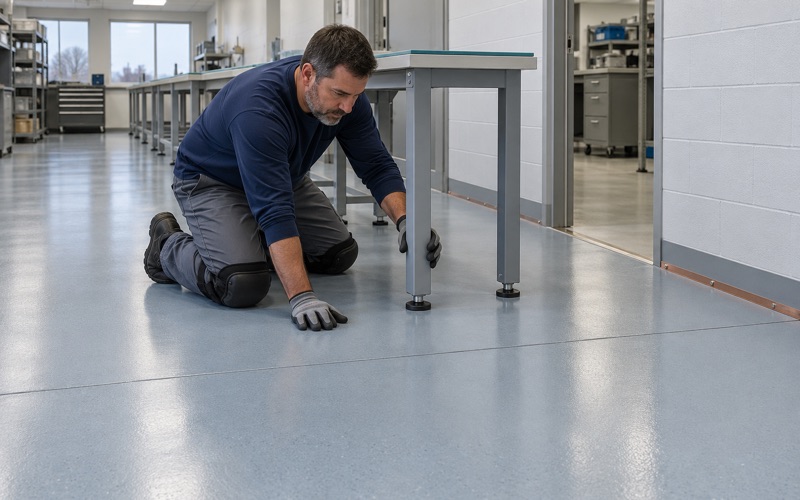
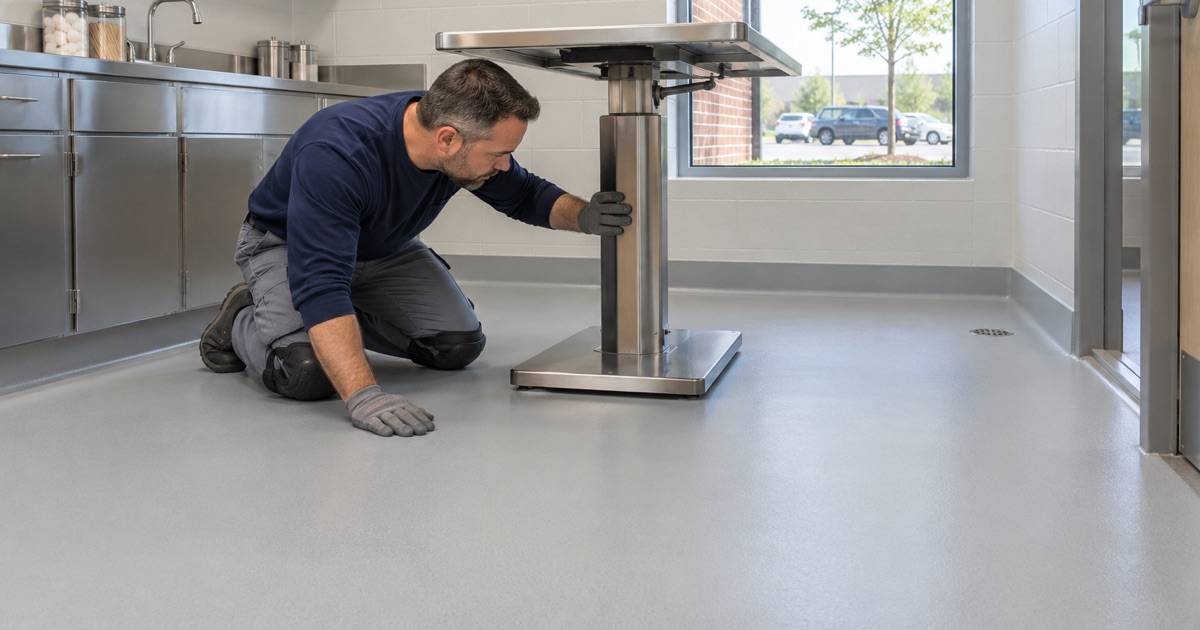
For a treatment room, exam room or any space where small sharp items get counted, we generally suggest a solid-color 100% solids epoxy body coat in a light, even shade. It gives one uniform background from wall to wall, and a coved base at the wall removes the dark corner seam where small things roll and settle.
A floor color does not stop needlestick injuries, and we will never sell one as if it did. What a solid, light floor can do is make a dropped item easier to see, which shortens the search that follows a count that comes up short.
Low Glare for Visual Inspection
High gloss can work against a search. Overhead lights bounce off a glossy topcoat as bright patches, and a needle lying inside one of those hot spots simply washes out. A satin or matte polyaspartic or urethane topcoat cuts that glare while still sealing and protecting the surface. Lighting and finish should be judged together, ideally with a sample panel under the room’s own fixtures.
Slip resistance is handled as a separate decision. We specify it through the broadcast and topcoat we choose, and in a solid-color room that usually means a fine aggregate in the final coat rather than a heavy flake layer that would bring the camouflage problem right back.
Keeping a Clinic Open During the Work
Clinic floors rarely get a quiet week. We phase the work around opening hours, using evenings and weekends where a room cannot close, and we capture grinding dust at the machine with a vacuum instead of washing it toward a floor drain or storm inlet.
Before any of that, we map the slab for cracks, spalls and old coatings, and a moisture test goes into the written scope. If a room needs repair before it should be coated, we say so plainly before the price is final.
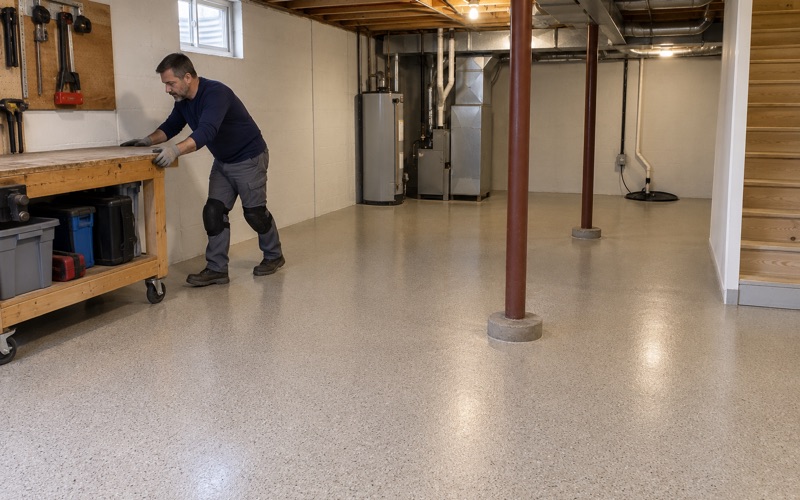
On a basement or ground-floor treatment room, that moisture test might be an ASTM F2170 in-situ relative humidity probe or an ASTM F1869 calcium chloride test, depending on the slab. Where readings run high, a moisture-mitigation primer goes down before the light body coat, so the finish stays bonded and stays one even color.
Pins, Needles and Screws in Home Workshops and Sewing Rooms
The Sewing Room and Craft Space
The same logic follows a needle home. A basement sewing room or craft space collects dropped pins and needles that are easy to step on and hard to spot on a busy floor. A solid, light epoxy finish makes a quick visual sweep far more reliable than crawling around with a magnet. Light colors also make loose thread and fabric lint easier to sweep up before they work into corners.
Owner occupancy in Palos Heights runs about 93.4 percent, so many of these rooms sit in homes people plan to stay in for years. That makes the finish a long-term choice, and it is worth matching to how the room is really used rather than to a sample board.
Screws and Small Parts in a Home Workshop
Garage workshops lose screws, washers and drill bits in exactly the same way. Some owners split the difference, keeping a flake broadcast in the parking bays for wear and a solid color under the workbench where small parts tend to fall. Whichever mix you pick, cure timing follows slab temperature and dew point, so an unheated garage in deep winter is told to wait.
The parking side still has to stand up to the brine and rock salt that ride in on tires all winter, and we choose the system with that in mind. Owners of the city’s 1,020 owner-occupied townhouse-type homes should also check association rules, which can shape a garage project as much as personal taste does.
Registration and Paperwork in Palos Heights
The City of Palos Heights Building Department at 7607 W. College Drive handles contractor registration and permits. Registration has to be completed in person or by mail, never by email, and permits are picked up in person. Illinois has no state flooring license, so we confirm the city’s own rules before a job is booked.
For home jobs above the state threshold, you receive a written contract and the Illinois consumer-rights pamphlet before any grinding starts. We also explain what the coating warranty leaves out, starting with moisture, before you sign anything.
- 20+ Years Coating Floors
- Moisture Test in Every Scope
- Free Written Estimates