Tinley Park Epoxy Flooring has spent more than 20 years putting epoxy flooring in Mokena on concrete that has to stay safe when it gets wet, and every quote starts with one question: where does the water come from? A floor that only gets damp during a nightly mop-down needs a different surface than one that takes a fine, steady overspray all day long.
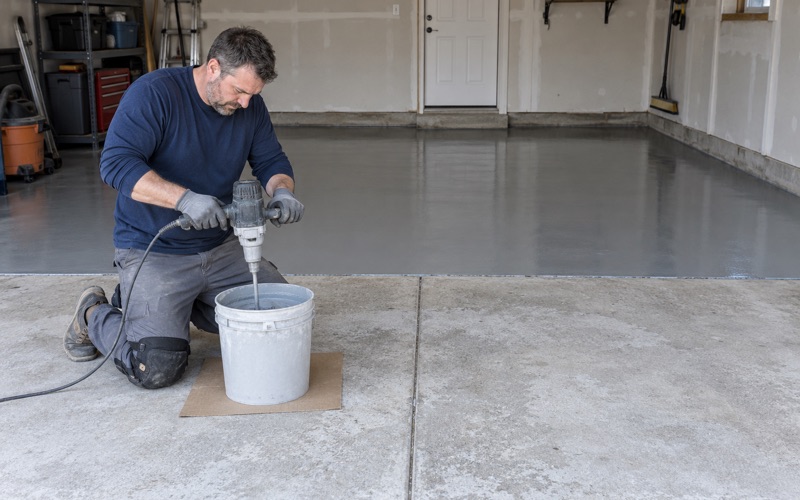
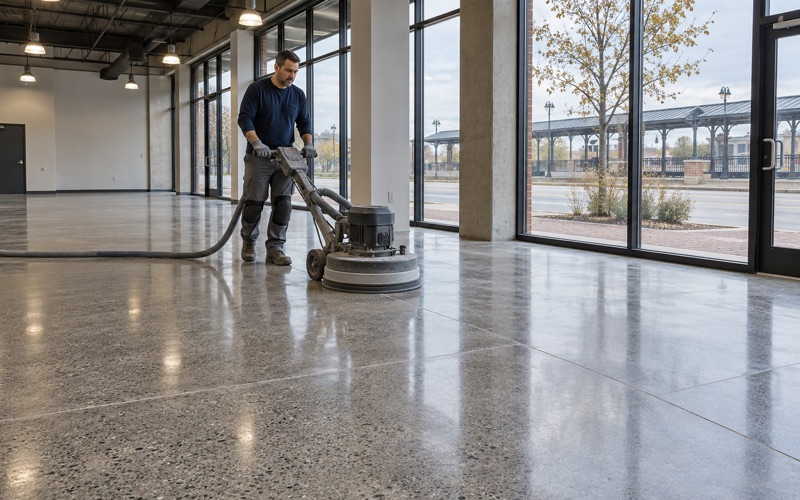
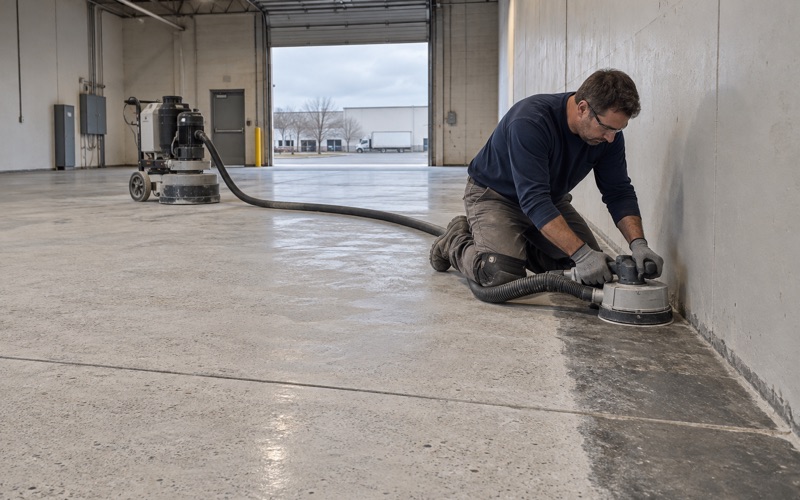
Whether the slab sits under a store, a shop or a family garage, the work opens the same way. We cut the surface with a diamond grinder or a shot blaster instead of an acid wash, so the primer bites into a real profile, and a moisture test is written into the scope before the price is final. The proposal names the product line, the coat count and the finished thickness, so you can hold the floor up against the quote.
This page is about floors that get wet without anyone spilling anything. The produce aisle of a grocery store is the clearest example, and the same problem shows up at home in front of a garage refrigerator or inside a mudroom door. Each one needs grip that survives a film of water and a surface that gives that water up quickly.
Mokena’s Independent Grocer and the Wet Produce Aisle
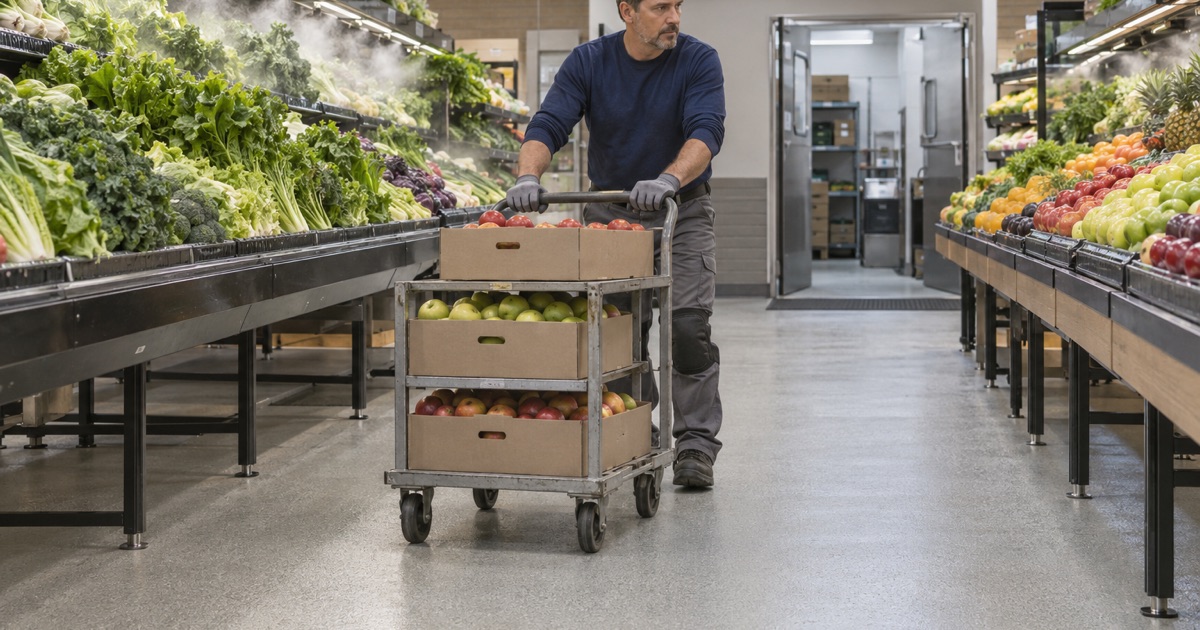
A family-owned store on La Grange Road
Brookhaven Marketplace is a family-owned independent grocer headquartered in Mokena, with its home store at 19818 S. La Grange Road. Blue Book Services lists it as a produce buyer, and the store also staffs a bakery department and a butcher counter that local reviewers rank highly. We have no connection to the business; it simply shows the kind of fresh-food retail operating inside the village.
That address falls inside Mokena village limits, in Frankfort Township of Will County. Food stores in the county answer to the Will County Health Department’s Environmental Food Safety program, which handles plan reviews, openings and routine inspections, so any floor work in a grocery is scheduled with that oversight in mind.
Why the produce department behaves differently
Most grocery aisles stay dry until a jar breaks. The produce department is wet on purpose. Leafy greens, herbs and many vegetables are kept crisp with water, and a shopper who lifts a bunch of kale off a wet rack carries drips several steps before it ever reaches a cart.
That water rarely arrives as a puddle someone can rope off. It lands as a thin, scattered film, often on a glossy floor under bright display lighting where it is close to invisible. A produce-floor coating has to be chosen for exactly that condition, not for how it looks on opening day.
Mist drift and wet racks
Grocers that use produce spray misters run them on a cycle all day. When a nozzle gets bumped or a mist head turns during cleaning, part of the spray drifts past the display and settles on the floor in front of it. Misting equipment vendors describe heads turned toward the floor as a common source of grocery slip claims.
Wet racks add their own drip line. Rinsed bunches, trimmed stems and melting ice all shed water at the base of the case, leaving a damp band of floor a couple of feet wide that comes back after every restock. Housekeeping catches most of it, but even a quick mop pass leaves the floor damp for minutes at a stretch. The coating underneath decides how risky those minutes are.
Looking for epoxy-flooring closer to Matteson? See Matteson Epoxy-Flooring.
What NIOSH Asks of a Produce Aisle
Grocery workers fall more often
NIOSH, the federal research agency for workplace safety and health, published guidance on preventing slips, trips and falls in wholesale and retail trade. It reports that employees in grocery stores and meat-handling establishments are injured at a rate 75% greater than average for the industry: 28.3 per 10,000 employees against 16.1.
That rate describes the people stocking, trimming and cleaning, who cross the wet zones all shift long. Shoppers walk the same floor, but the published number is about staff, and a floor plan for a produce department should be built around them.
Keep the water on the produce
The guidance is direct about misters. It tells grocers to make sure water from produce spray misters lands on the produce and does not spray onto the floor. It also asks stores to give customers plastic bags and paper towels for wet produce, so a dripping item is wrapped before it travels.
Those are equipment and housekeeping steps, and they come first. A coating is no substitute for a properly aimed nozzle or a stocked bag dispenser. What a well-chosen coating does is make the floor more forgiving when some water gets past both.
Flooring is on the list as well
The same publication tells employers to use flooring with a static coefficient of friction of more than 0.5 for high-risk areas. A produce aisle under intermittent overspray fits that description about as well as any space in a store, and that figure is the target a textured system is selected to approach.
We do not issue slip ratings or test certificates. What we put in writing is the exact broadcast and topcoat that create the texture, so an owner, an insurer or a safety consultant can measure the finished floor and compare it with that target.
Grip Above 0.5 and a Surface That Dries Fast
Texture comes from the broadcast
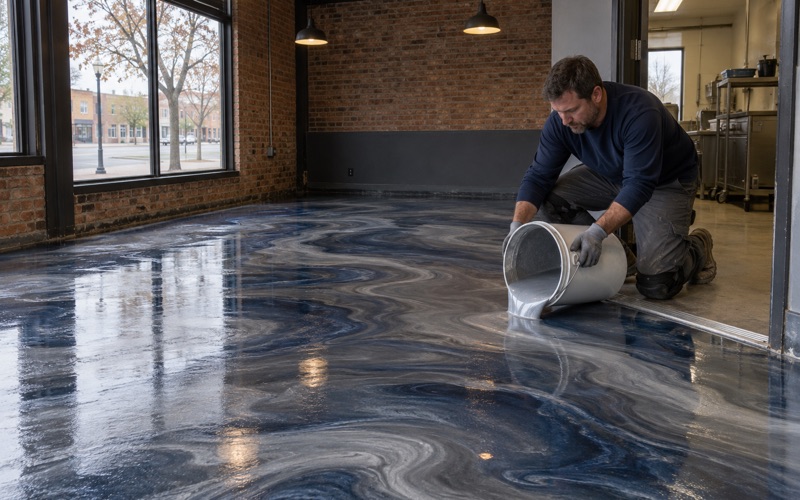
Smooth, high-gloss epoxy looks spotless under produce lighting and turns slick the moment it gets wet. For a wet zone we build texture into the system itself: quartz aggregate broadcast into a 100% solids epoxy body coat, then locked down with a topcoat thin enough to leave the grain standing. Grain size and topcoat thickness decide how aggressive the surface feels underfoot.
There is a trade-off. Coarser texture grips better but holds more grime, so it needs a scrubber rather than a damp mop. We match the texture to the cleaning routine a crew will actually keep, and the proposal says which grade we chose and why.
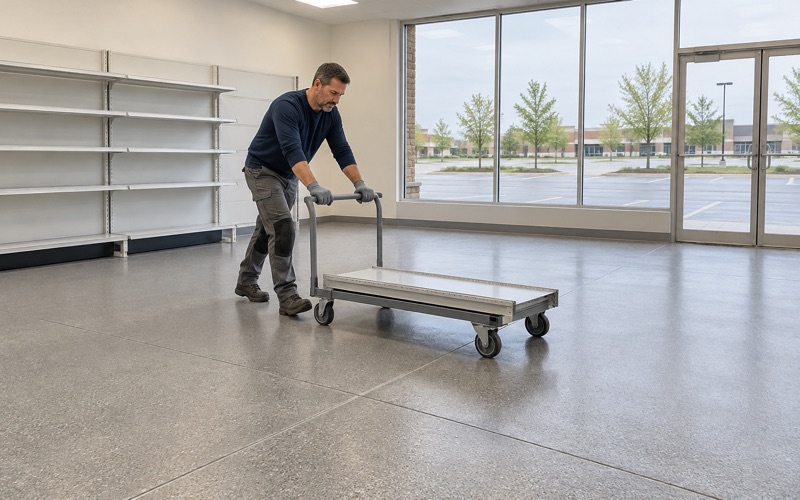
In a produce department the texture does not have to cover the whole store. We can run the textured system in a band in front of the cases and along the wet racks, and carry a smoother finish of the same color through the dry aisles, so the change in grip follows the water rather than the floor plan.
Drying speed matters as much as grip
A floor that holds a film of water for an hour is a hazard for that whole hour. A sealed, nonporous coating keeps water on top where it can be squeegeed away, instead of soaking into bare concrete and wicking back out later. A light texture also breaks a sheet of water into beads that clear in a single pass.
Polyaspartic and polyurea topcoats suit this work because they cure quickly and stand up to repeated wet cleaning. A short return-to-service window matters to a grocer, because a produce department cannot close for days while a floor hardens.
Fitting the work around a store that stays open
Food retail rarely closes, so we phase coating in sections, use overnight and weekend windows, and keep clear walking lanes while each zone cures. The cure schedule follows slab temperature and the dew point spread at the surface, not the calendar, because a cool, damp night can leave amine blush on fresh epoxy.
The FDA Food Code, in section 6-201.11, carves out an exception to its smooth-floor rule for antislip floor coverings where safety calls for them. That lets a textured finish sit comfortably inside a food store’s cleanable-surface expectations, which an inspector will look at.
Wet Zones at Home: Garage Fridges, Garden Harvests and Mudrooms
The second refrigerator in the garage
Plenty of homes keep a spare refrigerator or chest freezer in the garage. On a humid summer day the cabinet sweats, a drain pan overflows or a door gasket drips, and a shallow puddle forms exactly where someone stands to grab a drink. A textured coating in front of that appliance does the produce-aisle job on a smaller scale.
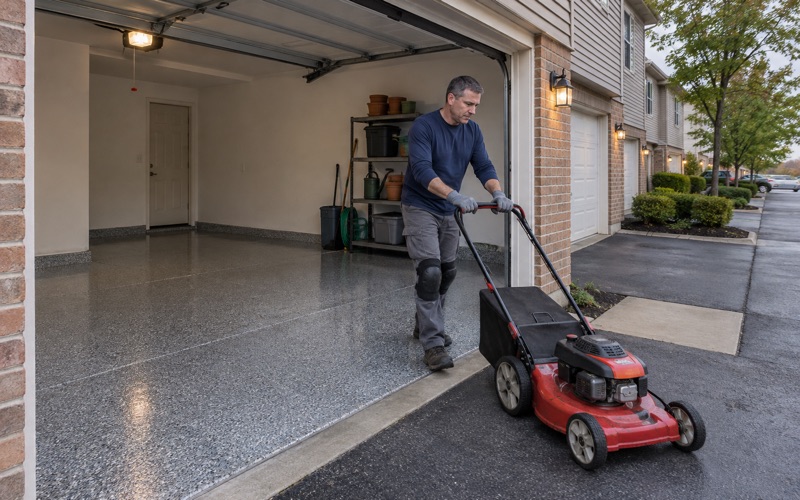
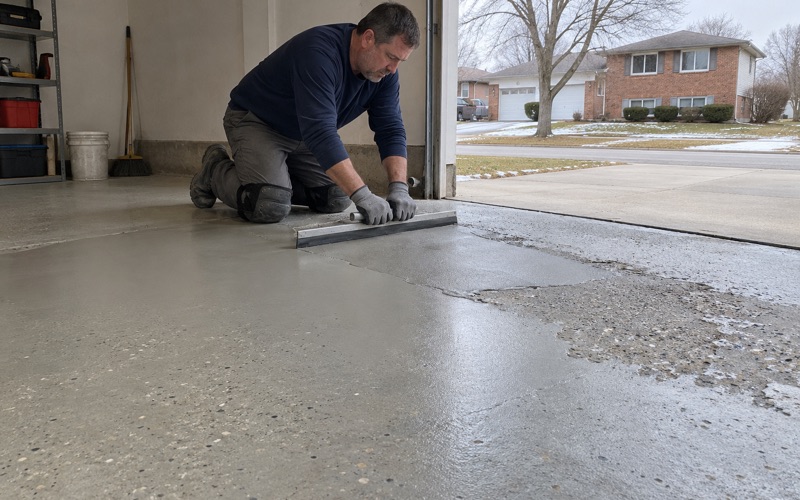
Mokena’s housing makes this a familiar setup. About two-thirds of the homes were built since 1990, nearly all owner-occupied homes are single-family houses or townhomes, and the typical garage floor is a slab poured in the 1990s or 2000s. We map its cracks and spalls first and tell you plainly if a section needs repair before it should be coated.
Garden produce coming through the door
Home gardeners bring the harvest in by the bucket. Rinsed lettuce, muddy carrots and a hose left running by the side door all put water on the floor the same way a wet rack does. A vinyl flake system with a textured topcoat handles that traffic and cleans up with a hose and a floor squeegee.
Flake on its own adds some grip; a fine aggregate mixed into the topcoat adds more. We show samples wet as well as dry, so you can feel the difference with your own shoes before choosing a finish.
Mudrooms and basement entries
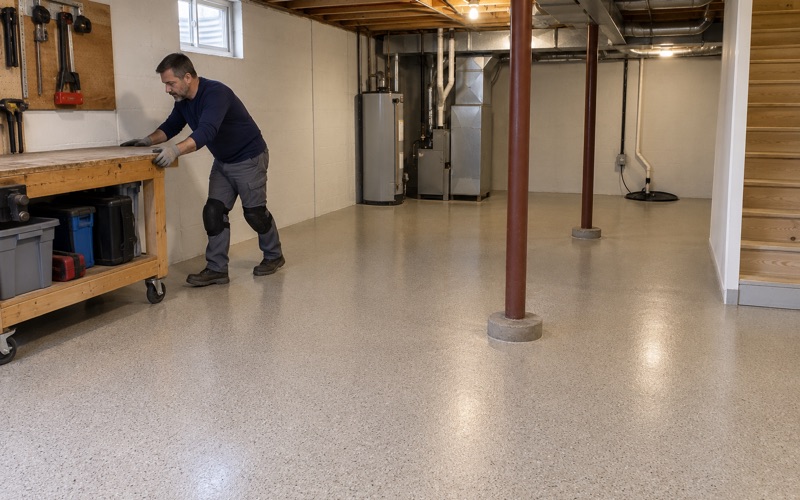
A mudroom collects wet boots, dripping umbrellas and muddy dog paws. Where that room sits on a slab, a sealed floor sheds water and wipes dry quickly. A basement entry gets an ASTM F2170 relative humidity probe or a calcium chloride test first, because moisture rising through the slab is the first exclusion on any coating warranty, and we explain that before the job is sold.
Registration and permits in the village
Illinois issues no state license for flooring or coatings contractors, so the rules that matter are the village’s own. We check the registration, bond and insurance terms in Mokena before a job is booked.
Before working in the village, a contractor registers with the Community Development Department on Carpenter Street, filing a $150 fee, $500,000 each in general liability and workers’ compensation coverage, and a $10,000 surety bond. Floor coating is not named on the village’s no-permit finish-work list, so we confirm with that department before a start date is set.
- 20+ Years Coating Floors
- Moisture Test in Every Scope
- Free Written Estimates