Tinley Park Epoxy Flooring has spent more than 20 years putting down epoxy flooring in Midlothian and across the southwest suburbs, and the floors that teach us the most are the ones people walk on in cleats. A coating that looks perfect on day one can lose its texture within a season when sand and spikes grind across it every afternoon.
This page is about that kind of wear. Abrasion is a slower failure than peeling or a moisture blister, and it is easy to misread, because the floor stays bonded while its surface goes dull, smooth and slick in the traffic lanes. Choosing for it means thinking about wear-layer thickness, broadcast texture and the topcoat before anyone talks about color.
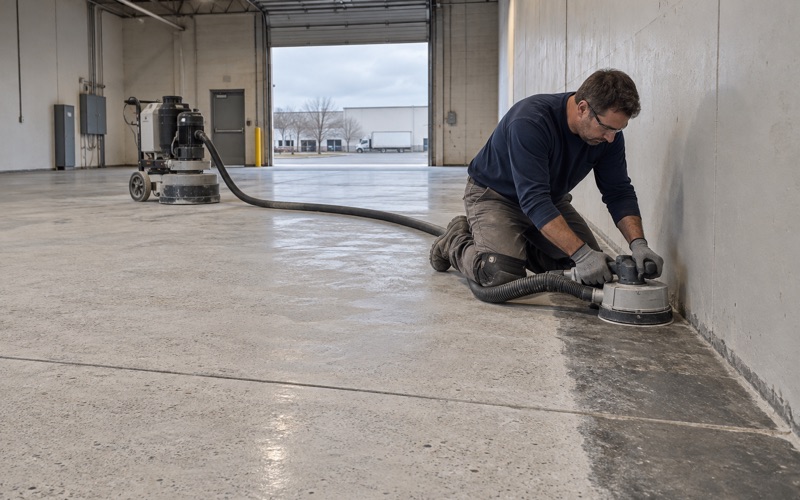
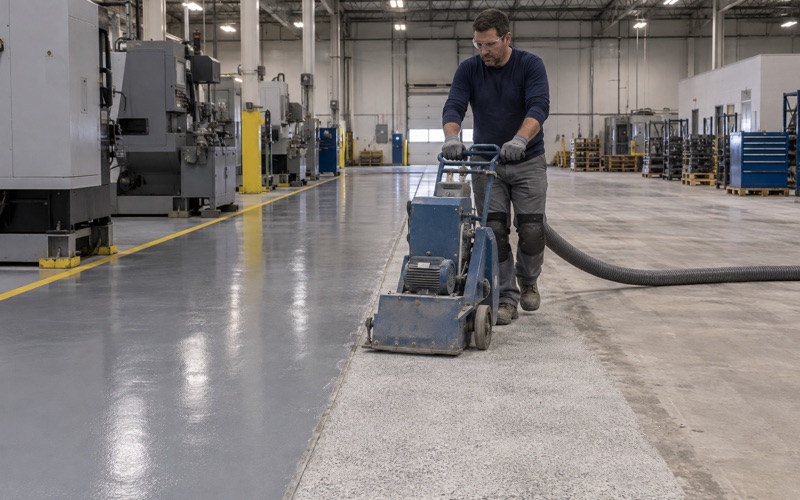
We open every slab with a diamond grinder or a shot blaster rather than an acid etch, run a moisture test before the price is settled, and write the product line, coat count and finished thickness into the proposal. On a floor that will take spikes and grit, those three numbers are what you check the finished result against.
A New Halfway House at an 1898 Golf Club
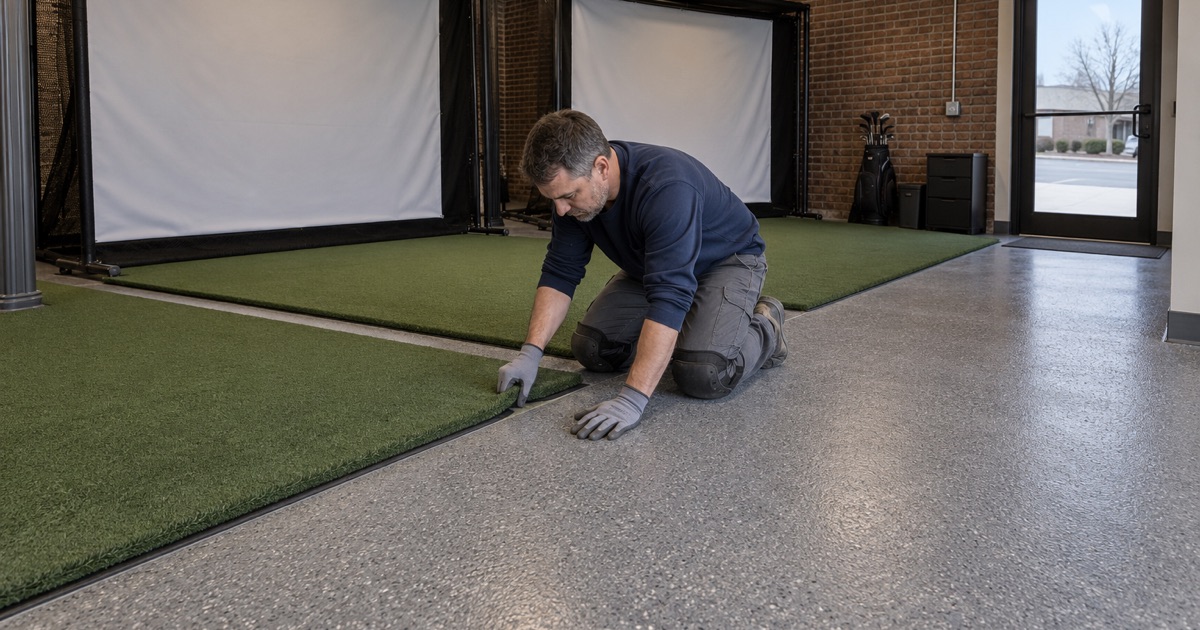
Midlothian Country Club, founded in 1898 at 5000 West 147th Street, is older than the village around it. Midlothian was incorporated on March 17, 1927, and took its name from the club, which had already hosted the 1914 US Open. Golf is not a backdrop here; it is the reason the place carries the name it does.
The club has been rebuilding its rooms. In April 2024 it showed members a renovated upstairs Lounge, the Midlothian Ballroom, the Thorne Room and the Ladies Locker Room. Then, in September 2025, its new Halfway House and Golf Simulator Lounge opened for members, described by the club as modern and tech-friendly. We have not seen that building’s floor and do not know what it is.
Rooms golfers enter mid-round
What interests us is the type of room. A halfway house is where players stop between nines, usually without changing shoes. They come in from the course in cleats, with whatever the last few holes left on their soles. Every grain on a shoe is carried across the threshold, ground into the floor under body weight, then carried a few steps further.
That pattern is not unique to a private club. Any room people enter straight off grass or sand, in shoes built to grip turf, sees the same load. It concentrates at the door, along the path to the counter and in front of wherever people stand still. Those three zones are where a hard floor shows its age first.
What golf learned about clubhouse floors
The game worked this out decades ago. Softspikes were introduced in 1993, according to a 2017 Sports Illustrated piece, mainly to reduce the damage traditional metal spikes did to greens, and also to wooden bridges, walkways, clubhouse carpets and floors. The same article argued that some of today’s aggressive cleats do more damage than the old soft spikes did.
So the industry’s own answer was to change the shoe, and the shoe has since changed again. A floor owner cannot count on footwear being gentle. The safer assumption is that cleats will keep evolving, and that the floor has to stand up to whatever arrives on the next pair of shoes through the door.
Rubber, carpet and resin
Clubs commonly buy spike-resistant rubber flooring and matting for pro shops, locker rooms and grill rooms, and some carpet is marketed as meeting British Standard BS 7044 for spike resistance. We have not found an independent test comparing those products with each other or with resin floors, so we will not claim that one of them wins.
A resin floor answers the problem differently. It does not give under a spike the way rubber does; it resists by being hard, thick and textured enough that the wear takes years rather than months. No coating is immune to spikes, and we have not tested any system against BS 7044. What we can do is specify a build that gives the wear plenty of material to work through.
Looking for epoxy-flooring closer to Hazel Crest? See Epoxy-Flooring Services in Hazel Crest.
Bunker Sand and Wet Grass Under Every Cleat
Spikes are only half the problem. Bunker sand is a hard, angular abrasive, and a cleated sole is a very efficient way to carry it indoors. Each step presses the grains into the floor under a point load, and when a foot pivots at a counter or a doorway, the sand works like sandpaper wrapped around a block.
Wet grass and turf grit
Morning dew and irrigation add a second layer. Wet clippings and fine turf grit pack into the gaps between cleats and let go once they hit a hard surface. A damp film holds sand in place right where people turn, and as it dries it leaves a gritty residue that the next group of shoes grinds further in.
That is why a floor walked by golfers wears in a path rather than everywhere at once. The lane from the door to the counter dulls first, then the turn in front of a cooler or register. Open areas away from traffic often look new for years. We plan thickness and texture around those lanes, not around the average of the room.
Managing grit at the door
The cheapest protection is stopping grit before it reaches the coating. Brush mats, cleat cleaners and a stretch of spike-resistant rubber at the entry catch most of the sand in the first few steps. On a resin floor, that entry zone is where we would rather see a worn mat replaced than a worn topcoat.
Cleaning matters as much as matting. Dry-sweeping or vacuuming sand before mopping keeps a wet mop from dragging grit across the whole floor, and a soft auto-scrubber pad does the same job in a larger room. We talk through the cleaning routine before choosing a finish, because a texture that suits one routine can trap grit under another.
Wear Layer, Texture and Topcoat for a Floor Walked in Cleats
On a floor that wears by abrasion, gloss is the least useful number. A high-gloss finish shows every scratch and loses its shine first in exactly the lanes people use, while a satin finish hides wear longer. The properties that decide how many years the floor lasts are thickness, the hardness of the broadcast and the toughness of the topcoat.
Thickness is the wear allowance
A thin roll-on coating may measure only a few mils, and cleats with sand under them can work through that in one busy season. A 100% solids epoxy body coat, broadcast to refusal and sealed, builds a much deeper wear layer. Our proposal states the finished thickness, so you know how much material stands between the traffic and the concrete.
Thickness also starts with the profile. We grind or shot-blast to an ICRI concrete surface profile matched to the system, usually in the CSP 2 to CSP 4 range for a broadcast floor. A coating that grips a real profile does not shear off where a cleat catches an edge, so wear stays a surface problem instead of turning into delamination.
Quartz versus vinyl flake
Broadcast choice changes how the surface wears. Vinyl flake looks good and hides dirt, but the chips are soft compared with sand. Quartz aggregate broadcast is harder than most of the grit a shoe carries, so it holds its texture longer under abrasion. For a floor that sees spikes every day, we lean toward quartz, or toward flake with a heavier topcoat.
Slip resistance comes from the same decision. We specify texture by the aggregate size and the topcoat build over it rather than promising a non-slip floor. A coarser profile grips a cleat or a wet sole better but holds more grit, so texture is a balance between traction and how easily the floor cleans, and we show samples before you choose.
Topcoat and the recoat plan
The topcoat is the sacrificial layer. Polyaspartic and polyurea topcoats generally resist abrasion and scuffing better than a plain epoxy top coat, which is why we favor them on floors that see cleats. Whichever we specify, the plan assumes the traffic lanes will need a fresh topcoat before the body coat is touched, and a recoat costs far less than a full redo.
We also explain what the warranty leaves out before the job is sold. Moisture is the first exclusion we name, and abrasion from grit and cleats is normal wear rather than a defect. Knowing that up front lets an owner budget for a scheduled recoat instead of being surprised when the lane by the door goes dull.
Cleats, Sand and Turf in Midlothian Garages and Mudrooms
Most of the cleats in Midlothian never see a clubhouse. They belong to kids playing soccer, baseball and football, and they come home caked in field dirt and lawn grit, then get kicked off in the garage or the mudroom. The wear is milder than at a golf club, but the pattern repeats: grit at the door, a worn lane, and a floor that dulls where shoes come off.
Garage and mudroom choices
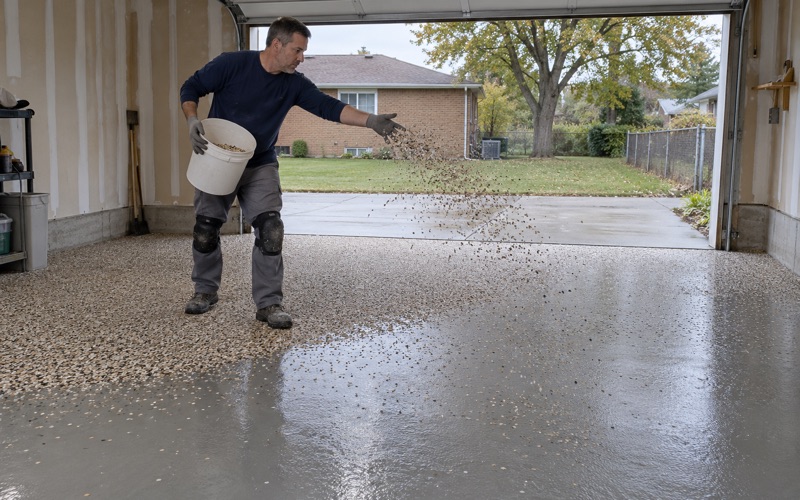
For a garage that doubles as the shoe drop, a flake or quartz floor with a polyaspartic topcoat handles cleats and grass clippings without much fuss. A mudroom off the garage takes the same load in a smaller space. A rubber mat where cleats come off saves the coating, and a topcoat with some texture keeps a wet sock from sliding.
Before we price either, we test the slab. An ASTM F2170 relative humidity probe or a calcium chloride test tells us whether the slab can take a coating as it is or needs a moisture-mitigation primer first. We also map cracks, spalls and old coatings, and if a slab should be repaired or replaced before it is coated, we say so plainly.
Village rules and how the work runs
Illinois does not license flooring or coatings contractors, so local rules carry the weight. The Village of Midlothian requires an annual contractor license, $300 for a general contractor or $100 for a trade, along with a $10,000 bond and a $1 million liability certificate naming the village. All of those licenses expire December 31, and we check the requirements before a job is booked.
Where a permit is involved, the Building Department at 14801 S. Pulaski Road schedules inspections Monday through Friday only, with one business day’s notice. On a home job over the state threshold, you get a written contract and the Illinois consumer-rights pamphlet before grinding starts. Dust is vacuumed at the grinder, and cure times follow slab temperature and dew point rather than the calendar.
Storefront floors on the main roads
Midlothian’s commercial floors are mostly storefronts along 147th Street, Cicero, Kedzie and Pulaski rather than industrial plants. For a business that cannot close, we phase the work around opening hours with overnight and weekend windows, and we choose products inside the Illinois VOC limits for floor coatings, which bind whoever applies them.
- 20+ Years Coating Floors
- Moisture Test in Every Scope
- Free Written Estimates