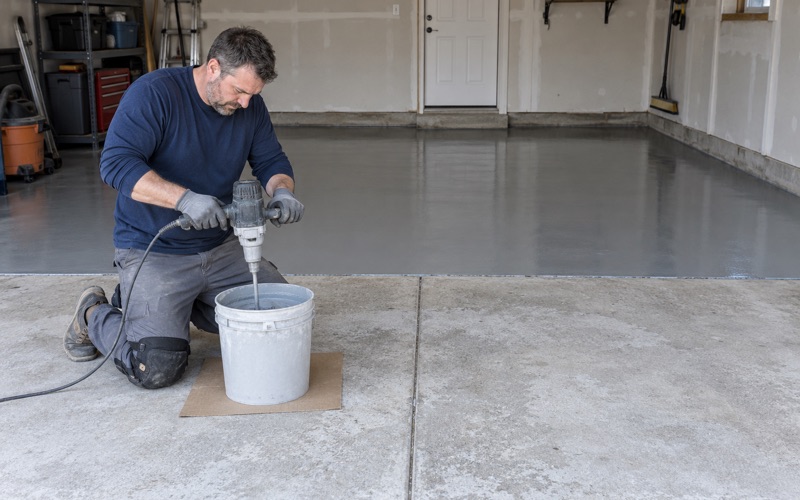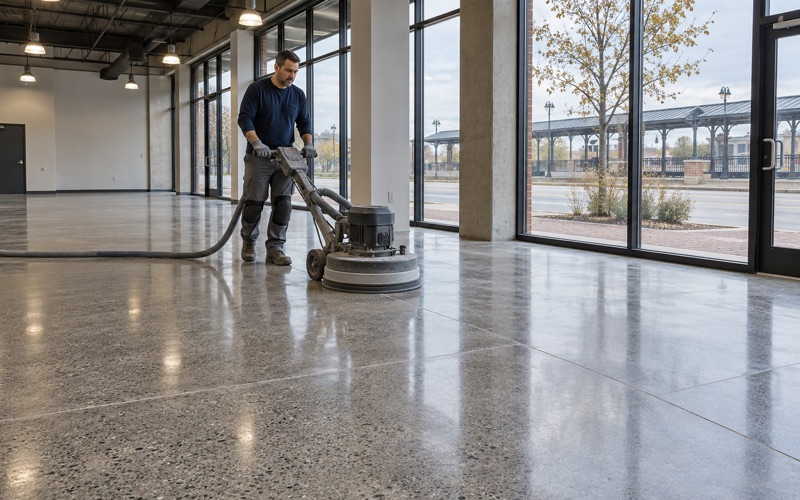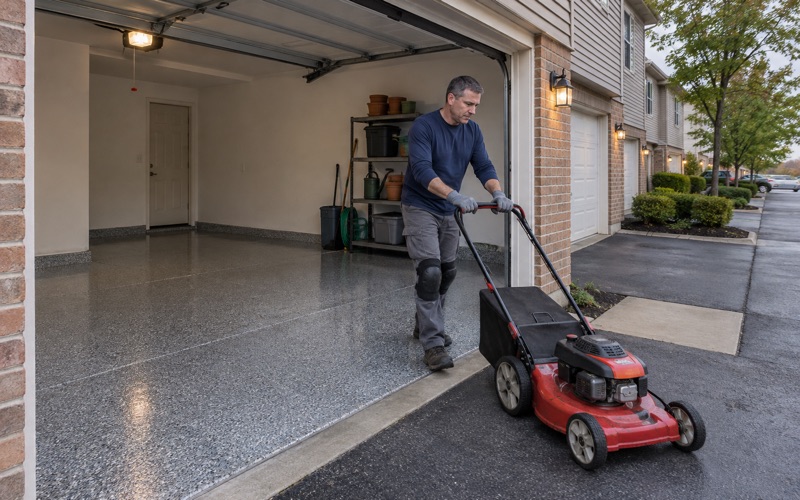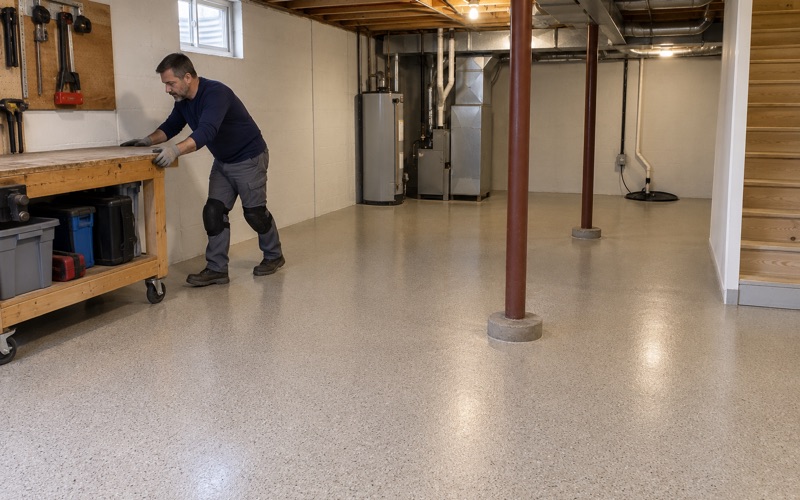
Tinley Park Epoxy Flooring has put more than 20 years into epoxy flooring in Markham and the rest of the south suburbs, and the floors that teach us the most are rarely flat. A level garage slab is forgiving. A floor that climbs in steps, drops down a basement stair or meets the house at a raised threshold is where a coating proves itself or fails.
That is why this page spends its time on edges. Most people judge a coated floor by the broad field they walk across, but the field is the easy part of the job. The places that chip, peel and get called back are the corners where a horizontal surface turns down into a vertical one.
We prepare every one of those surfaces mechanically, test the slab for moisture before the price is set, and write the product, coat count and finished thickness into the proposal. What follows explains how stepped floors behave, where they break first and what we do differently because of it.
A Lunchroom on Steps at Prairie-Hills Junior High
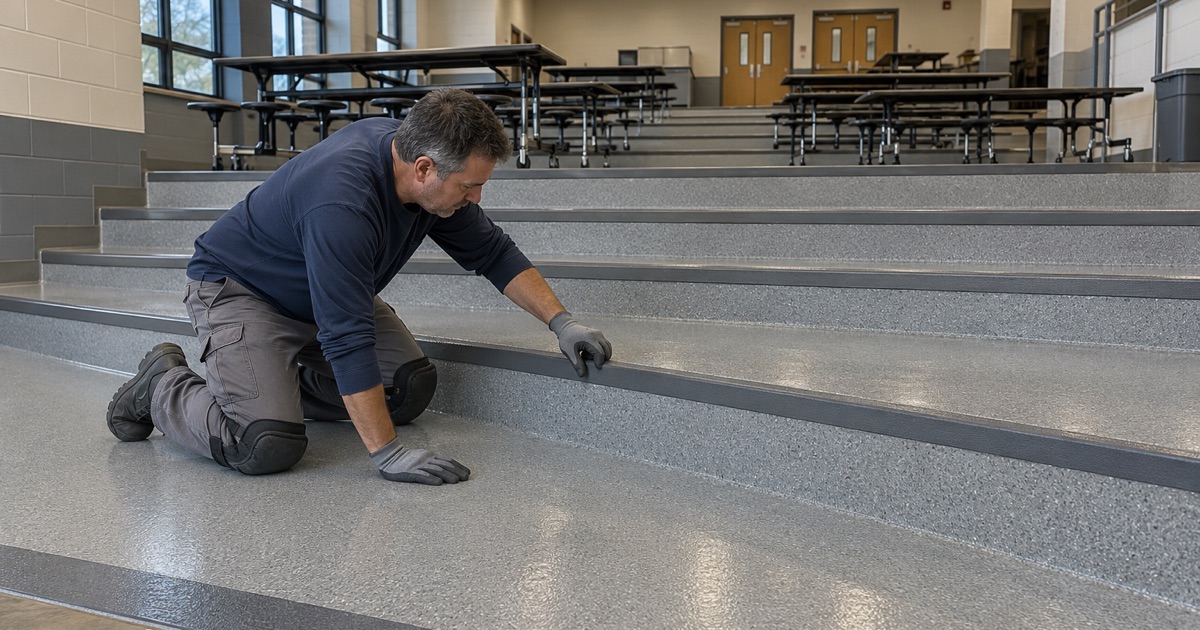
Markham is a city and south suburb of Chicago in Cook County, with 11,661 residents at the 2020 census. One of its larger public buildings is a good lesson in how floors wear. Prairie-Hills Junior High, part of Prairie-Hills Elementary School District 144, was completed in July 2012 for 1,200 students in grades 6-8.
The building’s cafetorium pairs a stage with full theatrical rigging and lighting with a floor that is stepped to seat 400 students for lunch. We have no connection to the school or the district and have never seen that floor’s finish. We point to it because it is the clearest local picture of a tiered surface where people eat every day.
What a stepped floor asks of a coating
A flat cafeteria spreads its wear across one plane. A stepped one concentrates it, because every tier has a front edge, a riser face below that edge and a tread behind it, and each of those three surfaces takes a different kind of abuse.
The tread takes foot traffic and chair legs much like any floor. The riser takes kicks and splashes. The edge between them takes nearly everything at once, and it is the thinnest, most exposed piece of coating anywhere in the room.
Why tiers wear differently than a flat slab
On a level floor, a dropped tray lands, spreads and gets mopped toward a drain or a wet vac. On tiers, the same spill runs over the edge, down the riser and pools at the back of the tread below. Every level catches some of it, and every level gets mopped.
That repeated wetting and wiping lands hardest on the vertical faces and the edge where they meet. A coating that was rolled thin over a corner during installation sees more water and more scrubbing there than anywhere else, which is exactly the wrong combination.
Looking for epoxy-flooring closer to Palos Heights? See Epoxy-Flooring Services in Palos Heights.
The Step Nose Is Where Coatings Chip First
The step nose is the front edge of a tread, the line where a person’s foot lands as they climb or step down. Concrete steps already tend to chip and crack along that front edge before anyone coats them. A coating laid over a weak or square nose without any detailing inherits the problem and usually makes it more visible.
Chairs, carts and heels at the front edge
Chair legs dragged backward catch the nose. Cart wheels bump it when they roll up or down a level. Heels strike it on every descent. All of that force arrives on a narrow corner rather than a broad surface, so the coating there carries far more load per square inch than the field behind it.
A hard, brittle film on a sharp concrete corner is the classic recipe for a chip. Once the edge breaks, water from mopping gets under it, and the chip grows back along the tread with each cleaning cycle.
Spills and mopping on every riser
Risers are easy to undercoat because they are awkward to reach and rarely walked on. On a tiered floor where food is eaten, though, they collect drips and get wiped as often as the treads. We build the riser to the same thickness as the field and carry the coating up into the inside corner so liquid has no seam to find.
The inside corner at the back of each tread is the other quiet failure point. A cove or a properly filled radius there keeps mop water from sitting in a sharp joint, and it gives the coating a continuous surface instead of two films butted together.
Nosings or a properly detailed coated edge
There are two honest ways to protect a step nose. The first is a metal or composite stair nosing, which installers and makers use on high-traffic concrete stairs to take the impact so the coating behind it does not. The second is a coated edge that is ground round, filled where it is damaged and built thicker than the field.
Which one fits depends on the traffic, the condition of the existing edges and how the floor will be cleaned. We explain the tradeoff in the proposal rather than defaulting to one, and we never treat the field coating as the hard part, because on a stepped floor it is not.
Preparing Edges, Risers and Field Before We Coat
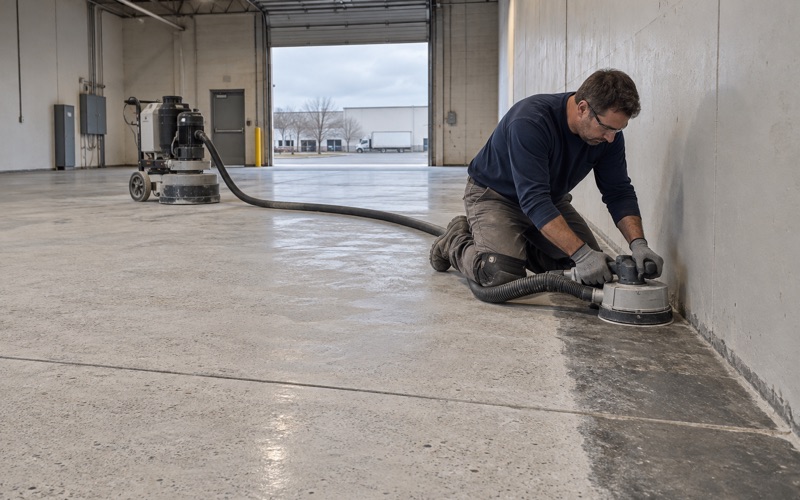
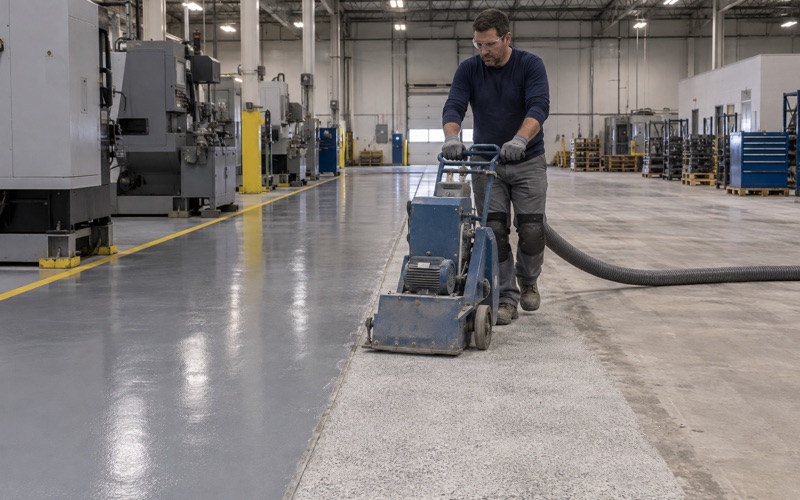
Edges fail first when preparation stops short of them. Our crews open every surface with a diamond grinder or a shot blaster, never acid, so the coating grips a real profile. On stairs and tiers that means hand grinding the nose, the riser face and the inside corner instead of leaving them smooth.
Mapping damage before the price is set
Before anything is quoted, we walk each step and mark chipped noses, cracked treads, spalls and old coatings that are letting go. Some steps need patching with a repair mortar and a reshaped edge. Others are too far gone to coat, and we say so plainly rather than sealing a broken corner under a fresh film.
Moisture on stair slabs and lower levels
Steps that lead down to a basement or a lower floor sit close to the ground, and moisture coming up through concrete is a very common reason a coating lets go. We run a moisture test as part of the written scope, using a plastic sheet test, calcium chloride or in-situ relative humidity probes depending on the slab.
If readings are high, a moisture-mitigation primer goes down first. Moisture is also the first exclusion we name when we walk through what the coating warranty does not cover, so nobody learns about it after a blister appears.
Cure timing and slip resistance on steps
We schedule cure around slab temperature and the dew point at the surface rather than a date on the calendar. A cold slab in an unheated space can pull moisture out of the air and leave amine blush on the surface, which weakens the bond of the next coat.
Slip resistance on a step is specified, not promised. We set it with the broadcast, usually a quartz aggregate or vinyl flake, and the topcoat chosen to lock it in, so the texture on a tread is a line in the scope.
Basement Stairs and Garage Steps in Markham Homes
Most floors in Markham are not school floors. This is a city of owner-occupied detached houses, and roughly half of its homes were built in the 1950s and 1960s. Those houses tend to have the same two step problems: a concrete stair down to the basement and a raised step from the garage into the house.
The garage-to-house step
That single step takes everything the garage floor takes plus a heel strike on every trip inside. In winter it also sits in the path of the brine and rock salt that ride in on tires and boots. We choose garage systems with that salt in mind and carry the coating over the step nose with the same edge detail we would use on a tiered floor.
Where the step edge is already broken, we rebuild it before coating. A neat line of flake ending at a crumbling corner looks finished for one season and then starts to lift right where every foot lands.
Basement stairs in mid-century houses
Concrete basement stairs in houses of this age often have worn, rounded or chipped noses and risers that have never been coated. We grind each tread and riser, repair the edges, and test the lower slab for moisture before choosing a primer. A floor coating is never offered as radon reduction, since in Illinois that work belongs to licensed mitigation contractors.
If the basement has taken on water, the source gets dealt with first. A coating is a finish over a dry, sound slab, not a fix for water that is still finding its way in.
Permits, bonds and who signs off
Illinois issues no state license for flooring or coatings contractors, so each city’s own rules govern the job. Markham’s Building and Housing Department is the office that answers for local work, and contractor bond requirements are reported in the city code. We confirm those requirements with the department before a job is booked.
On home jobs above the state threshold, homeowners receive a written contract and the Illinois consumer-rights pamphlet before any grinding starts. Grinding dust is captured at the machine with a vacuum rather than washed toward a floor drain, and the products we use stay inside the Illinois VOC limits for floor coatings.
- 20+ Years Coating Floors
- Moisture Test in Every Scope
- Free Written Estimates