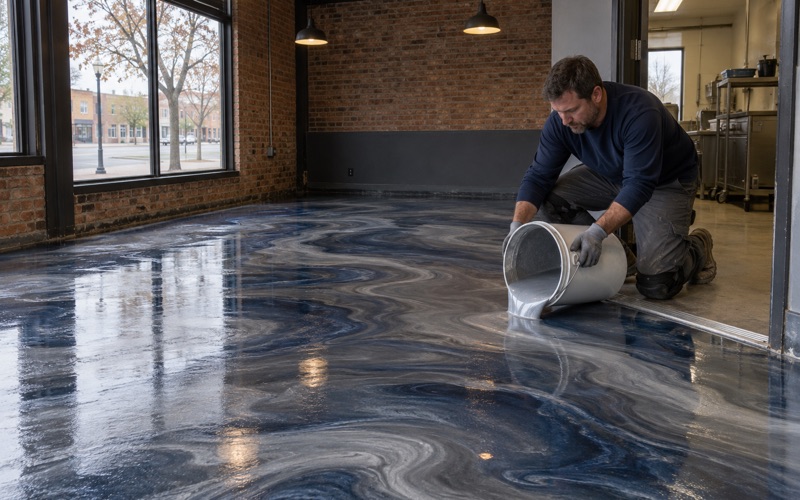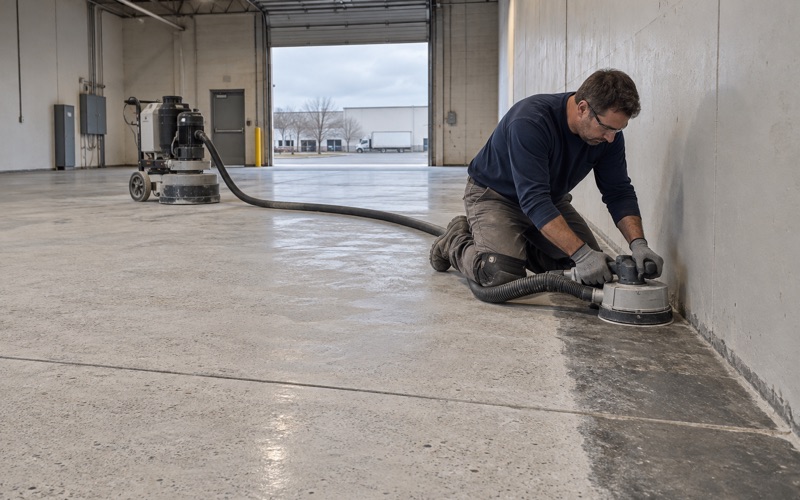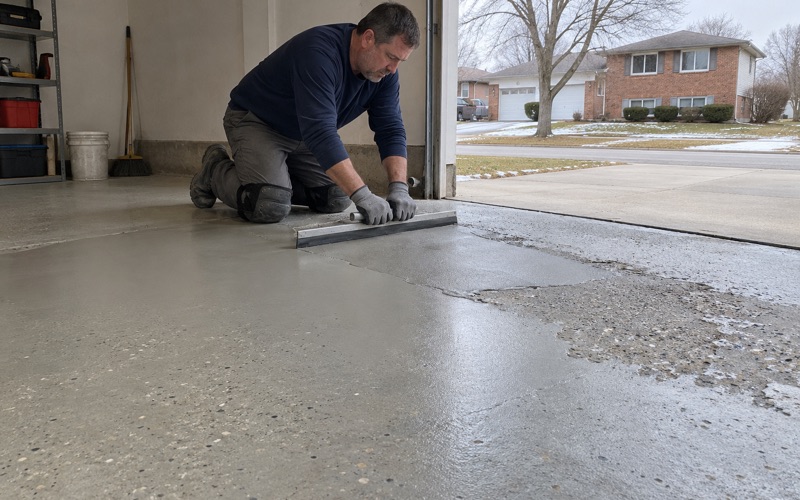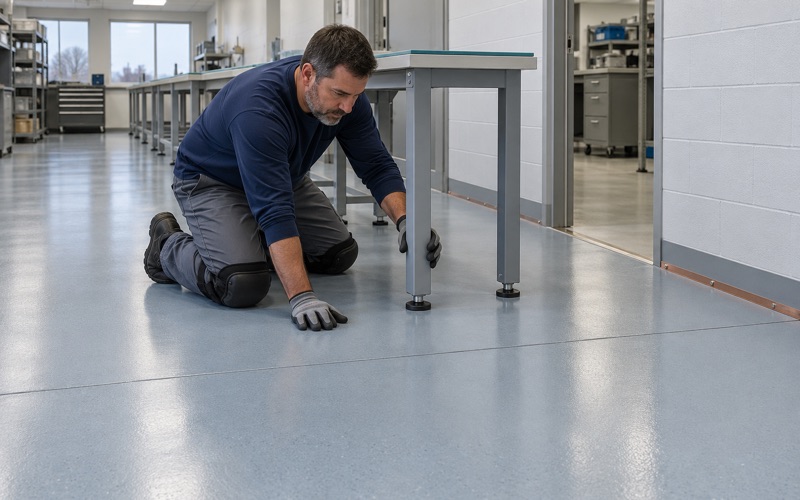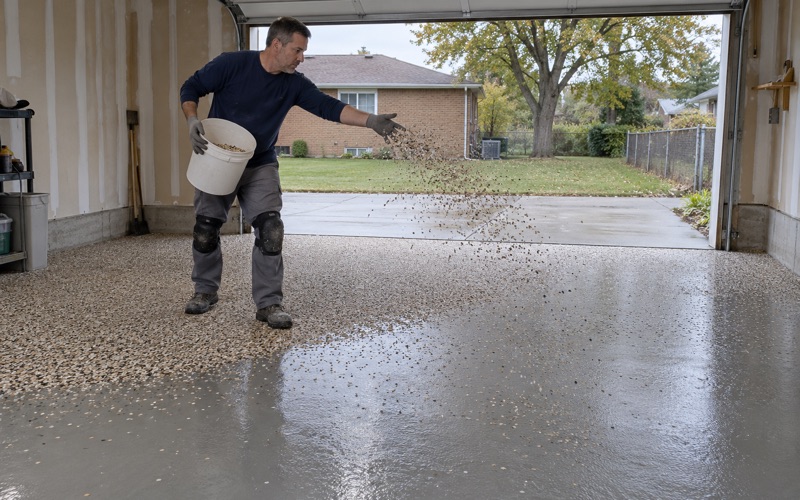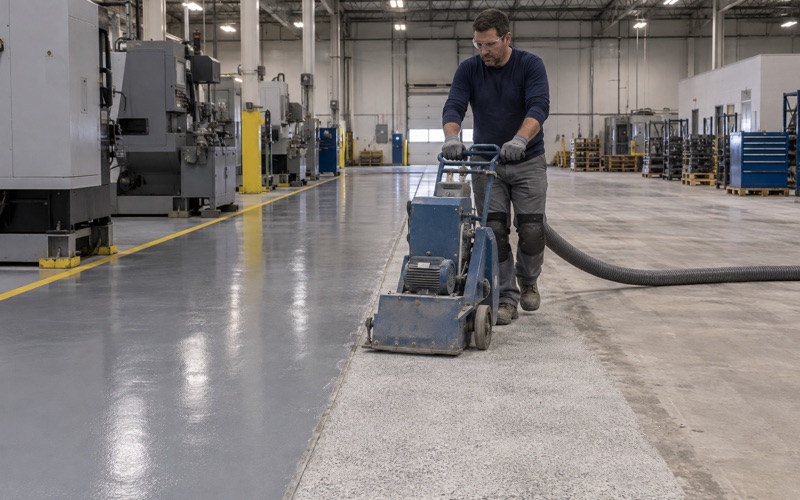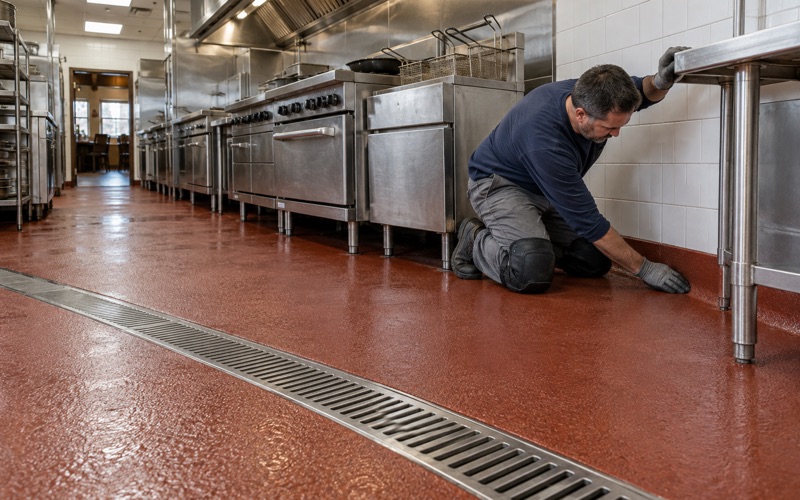
Tinley Park Epoxy Flooring handles epoxy flooring in Manhattan with more than 20 years in the trade behind the way we read a slab. Most of the floors we are asked about here are garage and basement slabs, but some of the most useful lessons come from commercial rooms where the floor has to do more than look clean. Knowing where a coating belongs, and where it must not go, is part of the scope from the first visit.
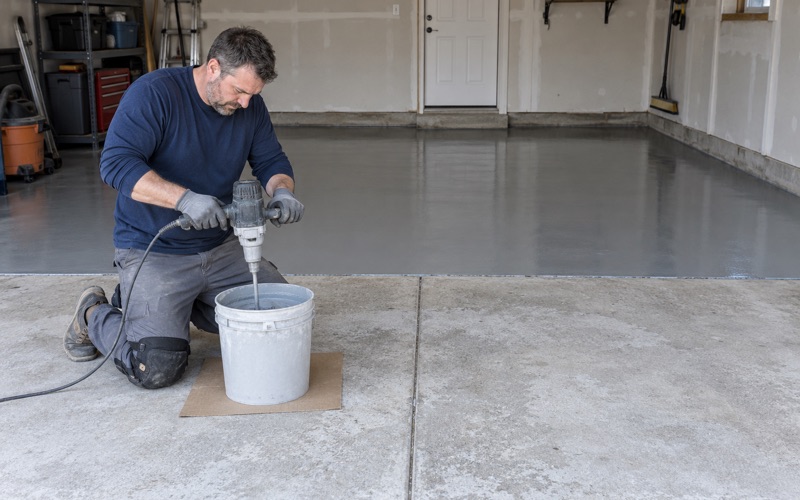
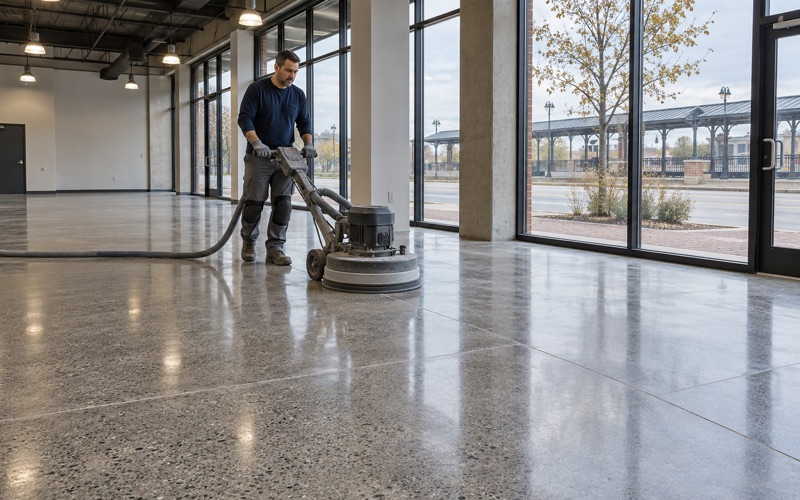
Every slab we take on is opened with a diamond grinder or a shot blaster rather than an acid etch, which gives the primer a real ICRI concrete surface profile to bite into. Before a price is final, a moisture test is written into the scope, and the proposal names the product line, the number of coats and the finished thickness. That way the floor you walk on can be checked against the paper you signed.
Cracks, spalls and failing old coatings get mapped before anything else, and we say plainly when a slab needs repair or replacement first. The sections below follow one practical question through a laundromat, a set of machine pads and a home laundry room: what should a coating cover, and what should it leave alone?
A Seven-Day Laundromat on North Street and Why Hardmount Machines Need Bare Concrete
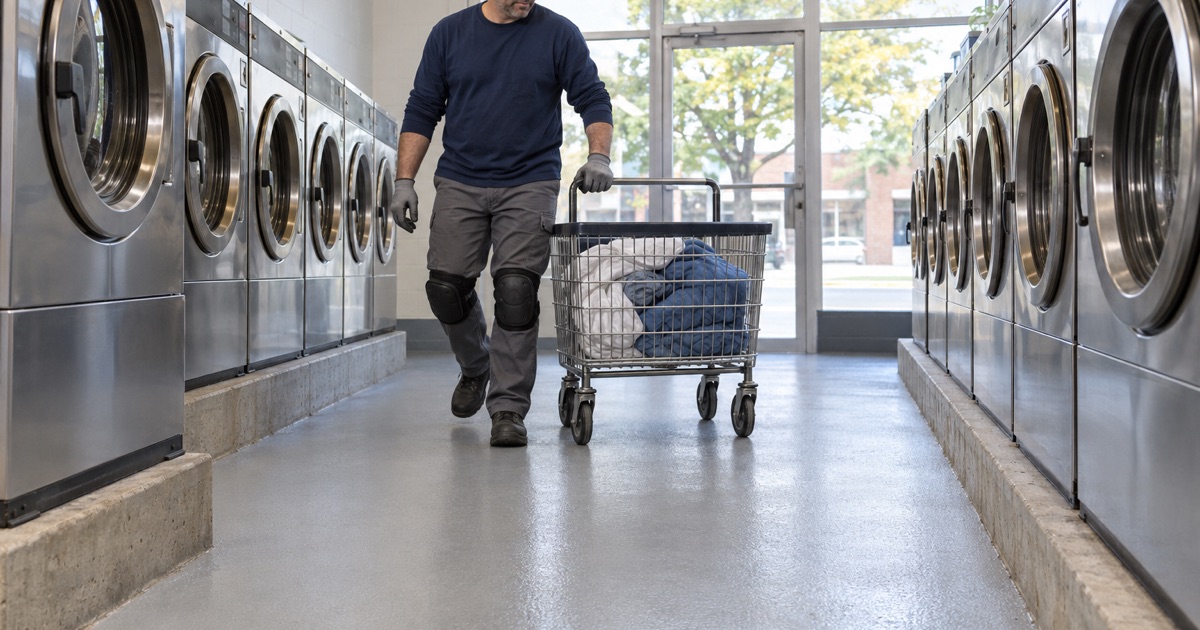
Sud-Z Time Laundry at 200 E. North Street is a full-service, air-conditioned laundromat that opens every day of the year from 7:00 a.m. to 10:00 p.m. Alongside its self-service machines it runs a drop-off wash-dry-fold service on weekday mornings, priced by the pound. A room that stays open fifteen hours a day, seven days a week, is a good illustration of what a hard-working wet floor asks of a coating.
We have not inspected that laundromat, and we do not know which machines it runs or what sits under them. What follows is trade-level guidance drawn from one manufacturer’s published installation manual, used to explain why commercial laundry floors are coated the way they are. It is not a description of any particular Manhattan business.
Why a Hardmount Washer-Extractor Wants Uncovered Concrete
A hardmount washer-extractor spins its load hard during the extract cycle, and that spin pushes real force into the floor. The Alliance Laundry Systems hardmount installation manual (Part No. F232135R12, June 2013) says not to mount these machines on wooden floors, tile floors, above ground level, or over basements or crawl spaces because of the high extract speed and the G-forces exerted. Its warning W743 goes further: to reduce the risk of fire, the appliance must be bolted to an uncovered concrete floor.
The same manual calls for a floor of at least 3,500 psi reinforced concrete set firmly in clean, compacted fill. It lists dynamic loads of roughly 374 to 1,404 pounds at about 7.5 to 8.8 hertz on its 2-speed 18-60 lb models. That is a repeating load, cycle after cycle, all day long.
Soft-Mount Machines Follow Different Rules
Not every commercial washer is a hardmount. Soft-mount machines carry their own suspension and come with their own installation requirements, so the bolted, uncovered-concrete rule above belongs to the hardmount type in that manual rather than to every washer ever built. When we look at a laundry floor, the first thing we ask for is the installation manual for the machines actually on it.
Reading the Slab Before Anyone Quotes It
A laundry slab that carries bolted machines has to be sound under the coated areas too. We map cracks running out from anchor points, spalled edges at pads and any old coating that has let go, because vibration finds weakness faster than foot traffic does. If the concrete needs repair before it should be coated, the proposal says so.
Looking for epoxy-flooring closer to Summit? See Summit Epoxy-Flooring.
Pads, Grout and Anchors: Where the Coating Stops
In a commercial laundry with hardmount machines, the coating goes around each machine footprint and pad, not under it. The base needs to bear on the concrete the manufacturer specified, and a film of resin between the two is exactly the kind of covering that manual rules out. Our job is to finish the floor up to that boundary and leave the boundary clean.
Grouted Bases and Elevated Pads
The hardmount manual requires the machine to rest on a smooth, level surface with its entire base supported, warns against supporting it on only four points, and states that grouting is required. An elevated concrete pad may not exceed 8 inches in height and must extend at least 4 inches beyond the machine on all sides. That 4-inch apron is part of the mounting, and we treat it as concrete to protect rather than a surface to coat.
Where a pad meets the floor, we terminate the coating with a clean, ground edge so it does not feather up the pad face or creep under the grout line. A neat stop there also makes the floor easier to maintain, because a lifted edge at a machine base collects lint and standing water.
Anchors and Future Machine Changes
Hardmount anchors in that manual are drilled 2.56 inches deep and set in an adhesive anchoring system. A coating should never bridge over an anchor location or hide where a future anchor will be drilled. When an owner expects to swap or add machines, we keep the planned footprints uncoated and mark them on the drawing that goes with the proposal.
Timing the Work Around Open Hours
A laundry room open from early morning to late evening has few natural closing windows. We phase floor work so one bank of aisles is down at a time, with overnight and weekend windows when the room cannot close. The cure schedule follows slab temperature and the dew point spread at the slab surface, not a calendar date, so a section reopens only once it is actually ready.
Wet Aisles, Detergent and the Floor Between Machines
The aisles between washers are where a coating earns its keep. Those lanes see dripping baskets, spilled detergent, splashed rinse water and rolling carts all day, and a seamless coated surface is far easier to keep clean than bare concrete that soaks up whatever lands on it.
Texture Specified, Not Promised
Detergent and water on a smooth floor is a slip waiting to happen. We specify slip resistance by the broadcast and the topcoat, typically a quartz aggregate or vinyl flake broadcast locked down by a polyaspartic or urethane topcoat sized to the traffic. The texture is written into the scope, so it is something you can check rather than a slogan on a brochure.
Products Chosen Inside Illinois VOC Limits
A coating applied in a room people use every day should not leave a lingering solvent smell. We pick products inside the 35 Illinois Administrative Code Part 223 Subpart C limits for floor and industrial coatings, which bind the person applying them. A 100% solids epoxy base coat carries little solvent to begin with.
Moisture Under a Wet Room
A laundry slab gets wet from above every day, and it can also carry vapor from below. Before we commit to a system we run ASTM F2170 in-situ relative humidity probes or an ASTM F1869 calcium chloride test, and if the readings call for it we add a moisture-mitigation primer. Moisture is the first warranty exclusion we name, and we explain the others before anything is signed.
What a Coating Will Not Do
A floor coating is a wear surface, not waterproofing. It will not stop water that finds its way to a slab edge, a floor drain or a gap at a machine pad, and it is not flood protection. We say that up front so nobody buys a coated laundry floor expecting it to behave like a membrane.
Grinding dust from preparing those aisles is captured at the machine with a vacuum. It is never rinsed toward a floor drain, which matters in a room built around drains and running water.
Washers, Utility Sinks and Laundry Rooms in Manhattan Homes
Most of the floors we coat in Manhattan are residential, and the laundry lesson scales down neatly. A household washer is not a bolted washer-extractor, but the questions are similar: what sits on the floor, what gets wet around it, and where the coating should end.
Laundry Rooms and Utility Sinks
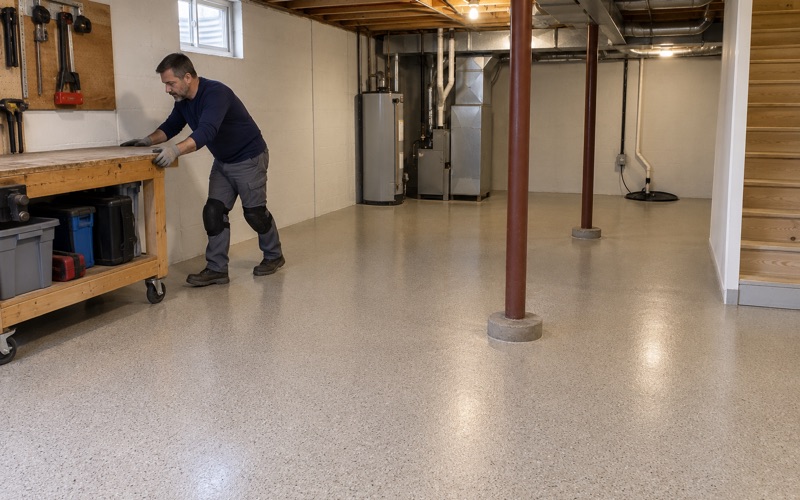
In a basement or garage laundry area, we coat the open floor and work cleanly around the washer and dryer footprint, the utility sink legs and any standpipe or floor drain. The area under a sink and in front of the washer sees the most water, so that is where we put a textured broadcast rather than a slick high-gloss finish. Appliances go back only after the floor has cured to the point the product sheet allows.
Garage Slabs and Winter Salt
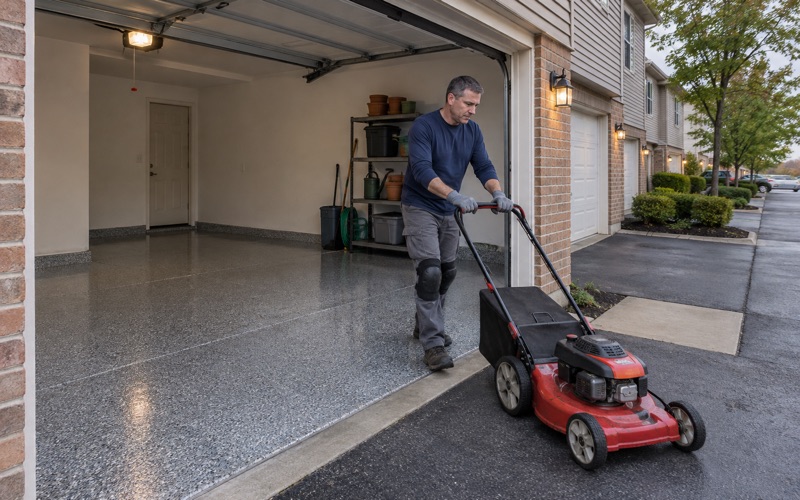
Many Manhattan laundry areas share space with an attached garage, and that floor faces a different enemy in winter. Brine and rock salt ride in on tires for months, so we choose garage systems built to hold up to calcium chloride and rock salt deicers and to resist hot tire pickup. An unheated garage in deep winter is told to wait until the slab and the air allow a proper cure.
We also watch for amine blush when a garage is cool and damp during cure, because that waxy film on fresh epoxy has to be washed off before the next coat will bond. Polyaspartic topcoats over an epoxy base are a common answer for a garage that needs to return to service quickly.
Registering With the Village Before Work Starts
The Village of Manhattan requires every general contractor and subcontractor working within its corporate limits to register, and registrations expire one year from the date registered. The fee is $150 for a general contractor and $100 for a subcontractor, along with a certificate of insurance naming the village, and the village no longer requires a permit bond. Illinois licenses no flooring or coatings contractor, so these local rules are the ones we check before a job is booked.
The village’s home-improvement permit page does not name floor coating either way, so we ask Building & Zoning at 815-418-2042 before starting. On home jobs over the state threshold, you receive a written contract and the Illinois Home Repair: Know Your Consumer Rights pamphlet before any grinding begins.
- 20+ Years Coating Floors
- Moisture Test in Every Scope
- Free Written Estimates