Tinley Park Epoxy Flooring brings more than 20 years of work to epoxy-flooring in Lyons, and a good share of that work is recoating floors that were already coated once. A recoat is only as good as the surface under it, and the most stubborn thing we find on an old coating is not dirt. It is a thin, slick film that looks clean and still refuses to let the next coat bond.
That film is usually silicone, and it reaches a garage floor in ordinary ways: tire shine, interior protectants, spray waxes and the overspray from all three. On a cured coating it does no structural harm, but it leaves the surface slippery and, more important, it makes any new coat pull away from it in small round craters. We look for it, plan around it and remove it before any new resin goes down.
Every one of our jobs starts the same way, with the slab opened by a diamond grinder or a shot blaster rather than an acid wash, and a written proposal that names the product line, the number of coats and the finished thickness. On a recoat, that grind is also what takes contaminated coating off, which makes prep and cleanup part of the same visit.
A Paint-Correction Shop on Ogden Avenue
Lyons has a detail business on Ogden Avenue that shows how close the car-care trade sits to the garage floor. DPL Detail, at 8044 Ogden Avenue, describes itself as a premium detail business that specializes in paint correction and ceramic coatings, and it also offers sealants, tinting and full interior and exterior detailing. By its own account, the business got its start from a home garage.
We have no connection to that shop and have never seen its floor, so we are not describing what happens inside it. The point is the path. Anyone in Lyons who details a car at home, the way that business began, is using the same products that make a car look finished and make a coated garage floor hard to recoat later.
Why a Detailing Habit Matters to a Floor
Paint correction and ceramic coating work happen on the car, but the bottles, pads and towels live on the floor around it. Dressings drip off tire sidewalls, protectant mist settles past the door sill, and a towel set down on the slab transfers whatever it carried. None of that is visible on a glossy flake floor until something goes wrong.
Roughly three in four Lyons homes were built before 1980 and almost none since 2010, so the garage floors we see here are old concrete, often under an older coating that is due for a fresh topcoat. That is when the detailing history of the floor finally shows up.
A Slick Film on a Cured Coating
Silicone left on top of a cured epoxy or polyaspartic floor does not dissolve it or eat into it. What it does is sit there as a slick film that spreads, collects grit and turns a damp floor into a slipping hazard near the car doors. Ordinary floor cleaner tends to move it around rather than lift it.
That slickness is a nuisance on its own, but the larger cost waits until the floor needs work. On a floor that has spent years under dressings and protectants, the film is also the reason a recoat costs more prep than the owner expects.
Looking for epoxy-flooring closer to La Grange? See La Grange Epoxy-Flooring.
Tire Dressings, Shine Sprays and Fish Eyes
Most tire dressings use silicone oils as their main shine ingredient, and silicones migrate wherever they make contact. A tire dressed in the garage and parked on the same spot transfers some of that oil to the floor under it, and wheels carry it in strips across the slab. Spray protectants used inside the car add a fine mist to the same area.
Ceramic coatings for cars and coatings for floors share a word but not a chemistry, and a product made for paint is not a fix for a dull or worn garage floor. When a floor has lost its gloss, the answer is prep and a proper topcoat, not something borrowed from the car shelf.
What a Fish Eye Looks Like
Fish eyes are round separations or dimples in a fresh coat, where the new resin pulls back from a contaminated spot and leaves a small crater with a raised rim. Coating makers list silicone contamination as one of the plain causes, alongside oil and grease. The defect appears while the resin is still wet, and by then the only fix is to stop, let it cure and start the area over.
A few fish eyes are more than a cosmetic flaw, because each crater is a thin spot where the new film never reached full thickness. They also mark contamination on the floor, and the coat around them is sitting on that same surface.
Why Ordinary Cleaning Is Not Enough
A mop and degreaser will make a contaminated floor look clean without making it bondable. Silicone that has worked into the texture of a flake broadcast or the pores of a worn topcoat stays put through a wash, and the first sign of it is often the fish eyes themselves. That is why we treat any floor with a detailing history as contaminated until the prep proves otherwise.
Before quoting a recoat we ask how the garage is used: whether cars are dressed or detailed inside, where the products are kept and whether anything has been sprayed near the walls. Those answers change how much of the floor we treat as suspect and how deep the prep has to go.
Grind, Solvent-Clean and Recoat the Whole Area
The repair coating makers publish for silicone contamination is not subtle. Isolated spots are sanded with 60-grit paper or diamond ground, the coating is removed entirely where fish eyes are widespread, the substrate is cleaned with solvent to lift what remains, and the entire area is recoated rather than patched. We follow that order rather than patching, because a new coat over leftover silicone is a new chance to fish-eye.
Grinding Takes the Film Off With the Surface
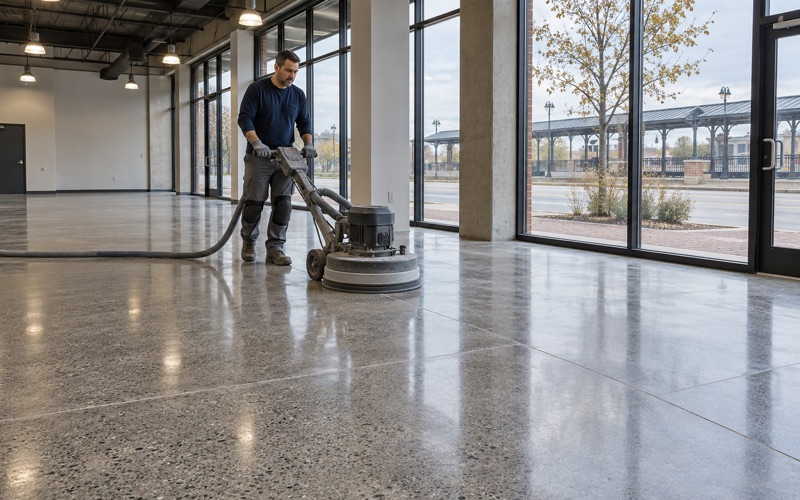
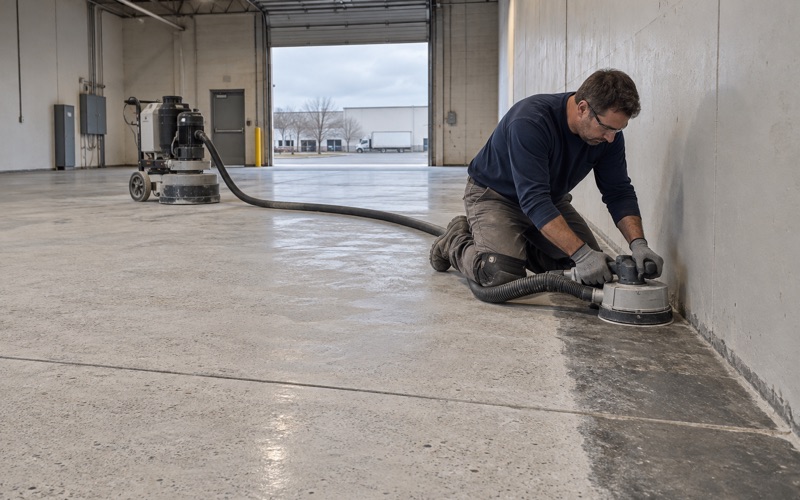
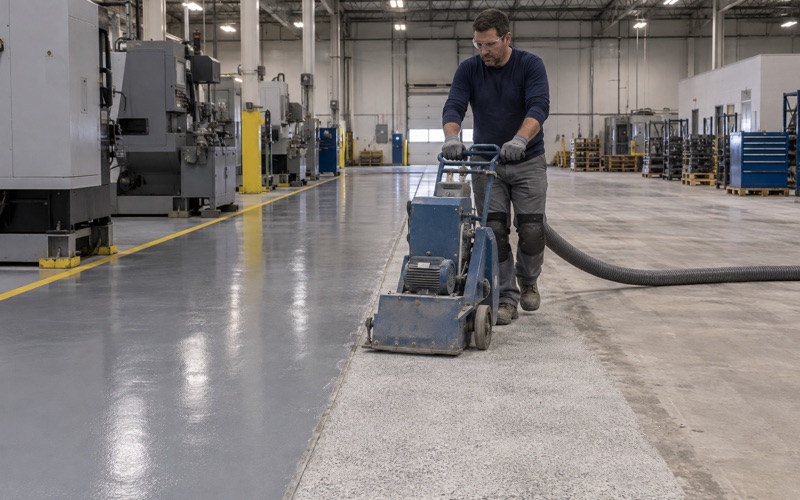
On a garage that has been dressed and detailed in for years, we usually grind the whole floor rather than chasing visible spots. The diamond grinder cuts through the old topcoat and the film on it together, opens a fresh profile for the new coat to grip, and runs with a vacuum at the machine so the dust is captured instead of washed toward a drain.
Where the old coating is sound and well bonded, grinding it to a uniform scratch can be enough to carry a new topcoat. Where it is lifting, cracked or covered in fish eyes from an earlier attempt, it comes off to bare concrete, and we map cracks and spalls before we price the rest.
Solvent Cleaning Before the First Coat
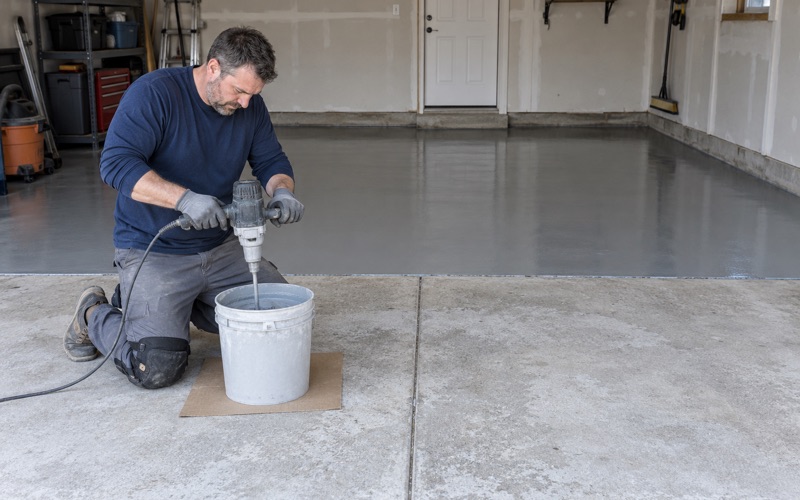
Grinding alone can smear a contaminant rather than remove it, so after the dust is vacuumed we wipe the prepared floor with solvent, changing rags often so we are lifting silicone instead of spreading it. We let the solvent flash off fully before priming, because a wet wipe-down is its own adhesion problem. Then the floor gets a moisture test, which is in the written scope on every slab before the price is final.
A plastic sheet test or calcium chloride test tells us whether vapor is moving up through the concrete, and on concrete poured decades ago we do not assume anything about what lies under the slab. A recoat that bonds well on top can still fail from below, which is why moisture is the first warranty exclusion we explain.
When a Recoat Has Already Failed
Some garages we are called to have already had one recoat go wrong, with craters across the topcoat or patches peeling at the edges. That floor has told us what it holds, so the coating comes off down to concrete, the slab is solvent-cleaned, and the new system goes on the whole floor rather than over the failed one.
That is the most expensive version of this job, and it is the one we most want owners to avoid. A homeowner who mentions a detailing habit before the first recoat can save the cost of grinding off a second failed coat later.
Detailing in a Lyons Home Garage
None of this means a coated garage cannot double as a detailing bay. It means the products and the habits need to change once the new floor is down, because the same silicone that caused the last failure can cause the next one.
Water-Based Dressings, Applied off the Floor
Water-based tire dressings minimize the migration risk that silicone-heavy shine products carry. We suggest applying any dressing with the car pulled out onto the driveway, using an applicator pad rather than a spray, and keeping a drop cloth under the work if it has to happen inside. A dressing that dries before the car rolls back inside leaves far less to transfer.
Sealants, waxes and interior protectants deserve the same care unless the label says they are silicone-free. Wiping drips the same day and keeping bottles on a shelf or tray instead of the slab does more for the next recoat than any floor cleaner.
Choosing a Finish for a Detailing Garage
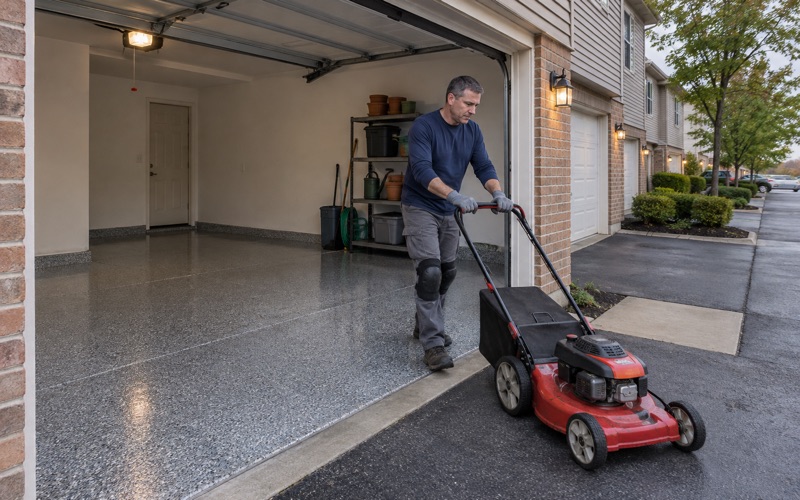
A full vinyl flake broadcast under a polyaspartic topcoat is easy to wipe and hides the occasional drip, while a quartz broadcast adds grip where a wet, dressed floor gets slippery. Slip resistance comes from the broadcast and topcoat we specify, and we write that into the proposal instead of promising it.
Timing matters as much as product choice. We schedule each coat by slab temperature and the dew point spread at the surface, not by the calendar, and an unheated Lyons garage in deep winter is a floor we tell the owner to wait on.
Rentals and Village Paperwork
More than a third of occupied homes in Lyons are rented, so the person who books a recoat is often a landlord rather than the driver who dresses the tires. In that case we put the floor-care notes in writing for both. Home jobs above the state threshold get a written contract and the Illinois consumer-rights pamphlet before grinding starts.
Lyons also runs its own contractor license application, and we check the village’s current requirements before a job is booked. We also confirm any bond and insurance rules at the same time, since Illinois has no state flooring license.
- 20+ Years Coating Floors
- Moisture Test in Every Scope
- Free Written Estimates