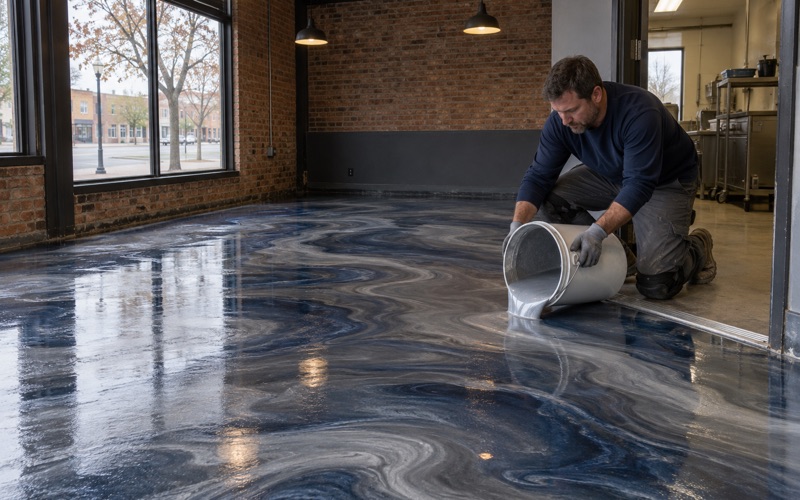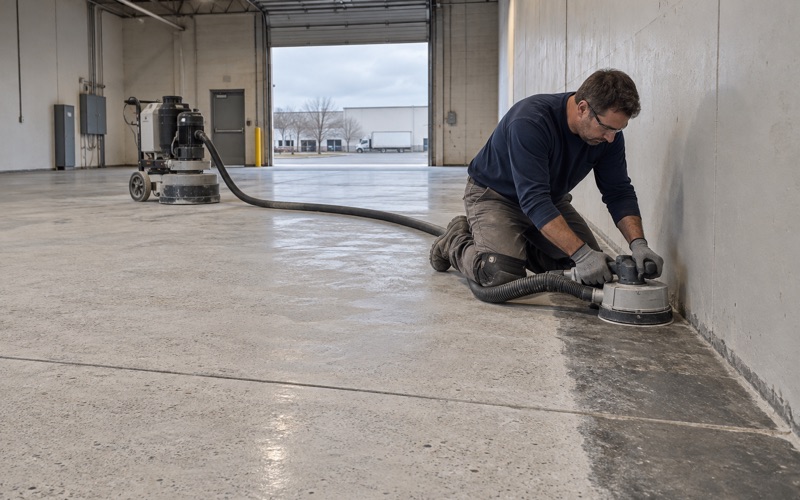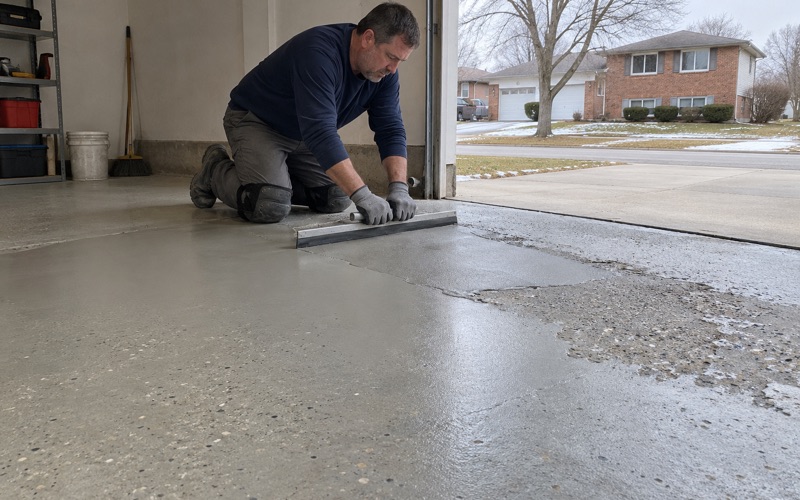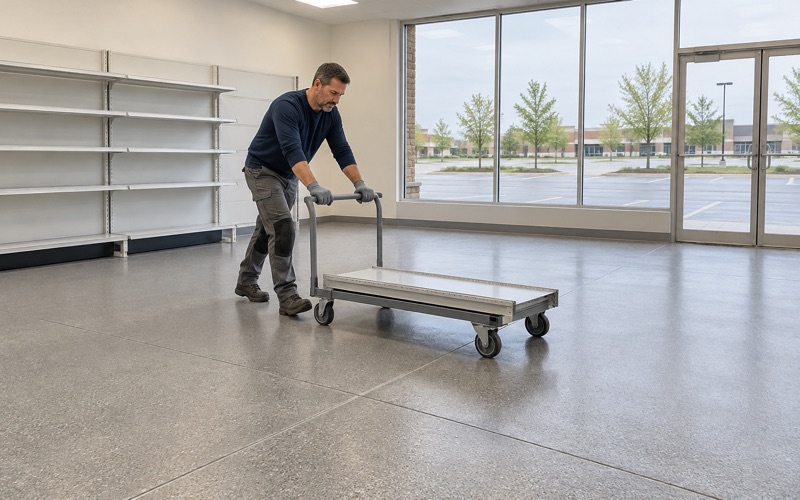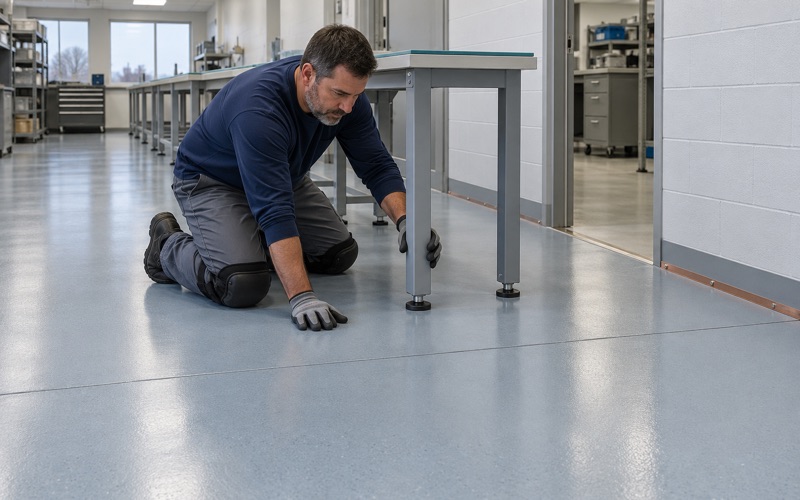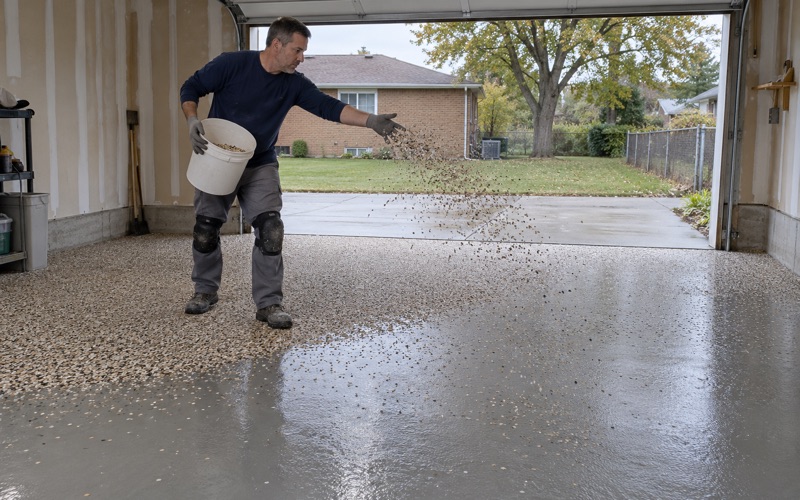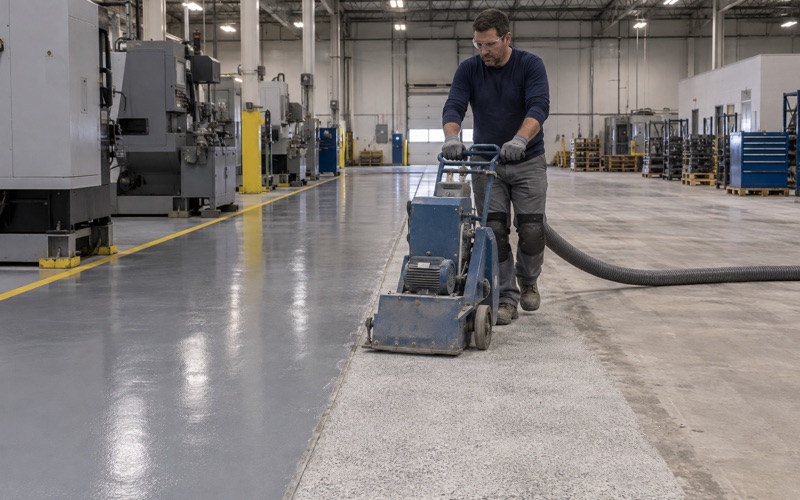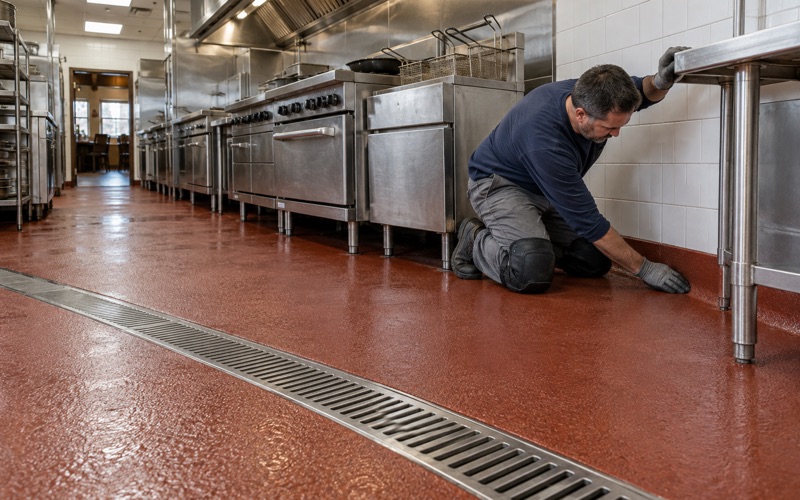
Tinley Park Epoxy Flooring has spent more than 20 years on epoxy flooring in Lemont and the surrounding suburbs, and a good share of that work starts with a slab that sheds powder before any coating goes down. We open every floor with a diamond grinder or a shot blaster rather than an acid wash, which gives the resin a real surface to lock into. That same step is also how a weak, chalky top layer gets removed instead of buried.
Before a price is final, our written scope includes a moisture test, whether the slab sits under a garage door or a finished basement. We also map cracks, spalls and any old coating, and we tell you plainly when a floor needs repair before it should be coated at all.
Every proposal lists the product line, the number of coats and the finished thickness. That gives you a way to hold the installed floor up against the quote, line by line, once the crew has packed up.
Simulator Bays, Launch Monitors and Why Dust Matters
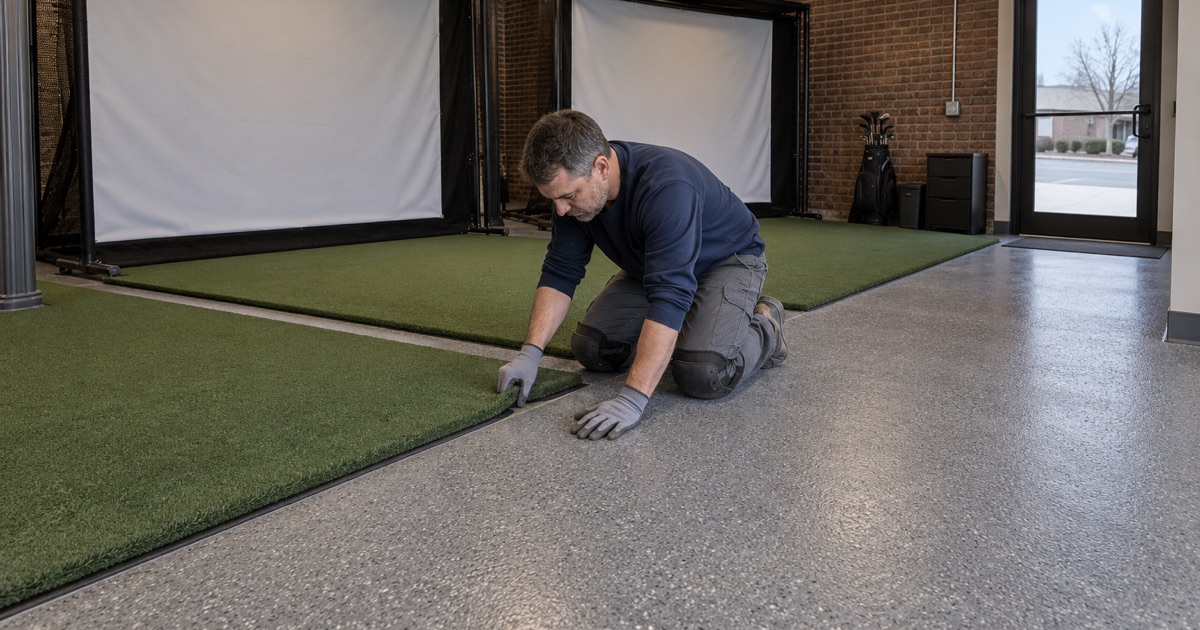
A golf simulator is a room full of sensitive equipment, and the floor is the largest surface in that room. That makes the condition of the concrete underneath part of the setup, whether the bays are commercial or in a home.
Five Bays on Ed Bossert Street
Downtown, The Club Lemont at 46 Ed Bossert Street runs an indoor golf venue with a kitchen and a bar, built around five simulator bays that are each 15 feet wide. Listings describe Uneekor EYE XO launch monitors in those bays, paired with GSPro software. Lemont’s downtown news noted that the village did not have an indoor golf facility nearby before it opened.
We have not worked there and have not seen that floor, so we make no claim about what is under its bays. The venue matters to this page for a different reason: it shows how much modern golf equipment depends on the room around it, and that includes the concrete.
What the Camera Maker Asks of the Room
The EYE XO is an overhead launch monitor. Its product guide describes dual high-speed cameras mounted 9 to 10 feet above the floor and about 3 feet 6 inches in front of the tee, and warns that missing those requirements causes accuracy issues.
The same guide says not to use the device where high humidity, smoke or dust is present, and to clean it only with a dry or wrung-out damp cloth. That warning is about the device’s environment. We make no promise that a coating changes how a simulator reads, but a slab that keeps shedding powder is one more dust source in a room whose equipment maker asks for none.
A Room Built Around Clean Air
A simulator room is usually a closed space with a projector, a screen, a computer and a camera unit hanging overhead. Foot traffic, club swings and a ball striking the mat stir up whatever sits on the floor, and in a small room there is nowhere for it to go.
That is why we treat the slab as part of the room, not just the surface under the turf. Getting the concrete sound first means the turf, the mat and the equipment overhead all start from a floor that is not adding to the problem.
Looking for epoxy-flooring closer to Bridgeview? See Epoxy-Flooring in Bridgeview.
Dusting Concrete: The Weak Layer That Keeps Powdering
The ready-mix industry’s own guidance, the NRMCA’s Concrete in Practice sheet on the subject, defines dusting as loose powder formed when the surface of hardened concrete disintegrates. These surfaces powder under any kind of traffic and scratch easily, because the top wearing layer is weak.
How a Slab Ends Up Dusting
Most of the causes trace back to the day the concrete was placed and the days right after. Finishing while bleed water is still on the surface, troweling in condensation, and insufficient curing all leave a soft skin. The guidance singles out cold basement floors for the condensation problem, and carbonation from unvented heaters or running engines in an enclosed space is another named cause.
None of this depends on how old the slab is. A floor poured last decade can dust as readily as an older one if it was finished wet or never cured properly, which is why we look at the surface itself rather than guess from the house.
Signs Your Slab Is Dusting
The tell is simple: run a palm across the bare concrete and look at it. A floor that leaves gray powder on your hand, scratches under a key or leaves a fresh film after every sweep is shedding its top layer.
We check for this during the same site visit where cracks, spalls and old coatings get mapped. A dusting slab changes the prep line on the proposal, so you see the extra grinding priced before the work starts rather than found halfway through.
Why Covering It Does Not Work
NRMCA notes that adhesives for floor coverings will not bond to a dusting floor, and that dusting can permeate through carpeting. We expect turf and padded mats to behave much the same way, since the powder keeps forming underneath and can work up through the covering with every step.
So laying turf over the problem only hides it for a while. The weak layer has to come off, or be bound back together, before anything sits on top.
Blast, Harden, Seal or Coat: Fixing the Surface
The repair order in the industry guidance is straightforward, and it lines up with how we already prepare floors. Removal comes first, and the choice of finish follows from what is left once the soft material is gone.
Grinding or Blasting Off the Weak Layer
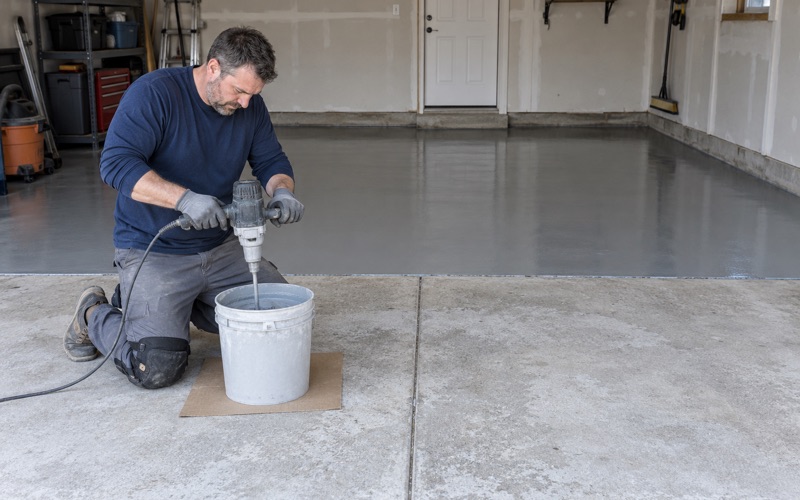
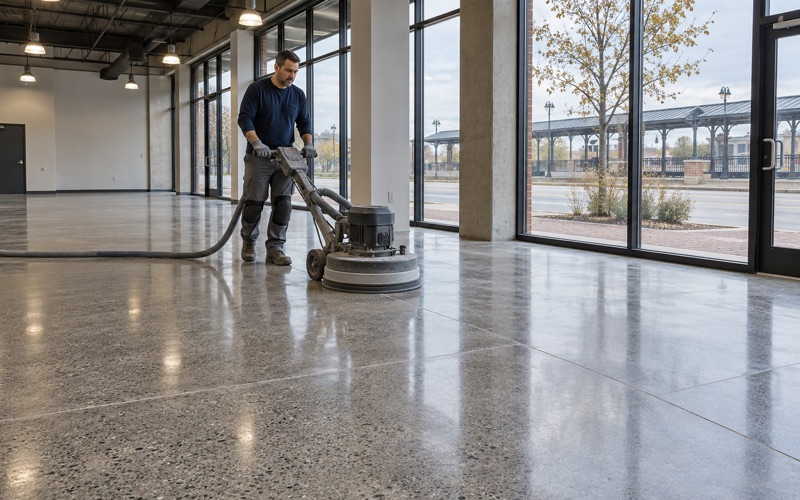
The guidance lists sandblasting, shot blasting or pressure washing to remove the weak surface, and wet grinding down to sound concrete in severe cases. We use diamond grinding and shot blasting, with dust captured at the machine by a vacuum instead of rinsed toward a floor drain.
The aim is an ICRI concrete surface profile matched to the system going down, not just a clean look. A thin film sealer wants a lighter profile, while a 100% solids epoxy build wants more tooth.
Grinding also tells us how deep the problem goes. If the powder stops after a light pass, the slab is sound underneath; if it keeps coming, we grind further before any hardener or coating is chosen.
Hardeners and Densifiers
Once the slab is sound, a chemical hardener can bind what remains. The guidance names sodium silicate and metallic fluosilicates, and lithium silicate densifier is a related product we also use on bare floors.
A hardener can be the right finish for a slab that will stay exposed or carry a mat. It does not add a wearing surface of its own, so it is a poor choice when you want color, gloss or a broadcast texture.
Sealers for Light-Duty Rooms
Between a bare hardened slab and a full coating sits a penetrating or film-forming sealer. It suits a spare room or a basement corner that sees socks and sneakers rather than car tires, and it costs less to put down.
The tradeoff is life span. A thin sealer wears through faster than a built-up coating, so a simulator room with daily play usually earns the heavier system.
When a Coating Is the Answer
The guidance is blunt: if dusting persists, use a coating, and it names epoxy sealers among the options. For a garage or basement that sees real traffic, we usually go to a 100% solids epoxy base with a polyaspartic topcoat, which puts a continuous film over the prepared surface.
Before that, the moisture test in our scope decides what the primer has to do. If an ASTM F1869 calcium chloride test or an ASTM F2170 relative humidity probe comes back high, a moisture-mitigation primer goes under the system, and our warranty paperwork names moisture as its first exclusion.
Turf Over a Garage or Basement Slab: The Lemont Home Simulator
The same reasoning applies to the simulator rooms going into Lemont homes. Most of the village’s housing is detached single-family, and a deep garage or an open basement is the obvious place to hang a screen and lay turf.
Garage Bays
A garage simulator shares its floor with cars for part of the year, which means rock salt and brine ride in on the tires all winter. We choose garage systems that hold up to that, and we finish the area under the hitting mat and turf so the covering lies flat.
An overhead monitor’s mounting height is measured from the floor, so settle the room layout before the coating is scheduled. A slip-resistant finish comes from the broadcast and topcoat we specify, which matters when the same floor doubles as a walkway to the car.
Basements
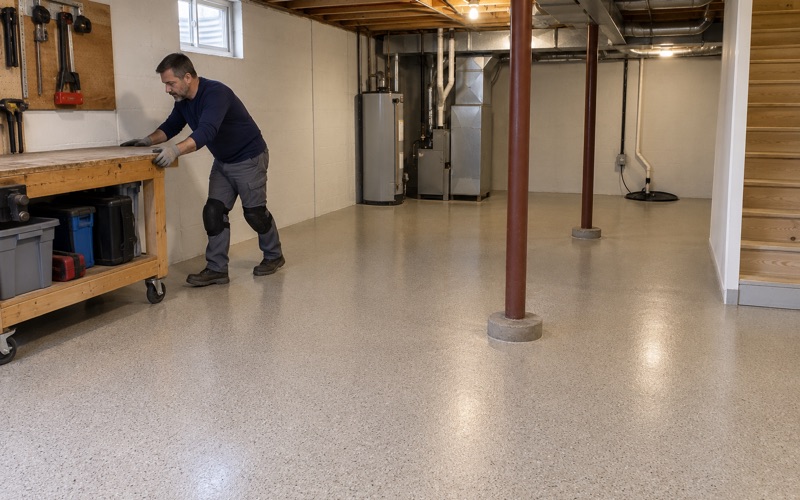
Basement slabs are where troweling in condensation and moisture both show up, so they get the full test before we quote. A plastic sheet test under ASTM D4263 is a quick screen, but the written number comes from a calcium chloride or relative humidity test.
A coating is also never a radon fix. In Illinois that is licensed mitigation work, and we will not sell a floor as a substitute for it.
Turf, Mats and the Finished Floor
Once the coating has cured, turf and a hitting mat can go straight down on it. A smooth coated floor also makes it easy to lift the turf now and then, vacuum underneath and see that nothing is building up.
If you would rather keep part of the room bare, the hardener route leaves a harder, less dusty slab without the look of a coating. We lay out both options on the proposal, with the product and thickness spelled out for each.
Permits and Paperwork in Lemont
Illinois licenses no general, flooring or coatings contractor, so the rules that apply are the village’s own. Lemont’s Building Department works under its building code with the 2021 I-codes adopted, and we confirm its registration, bond and insurance requirements before a job is booked.
Lemont spans Cook, DuPage and Will counties, but for a floor coating inside the village the Building Department is the office to call. For home jobs above the state threshold, you get a written contract and the Illinois Home Repair: Know Your Consumer Rights pamphlet before any grinding begins.
- 20+ Years Coating Floors
- Moisture Test in Every Scope
- Free Written Estimates