Tinley Park Epoxy Flooring brings more than 20 years of resin floor work to epoxy flooring in La Grange, and some of the most careful layouts we draw are the ones where the floor has to share a room with open flame. A coating is a polymer film bonded to concrete, which makes it tough, cleanable and chemical resistant, but it is never a hearth. Knowing where it should stop is as much a part of the job as knowing how to put it down.
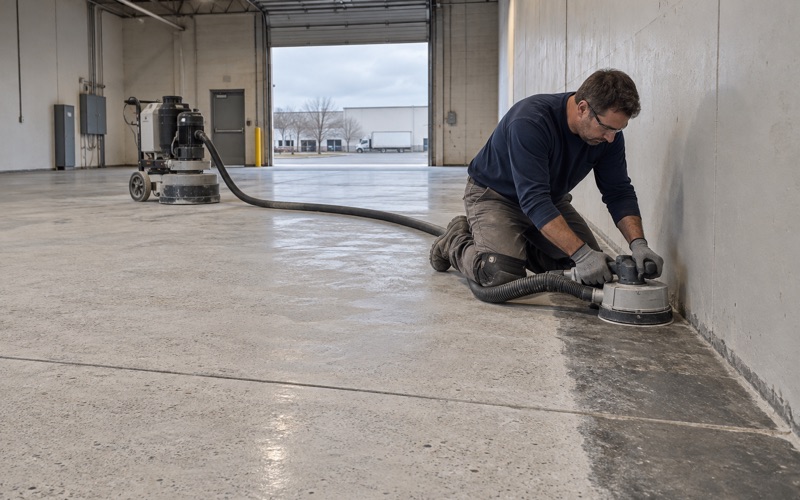
Every slab we coat is opened with a diamond grinder or a shot blaster, never an acid etch, so the resin grips an actual surface profile. Our written proposal names the product line, the number of coats and the finished thickness, which lets an owner check the finished floor against the quote. A moisture test sits inside that scope before the price is settled, whether the slab is under a restaurant kitchen or a basement family room.
This page is about one particular kind of floor plan: the kind drawn from a heat source outward. A wood-fired oven, a wood stove or a grill sets a zone the coating should never enter, and the rest of the layout follows from that line.
A Wood-Fired Pizzeria on Calendar Avenue
Downtown La Grange has a working example of this problem, and it is worth walking through before talking about coatings at all. It shows why a kitchen floor around live fire gets drawn differently from almost any other commercial floor.
A Renovated Historic Building Downtown
Wooden Paddle, which describes itself as a wood-fired pizzeria, opened its La Grange location at 23 Calendar Avenue after starting in Lemont. The La Grange Business Association noted that the historic building the owners acquired required extensive renovations, and that unexpected setbacks delayed their plans. The building now also holds a second-floor event space named Remi.
The restaurant runs until 10:00 p.m. Monday through Thursday and 11:00 p.m. on Friday and Saturday, and it offers private and semi-private space for groups of up to 70. We have not seen its kitchen, its oven model or its floor, and nothing here describes them. What the setting illustrates is a general rule: an old structure fitted with a live-fire oven has its floor plan set by that oven before anything else.
What the Oven Asks of the Floor in Front of It
A wood-fired oven is loaded, tended and emptied through one opening, and everything that falls out of it lands on the floor directly below. Embers ride out on the peel, ash spills during cleanout, and the floor near the mouth sees radiant heat for every hour the oven is lit. That strip of floor works under conditions no other part of the kitchen shares.
Oven makers address it directly in their installation instructions, setting a minimum distance between the opening and any combustible floor. The clearances belong to each listed oven, so the manual for the specific oven installed is the document a floor plan starts from, not a rule of thumb or another restaurant’s layout.
Planning the Kitchen From the Oven Outward
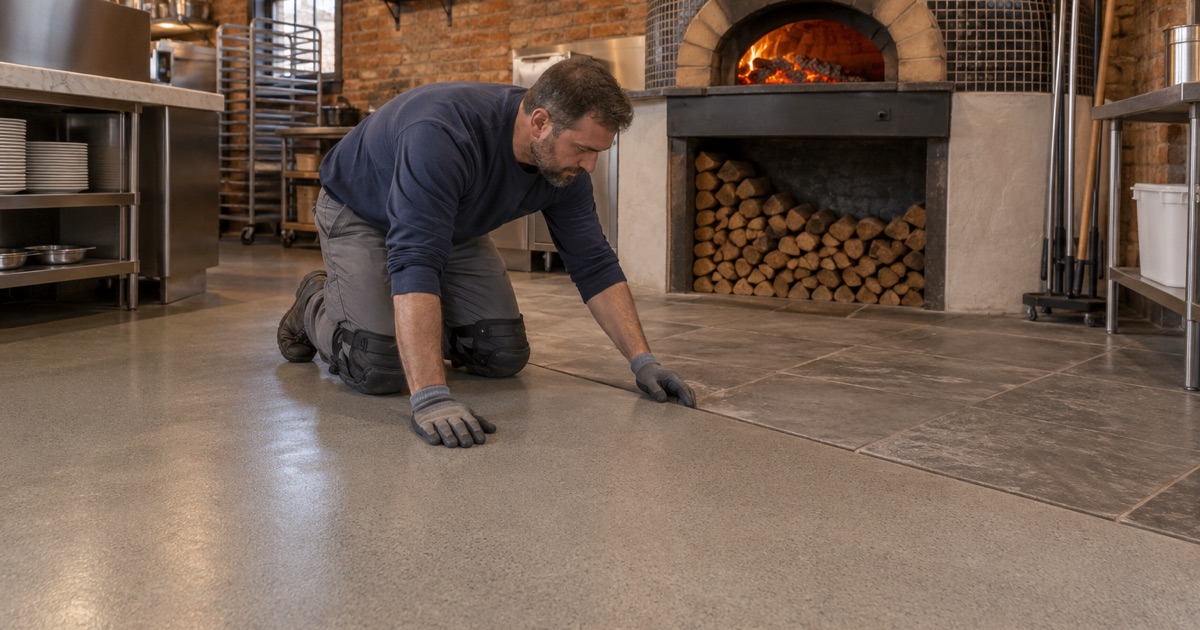
When we lay out a floor for a kitchen like this, we start at the oven mouth and work back toward the prep line, the dish area and the dining room. The noncombustible zone is marked first, then the coated field is drawn to meet it, and only then do we choose a system for the rest of the room.
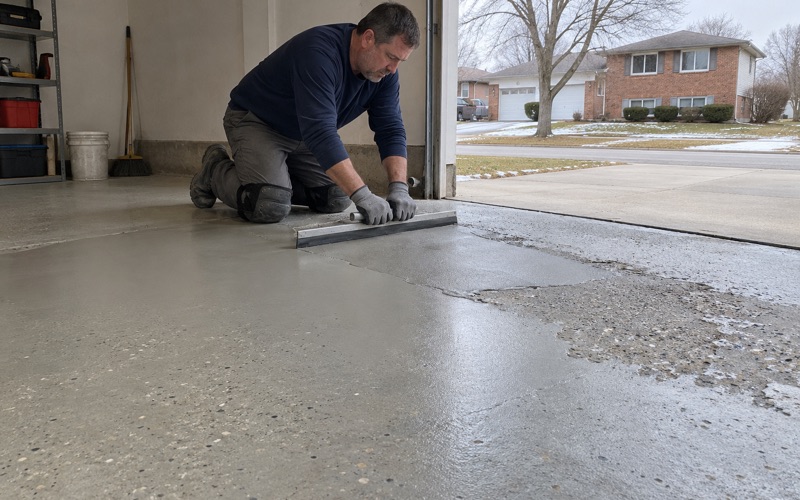
In a renovated building, that order matters even more because the slab itself may be patched, uneven or partly replaced. We map cracks, spalls and any old coating before quoting, and if a section of slab needs repair or replacement before it should carry a coating, we say so plainly rather than coating over it.
Looking for epoxy-flooring closer to Western Springs? See Epoxy-Flooring in Western Springs.
36 Inches in Front, 30 to Each Side: Where Resin Stops
One Oven Maker’s Clearances
To show what these numbers look like on a real floor, take one manufacturer’s published installation manual for its own listed oven. It sets the minimum clearance from combustibles at 30 inches to each side of the door opening and 36 inches in front of the oven opening. It also states that any adjacent combustible floor projecting in front of the oven must sit at least that far from the opening.
Those figures belong to that one oven and that one manual. They are not a code number, and they are not Wooden Paddle’s figures, since the make and model of its oven have not been published. Every oven we plan around gets its own manual read before a line goes on the floor.
Why a Resin Film Stays Off the Apron
Epoxy, polyaspartic and urethane cement systems are all organic polymers, however hard they cure. A 100% solids epoxy is an excellent floor for grease, cleaning chemicals and foot traffic, but it is not a fire-rated surface and we never present it as one. Inside an oven’s floor clearance, we treat it as the kind of material that clearance is meant to keep away.
So the hearth apron in front of the oven stays tile, stone or bare concrete, and the coating stops at the clearance line. That is not a compromise in the finish. It is the floor doing two different jobs in two different places, each with the material suited to it.
Detailing the Edge Where the Systems Meet
The joint between a coated field and a hearth apron is where a resin floor tends to fail if it is treated as an afterthought. We terminate the coating against a ground keyway or a defined edge rather than feathering it thin, so the edge resists lifting when it gets mopped and kicked every shift.
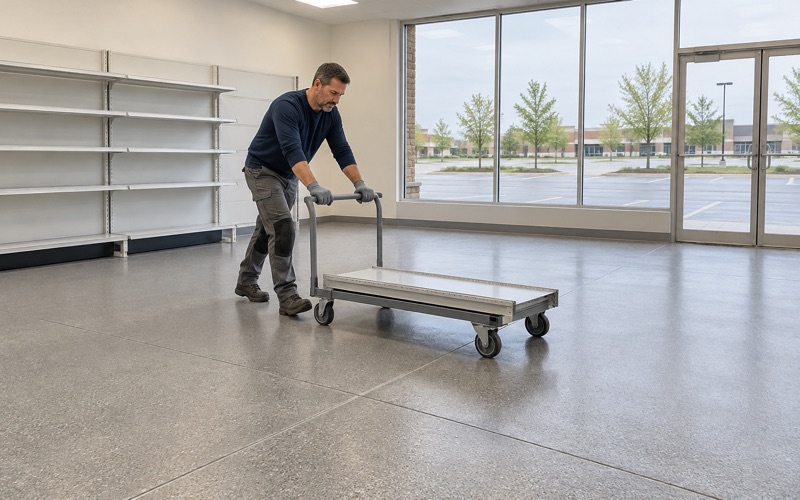
Both surfaces need to sit flush so a cart, a mop bucket or a server does not catch a lip. The slip-resistant texture on the coated side is set by the broadcast and topcoat we specify, such as a quartz aggregate broadcast under the final coat, rather than promised in general terms.
Coals, Ash and the Hearth Apron
Coals That Are Still Burning
The same oven manual is blunt about cleanout: never vacuum out or throw away coals that are still burning, and remove ash with the maker’s ash vacuum or a fireplace shovel. Live coals are exactly what a polymer floor should not meet, and the moment of risk is the trip from the oven deck to wherever the ash goes next.
A dropped ember on a tile or stone apron is swept up and forgotten. The same ember a few feet farther out, on a coated field, can leave a scorch or soften a topcoat, which is one more reason the apron should be generous rather than drawn at the bare minimum.
The Hood Above, the Floor Below
The oven manual also points to NFPA 96 for the exhaust hood and for how it is inspected, cleaned and maintained. That work belongs to the hood installer and the cleaning contractor, not to us, but it affects our schedule because grinding dust and coating fumes should not be pulled into a duct system that was just cleaned.
We capture grinding dust at the machine with a vacuum instead of rinsing it toward a floor drain, and we pick products inside the Illinois VOC limits for floor coatings, which bind whoever applies them. In a kitchen that has to reopen, the work is phased around service, with overnight or weekend windows when the room cannot close.
Choosing the Coated Field Around It
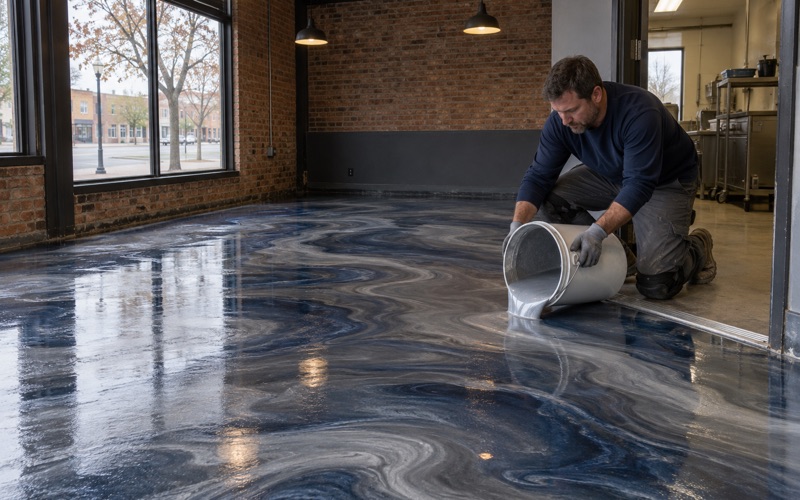
Outside the apron, a wood-fired kitchen still takes grease, flour, hot water and strong detergents, so the coated field is chosen for that load. A 100% solids epoxy body with a chemical-resistant topcoat, or a urethane cement where hot washdown is constant, are the usual candidates, and we write down which one we chose and why.
Before any of this is sold, we explain what a coating warranty leaves out, and moisture coming up through the slab is the first exclusion we name. Whatever the age of the building, the slab is tested with ASTM F2170 in-situ relative humidity probes rather than assumed dry.
Fire Pits, Grills and Stoves Near Coated Floors at Home
The same reasoning scales down to a house. In La Grange, 81.5 percent of occupied homes are owner-occupied, so the person asking about a garage or basement floor is usually the household that will live with it, including whatever burns near it.
Wood Stoves in a Finished Basement
A wood stove or insert in a lower level brings its own manufacturer’s floor protection requirements, and those are read the same way an oven manual is. The protected area under and in front of the stove stays the noncombustible material the stove maker calls for, and the coated floor begins where that protection ends.
Finishing a basement room in La Grange requires a village permit, while simply replacing existing flooring does not, according to the village’s own permit guidance. If a coating is part of a larger basement finish, we make sure the homeowner knows which side of that line the project falls on before work is scheduled.
Grills and Fire Pits at the Garage Door
A garage is where grills get rolled in for storage and where a portable fire pit sometimes sits just outside the open door. A hot grill parked on a coated slab, or ash knocked out of a fire pit onto the slab, can mark a polyaspartic or epoxy topcoat the way a dropped ember marks a kitchen floor.
We suggest a simple habit: let grills cool fully before they come inside, and keep fire pits and their ash on the driveway or patio, never on the coated floor. The topcoat we choose is meant for tires, chemicals and hot tire pickup, not for live fire, and we say that in writing.
Testing and Timing Before Any Coat Goes Down
At home, the same moisture test applies, using an ASTM F1869 calcium chloride test or relative humidity probes depending on the slab. Cure schedules follow slab temperature and the dew point spread at the surface, not the calendar, and a cold garage is told to wait until the slab is warm enough.
Home jobs above the state threshold get a written contract and the Illinois Home Repair: Know Your Consumer Rights pamphlet before any grinding begins. And a floor coating is never sold as radon reduction, because in Illinois that is licensed mitigation work, not something a resin floor can promise.
If you are planning a kitchen around a wood-fired oven, or a basement around a stove, start with the appliance manual and a floor plan. We will mark the noncombustible zone first and price the coated floor around it.
- 20+ Years Coating Floors
- Moisture Test in Every Scope
- Free Written Estimates