Tinley Park Epoxy Flooring has spent more than 20 years on epoxy-flooring in Justice and the villages around it, and the part of a garage or shop floor we watch most closely is the strip under the overhead door. That strip is where a new coating meets the one piece of the building that moves. Get it wrong and a well-bonded floor still leaves a door that seals poorly or reverses when it should not.
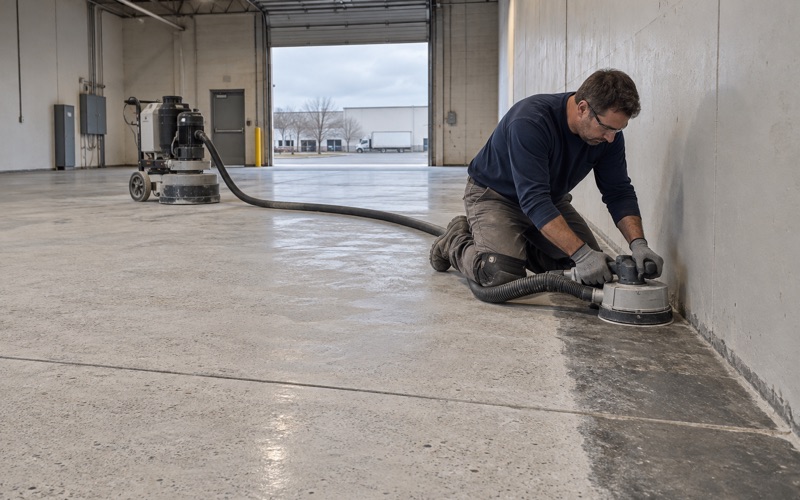
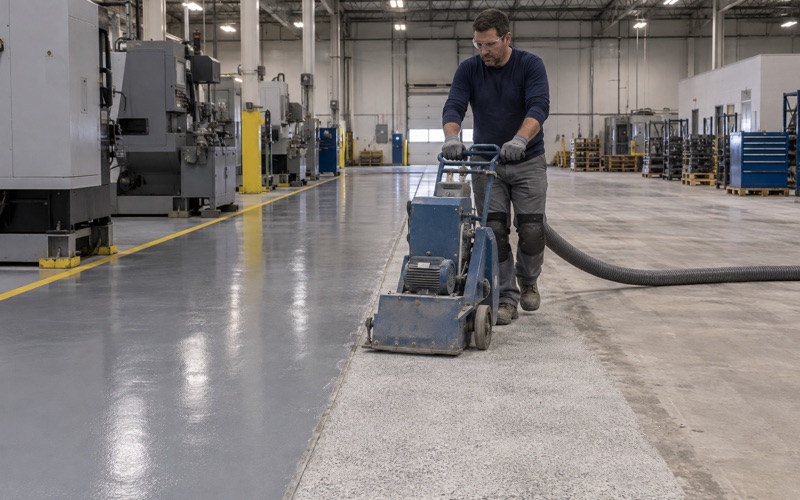
Every slab we coat is opened mechanically, with a diamond grinder or a shot blaster rather than an acid etch, so the coating has a real surface profile to hold. Before the price is final we run a moisture test and write it into the scope. Cracks, spalls and old coatings get mapped, and if a slab needs repair or replacement first, we tell you before anything is sold.
Our written proposal names the product line, the number of coats and the finished thickness. That last number matters more at a door opening than anywhere else on the slab, because it decides how far the floor rises under the door’s bottom edge. The rest of this page explains why, and how we finish that line.
An Overhead-Door Company on Archer Road
Justice is a village in Cook County, established in 1911, and Archer Road is one of its main commercial arterials. At 7600 South Archer Road sits Anagnos Door Company, a commercial and industrial overhead door dealer established in 1989. Its dealer listing describes selling and servicing sectional steel doors, from polyurethane-insulated models to ribbed steel, along with rolling steel doors across a service area of about 50 miles.
We mention them because a door company on the village’s main road is a useful reminder of who owns the other half of the door line. We are a floor coating contractor. We do not adjust, repair or install doors or openers, and we have no arrangement with Anagnos or any other door company.
Sectional and Rolling Steel Doors in Shops
A commercial shop usually has one of two door types. A sectional steel door rides on rollers in side tracks and closes onto the floor with a rubber bottom seal along its lowest panel. A rolling steel door coils above the opening and drops a bottom bar onto the slab, usually with its own astragal or seal strip.
Both were set to close on the floor as it was when they went in. Neither knows the floor has changed unless someone checks after the coating cures.
A Garage Door Is the Same Problem at a Smaller Scale
A residential sectional door with an automatic opener works the same way. The opener learns a down limit, the point where it stops pushing, and that point was set against the bare concrete. Raise the floor and the door reaches its seal sooner, which changes how hard the opener presses when it gets there.
Garage doors leave little room for error at the floor. The bottom seal is a soft strip meant to flex against a known surface, and a coating build of even a fraction of an inch changes how much it compresses. That is why we treat the door line as part of the floor job rather than an edge to trim at the end.
Looking for epoxy-flooring closer to Burr Ridge? See Epoxy-Flooring in Burr Ridge.
The Door Line, the Bottom Seal and the Down Limit
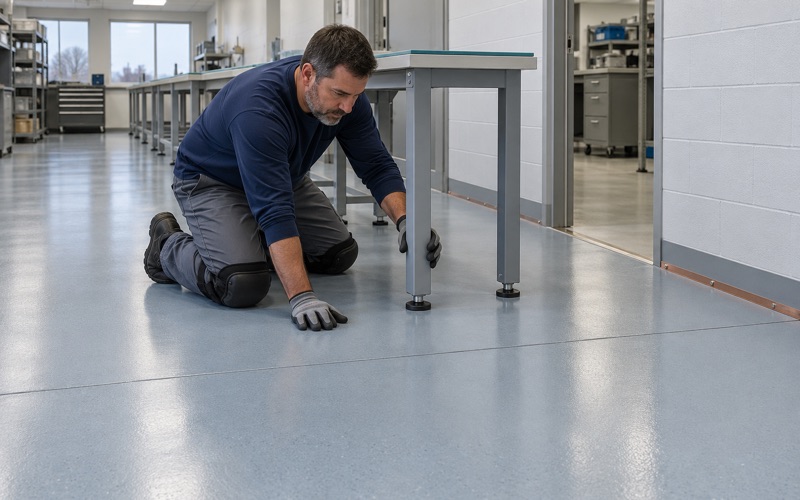
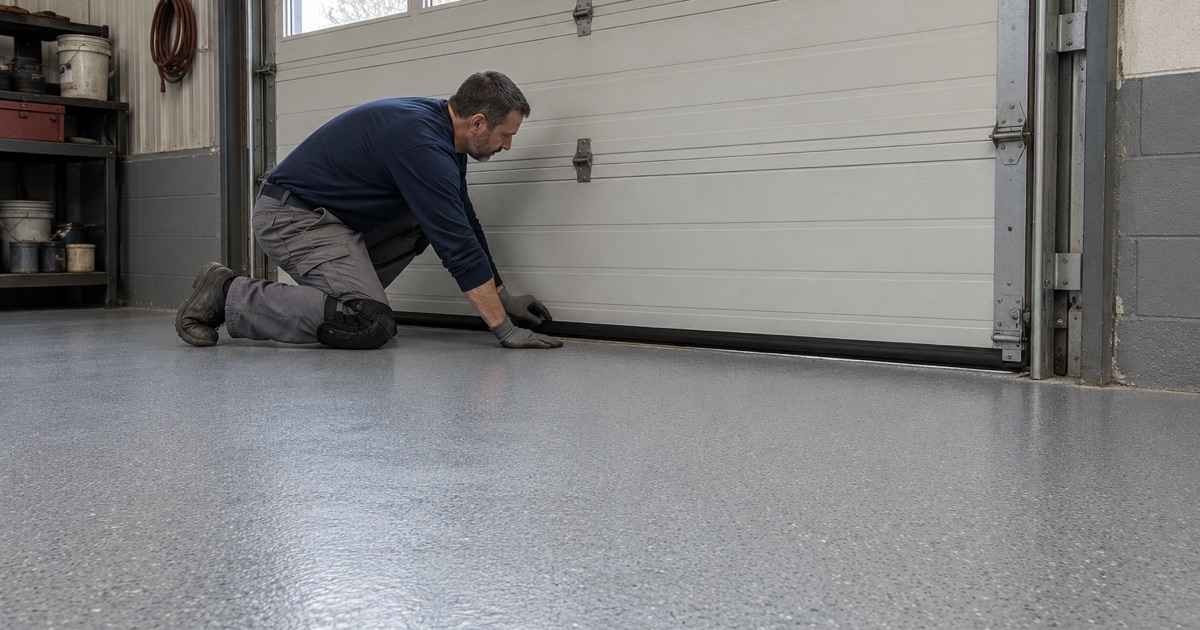
The door line is the band of floor under a closed door, running the full width of the opening. It is where the interior coating ends and the outside slab or apron begins, and it is the one place on a coated floor that a moving part touches every day. Treat it like any other edge and the door tells you about it later.
Coating Build Changes the Floor Plane
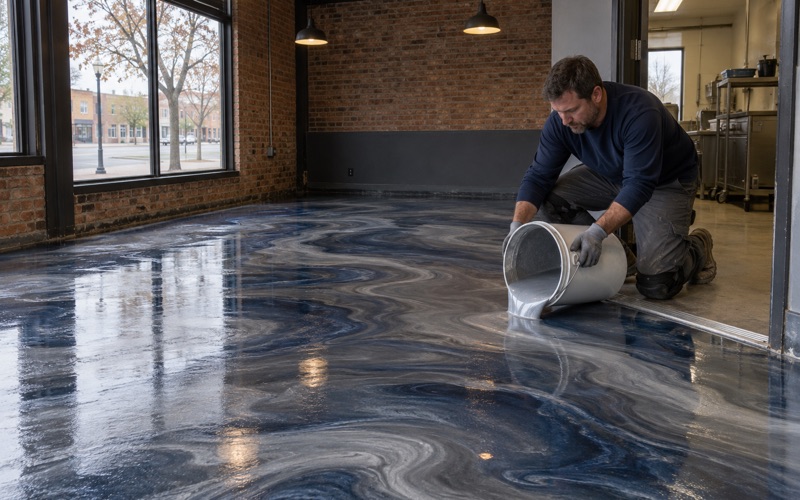
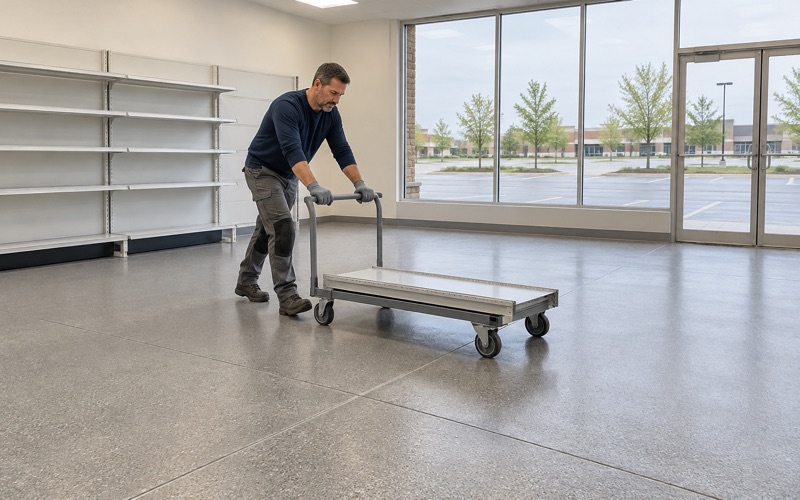
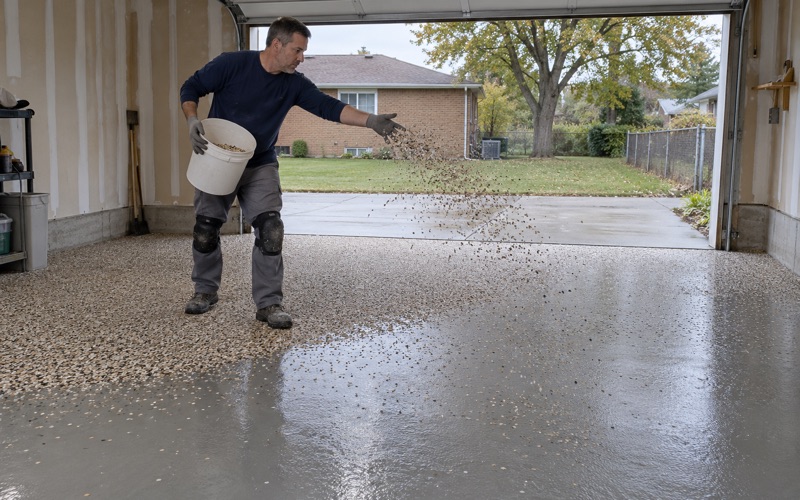
A thin roll-coat adds little height. A full vinyl flake or quartz aggregate broadcast, locked in with a polyaspartic or polyurea topcoat, builds measurable thickness over the bare slab. That new surface is the floor plane the door now closes onto.
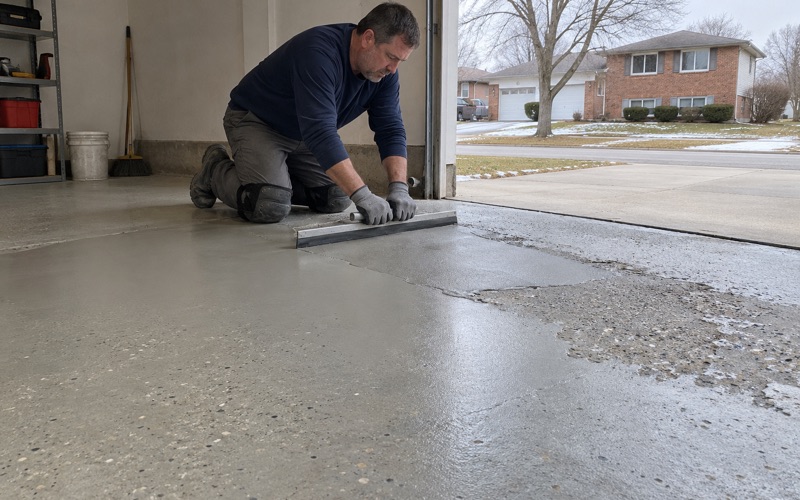
Uneven build is the worse problem. If the coating runs thicker at one jamb than the other, a level door bottom meets a tilted floor, and the seal crushes at one end while light shows under the other. We hold thickness consistent across the full opening and check it before the topcoat goes down.
What the Bottom Seal Sees
A bottom seal works by compressing a set amount against the floor. On bare concrete that compression was set when the door went in; on a coated floor it can be more. A seal-kit installation sheet notes that a thicker bottom seal can make some openers reverse until the opener is adjusted, and a thicker floor pushes the same way from below.
On a sectional door the seal usually slides into a retainer along the bottom panel, and on a rolling steel door it rides on the bottom bar. Either way, the seal was chosen for the gap that existed, and a door company can tell you whether a different profile suits the new floor.
Down Limit and Glued-Down Thresholds
Some shop owners want a glued-down threshold at the door, a rubber or vinyl hump that helps keep water and debris out. On a coated floor the adhesive bonds to the topcoat, so the threshold has to be placed once the coating has cured, and its height adds to whatever the coating already built. Each addition puts the floor a little farther from where the opener’s down limit was set.
Retest the Safety Reversal After Floor Work
Garage door openers are built to reverse when they hit something on the way down. The federal rule behind that, 16 CFR 1211.7, applies to the manufacturers of residential openers. It sets how their safety reversal is tested, not what a homeowner or a coating installer must do.
None of this means a coated garage is unsafe. It means the door was calibrated to a floor that no longer exists, and the check that confirms it still works takes a few minutes with a board on the floor.
What the Federal Test Measures
Under that rule the opener must begin to reverse within 2 seconds of contact with an obstruction. The test places a solid object 1 inch high on the floor, with the bottom edge of the door against the floor when it is fully closed. The floor is part of the test geometry, which is why changing it matters.
A coating does not change the opener. It changes where the floor sits relative to the down limit the opener was taught, and that is the variable the reversal test depends on.
What Opener Manuals Say
Opener manuals make the same point more directly. The Chamberlain 9950D manual lists any repair to or buckling of the garage floor among the events after which the safety reverse system must be tested. The test it describes uses a 1-1/2-inch board, or a 2x4 laid flat, centered under the door, and the door must reverse when it strikes it.
We read a new coating as a repair to the floor in that sense, so when we finish a garage we tell you plainly that the reversal test in your own opener’s manual is due. On a shop door with a commercial operator, the same logic points to whatever check its own documentation sets out.
Finishing the Door Line in a Justice Garage or Shop
Our process at the door is the same whether the floor is a two-car garage or a shop bay behind a rolling steel door. The details change with the door, the system and the season, but the sequence holds.
A Keyed Edge, Not a Feathered One
A coating feathered thin toward the door line is the edge most likely to lift, because it ends in a sliver the seal and tires can catch. We cut a shallow saw kerf across the opening, grind it clean and carry the coating into it, so the system ends at full thickness against a square shoulder.
Where the key sits matters too. Placing it so the closed door lands on coating of even thickness, rather than straddling the edge, gives the seal one consistent surface to meet.
Prep and Moisture at the Opening
The slab at a door opening sees more weather than the middle of the floor, so it gets the same diamond grinding or shot blasting as the rest, aimed at a profile in the ICRI CSP range the system calls for. The moisture testing in our scope includes a reading near the opening, using an ASTM F1869 calcium chloride test or ASTM F2170 in-situ relative humidity probes depending on the slab.
Cure timing follows slab temperature and the dew point spread at the surface, not the calendar. An open door lets outside air across that edge, so in an unheated garage in deep winter we tell you to wait rather than coat a door line that cannot cure properly.
After the Cure: Seal, Down Limit and Reversal
Once the floor is ready for the door, we close it on the finished surface and walk the seal line with you. We point out anything that looks off, such as a gap at one end or a seal that now presses hard. Then we hand over the next step, which is the down limit check and the reversal test your opener’s manual describes.
If the door does not reverse properly, it stays a door matter. That fix belongs to the manual or to a door company, and we would rather you hear that from us on the day than find it later.
Permits and Paperwork in Justice
Illinois licenses no flooring or coatings contractor, so in Justice the binding credential is the village’s own. The Village of Justice Building Department runs a Contractor’s Work Permit Program, and contractors working under a permit must be registered and bonded before any permit issues, with a $10,000 permit bond for all but sewer contractors on a licensing year running February 1 to January 31. We check those rules for each job before it is booked.
Home jobs above the state threshold get a written contract and the Home Repair: Know Your Consumer Rights pamphlet before grinding starts. Grinding dust is captured at the machine by vacuum, never rinsed toward a floor drain or out the open door toward a storm inlet.
- 20+ Years Coating Floors
- Moisture Test in Every Scope
- Free Written Estimates