Tinley Park Epoxy Flooring has spent more than 20 years putting epoxy flooring in Hinsdale homes and commercial buildings, and on an older floor the first thing we look at is not the concrete. It is whatever was glued to the concrete before us. Vinyl tile, sheet goods and the dark adhesive under them can carry a question that has to be answered before a single grinder is plugged in.
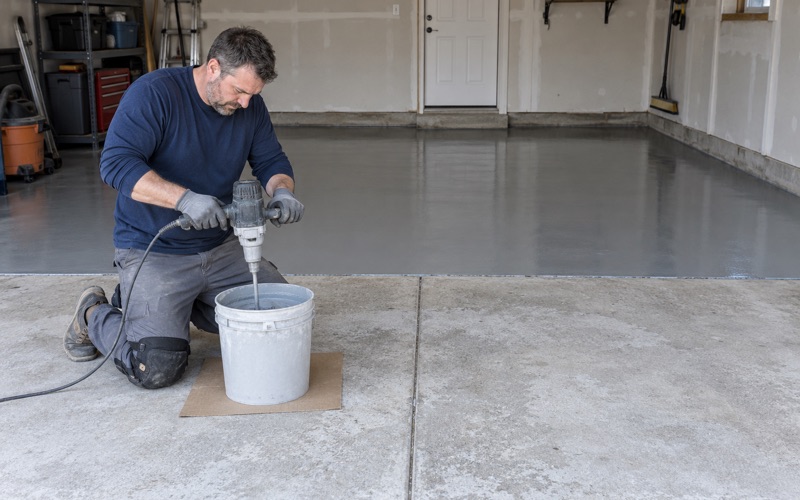
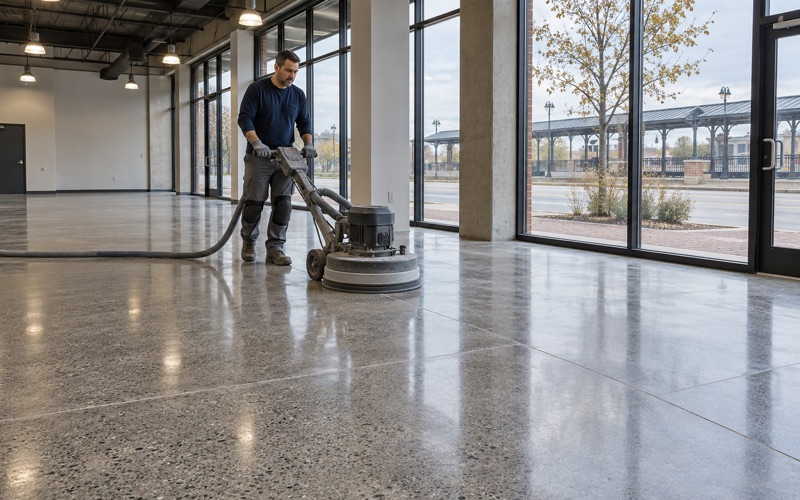
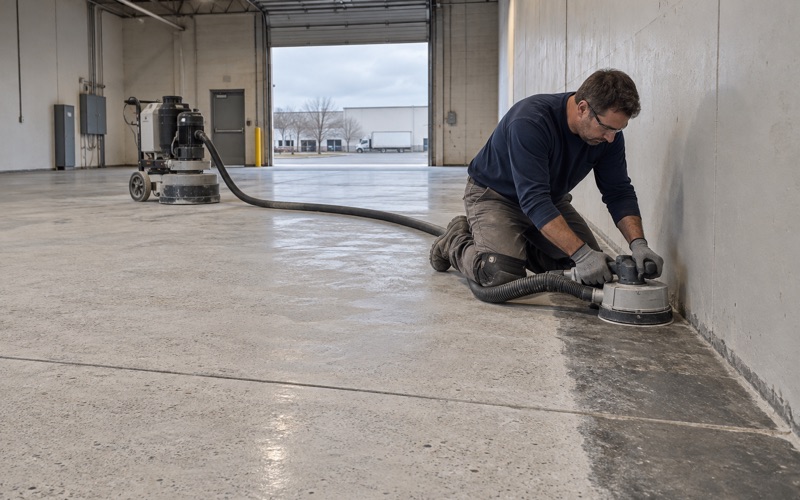
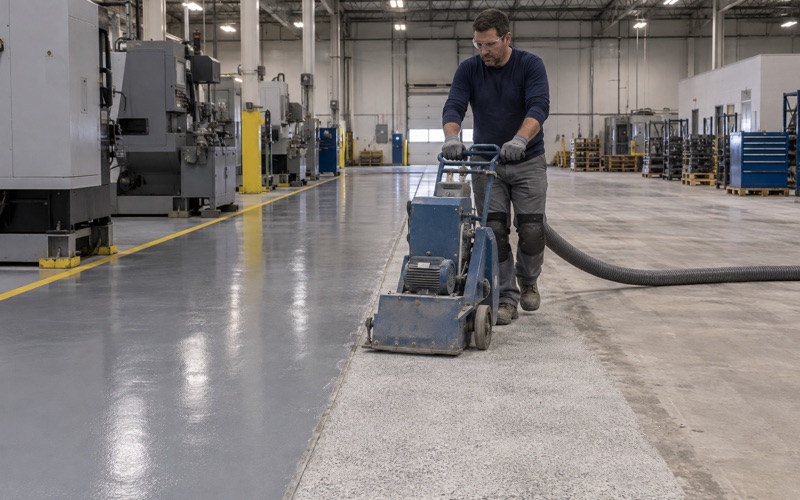
Every coating we install goes down on concrete opened with a diamond grinder or a shot blaster, never an acid etch, so the primer has a real profile to hold. That same grinding is exactly why an old resilient floor has to be identified first. A machine built to cut concrete will just as easily turn tile and adhesive into fine dust.
This page walks through how we handle that sequence, why a federal rule ties it to a date, and what it means for an owner planning a coated floor in an older building or house. The short version is that testing comes first and the coating schedule follows the result.
A Downtown Assisted Living Building Closed for a Full Renovation
In March 2024, Dial Senior Living suspended operations at Magnolia, the assisted living center at 10 N. Washington Street in downtown Hinsdale. The Hinsdalean reported that the 69-unit building was closing for structural, mechanical and aesthetic improvements, including fully remodeled apartments and a modernized HVAC system. Residents received three months’ notice and were relocated.
The building was 47 years old at the time, which places its construction around 1977. In July 2026, village trustees supported a major adjustment to the planned development for an interior renovation and some exterior work, with a vote set for August. We have no part in that project and have not seen its floors, but its timeline makes it a useful illustration.
An Empty Building Changes the Work
Renovating a senior living building while it is empty removes the hardest constraint on floor work: people living above, beside and across the hall. Grinding, ventilation and cure can run on the building’s schedule rather than around meal service and medication rounds. It also means any testing of old flooring can happen before a single trade sets up.
In an occupied building, every room opened for a coating has to be closed off and finished around residents. Empty, the sequence can be planned floor by floor: survey, test, clear what needs clearing, then prepare and coat.
Why the Age of the Building Matters
A building finished around 1977 predates a cutoff in federal workplace rules by a few years. That date does not say what is under the carpet or vinyl in any given room, and nothing published says whether original flooring survives at Magnolia. What it does is set the default assumption a contractor must work under until someone tests.
We raise this with any owner of a building from that era, whether it is a care facility, an office or a house. The useful question is not how old the building is, but whether the original resilient floor and its adhesive are still somewhere under the current finish.
Looking for epoxy-flooring closer to Brookfield? See Brookfield Epoxy-Flooring.
What OSHA Presumes About Floors Installed No Later Than 1980
The federal construction asbestos standard, 29 CFR 1926.1101, carries a line that matters to anyone grinding an old floor. It states that asphalt and vinyl flooring material installed no later than 1980 must be considered asbestos containing. The presumption holds unless the material is determined otherwise under the rule’s own testing provisions.
The date in the rule is about when the material was installed, not when the building was built. A building from the 1950s with flooring added in 1979 falls inside it, and a floor laid in a later remodel may not, so we ask about remodel history as well as the year the structure went up.
Mastic and Backing Count Too
The rule does not stop at the visible tile. Resilient flooring, including its associated mastic and backing, is assumed to be asbestos-containing unless an industrial hygienist determines otherwise. A floor that looks like it was replaced in the 1990s can still have a pre-1980 adhesive layer under it.
That is why we do not judge an old floor by its top layer. Two or three generations of covering are common in older buildings, and the one that matters for grinding is often the lowest.
A Presumption, Not a Finding
It is worth being precise about what this rule says. It is a legal default for how workers must treat the material, not a statement that every old tile contains asbestos. Testing settles it one way or the other, and until it does, the material is handled as if the answer were yes.
For our scope, that distinction is practical. A negative result frees the floor for normal preparation, while a positive or untested result means the removal belongs to someone else before we begin.
Who Signs Off That the Floor Is Clear
The rule names an industrial hygienist as the person who can determine that resilient flooring and its mastic are not asbestos-containing. That determination is the owner’s to arrange, and we ask to see it in writing before our scope begins. A guess from the coating contractor, including us, does not count.
In practice this keeps the paperwork in the right order. The test result goes in the project file, the proposal references it, and the crew that shows up to grind knows exactly what was on the slab and what has already been taken off.
Black Mastic and Old Tile: Test First, Then Lift Wet
Black mastic is the dark, tar-like adhesive that held down many older tile floors, and it is the layer we ask about first. Our diamond grinders and shot blasters exist to remove material and open concrete. Run over an untested adhesive, either one would do exactly what the federal rule is written to prevent.
Testing Before Grinding for a Coating
When we find old tile, sheet goods or black adhesive on a slab we have been asked to coat, we stop the scope there and say so in writing. The owner arranges sampling and testing of the resilient layers, and the coating schedule waits for that answer. We are not an asbestos contractor, and we do not quote around a material nobody has tested.
Our written proposal already maps cracks, spalls and old coatings before a price is final. An unknown flooring layer goes on that same map, with a plain note that the coating date depends on the result.
Wet Methods, No Sanding, No Dry Sweeping
Where flooring presumed to contain asbestos is taken up, the standard spells out how. Flooring and its backing are not sanded, resilient sheeting is cut with wetting, adhesive and backing are scraped wet, and tiles are removed intact where possible. Dry sweeping is not allowed, and cleanup uses a HEPA vacuum with a metal floor tool rather than a brush.
Those methods are the reverse of how a coating installer normally works. That is the reason we keep the two jobs apart: the floor is cleared by the people whose work it is, and only then does our equipment arrive.
When Our Grinding Starts
Once the old flooring is gone, or testing shows it is clear, the slab becomes an ordinary coating job. We grind to a concrete surface profile the primer can grip, collect the dust at the machine with a vacuum, and run a moisture test before the price is final. The proposal then names the product line, the number of coats and the finished thickness.
Clearance does not shorten the cure. Our cure schedules follow slab temperature and dew point rather than the calendar, so a renovation timeline that slipped while flooring was tested does not get made up by rushing a coat. We would rather tell an owner the floor needs another day than hand over one that was walked on too soon.
Pre-1981 Tile in Hinsdale Basements and Kitchens
The same question reaches into houses. Hinsdale has 6,215 housing units, and the census counts 984 built in 1939 or earlier, 819 in the 1960s and 467 in the 1970s. Many of those homes have been remodeled, but a basement or back kitchen can still hold the tile that was put down when the house was new.
Hinsdale is a village in DuPage County with a small portion in Cook County, and permits for most residential and commercial projects run through Village of Hinsdale Community Development as a combination permit. None of that tells anyone what is under an old basement floor, which is why the testing question comes before any of our paperwork.
Basement Floors Under Carpet and Laminate
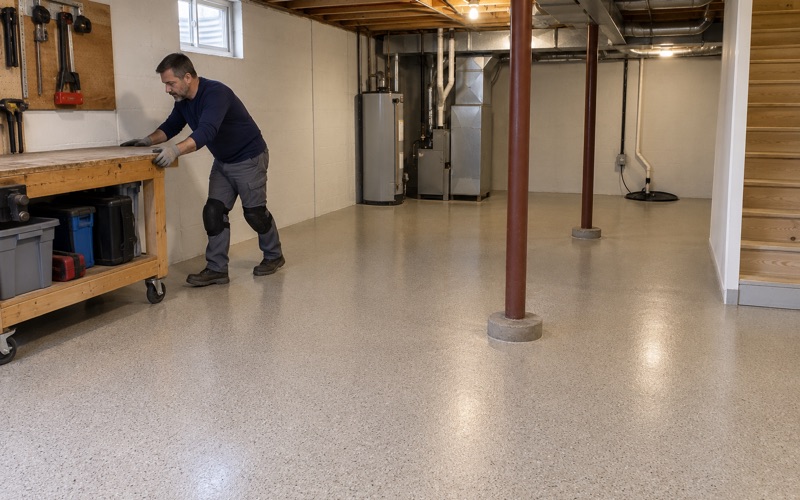
Basements are where old resilient tile tends to survive, often under carpet or a later layer of laminate. When a homeowner asks us to coat a basement slab, we pull back a corner and look before quoting. Old square tiles, a dark adhesive line or a layered floor all go into the written scope as items to test.
A basement slab also has to pass a moisture check, and on a below-grade floor that result can change the system we recommend. Whatever the flooring tests show, the warranty discussion names moisture as the first exclusion before the job is sold.
Kitchens, Laundry Rooms and Utility Spaces
Kitchens and laundry rooms collected sheet vinyl and tile in the same decades. If a homeowner wants a coated floor in a utility room or a converted space, the old covering is tested before it is lifted, and lifting follows the wet methods described above. We plan the coating once the bare slab is confirmed clear.
A kitchen slab that has carried tile for decades often shows patched spots, uneven areas and old cracks once it is bare. Those go on our crack and spall map too, and if the slab needs repair before it should be coated, the proposal says so.
A Written Contract Before Anything Comes Up
Home jobs over the state threshold get a written contract and the Illinois consumer-rights pamphlet before any grinding starts. On an older house, that contract also states plainly that coating work begins only after the old flooring question is answered. Nobody should learn about a testing delay after the crew has arrived.
For homeowners in Hinsdale, the order is simple: identify the layers, test what the rule presumes, clear the slab properly, and then talk about color, flake and gloss. Done in that order, the floor that goes down is one we can stand behind.
- 20+ Years Coating Floors
- Moisture Test in Every Scope
- Free Written Estimates