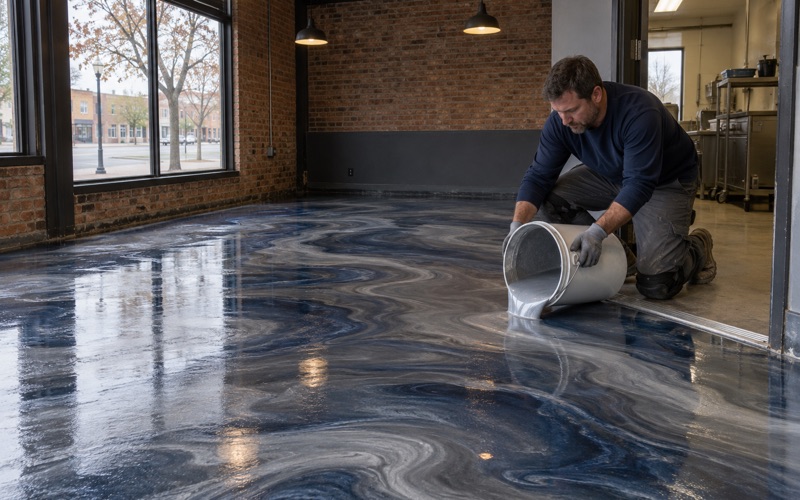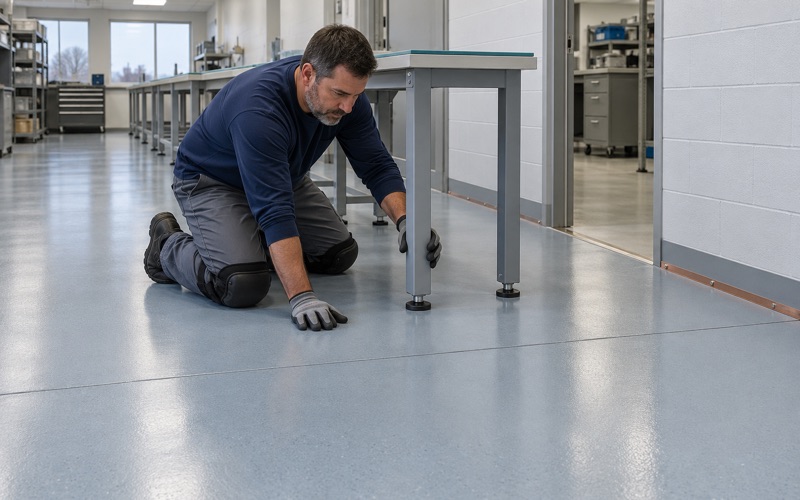
Tinley Park Epoxy Flooring has spent more than 20 years installing epoxy flooring in Hickory Hills and the surrounding suburbs, and a surprising share of that work comes down to one question: what is living in the gaps of the floor you have now? Open joints, hairline cracks and a raw seam where the slab meets the wall are where crumbs, grease and water collect. A seamless resin floor closes those gaps instead of working around them.
We coat kitchens, cafeterias, mop rooms, garages and basements, and every job starts the same way. We map the cracks, spalls and old coatings before we price anything, and we tell you plainly when a slab needs repair or replacement before resin should go down. A moisture test is written into the scope before the number is final.
This page looks at a narrower subject than most flooring pages: how a coated floor fits into integrated pest management, the approach Illinois health officials recommend for schools. A floor coating is not pest control, and we never sell it as such. What it can do is take away the cracks, open drains and damp seams that pests use as shelter, which is the part of the problem a flooring contractor actually owns.
Conrady Junior High and the State’s School Pest Guideline
Conrady Junior High School sits at 7950 West 97th Street, inside Hickory Hills city limits in Palos Township, and belongs to North Palos School District 117. The school’s own page lists the cafeteria stage as the venue for the fall play, and city council minutes put the district’s Back to School Bash at Conrady on August 6, 2026. It is a building where one room has to serve lunch, seat an audience and handle a crowd.
We have no relationship with Conrady or the district, and we have not seen the school’s floors. We use it as an example because it is the kind of building the state’s pest guidance was written for, and because the questions that guidance raises apply to every food room and wet room in town.
A Room That Serves Lunch, Then Hosts a Play
A cafeteria that doubles as a performance space carries two loads in one day. Food is served, spilled and mopped, and then chairs, risers and families fill the same floor in the evening. Any crack or open joint in that floor gets crumbs pushed into it by day and mop water by night.
That combination is exactly what the Illinois Department of Public Health describes when it explains why pests settle in a building. Its school guideline says pests ‘seek habitats that provide basic needs of moisture, food and shelter,’ and a worn cafeteria floor can offer all three in a single gap.
What the IDPH Guideline Says About Floors
In October 2009 IDPH published Developing and Implementing an Integrated Pest Management Program in Schools and Day Care Centers. For food preparation and serving areas it tells staff to ‘Seal cracks and crevices that allow pests access to harborage in wall voids.’ It also asks that floor drains be cleaned routinely, that covers be secured and in good condition, that water be kept in active drains, and that staff ‘Permanently seal unused drains.’
Illinois law, through 225 ILCS 235/10.2, encourages each school and day care center to adopt an integrated pest management program built on those guidelines. The guideline describes the approach partly as adding physical barriers and modifying habitats that attract or harbor pests. A floor is one of the largest habitats in any school, which is why we read that document as a floor specification.
Dry Rooms and Mop Closets
For rooms with extensive plumbing, the same guideline is blunt: ‘Do not permit water to stand; keep areas dry.’ For mop closets it asks that mops hang vertically on a rack above a floor drain and that mop buckets be dried. Each instruction assumes a floor that sheds water toward the drain and has no low spots or open seams where it can sit.
Looking for epoxy-flooring closer to Lemont? See Lemont Epoxy-Flooring.
Moisture, Food and Shelter in a Cracked Floor
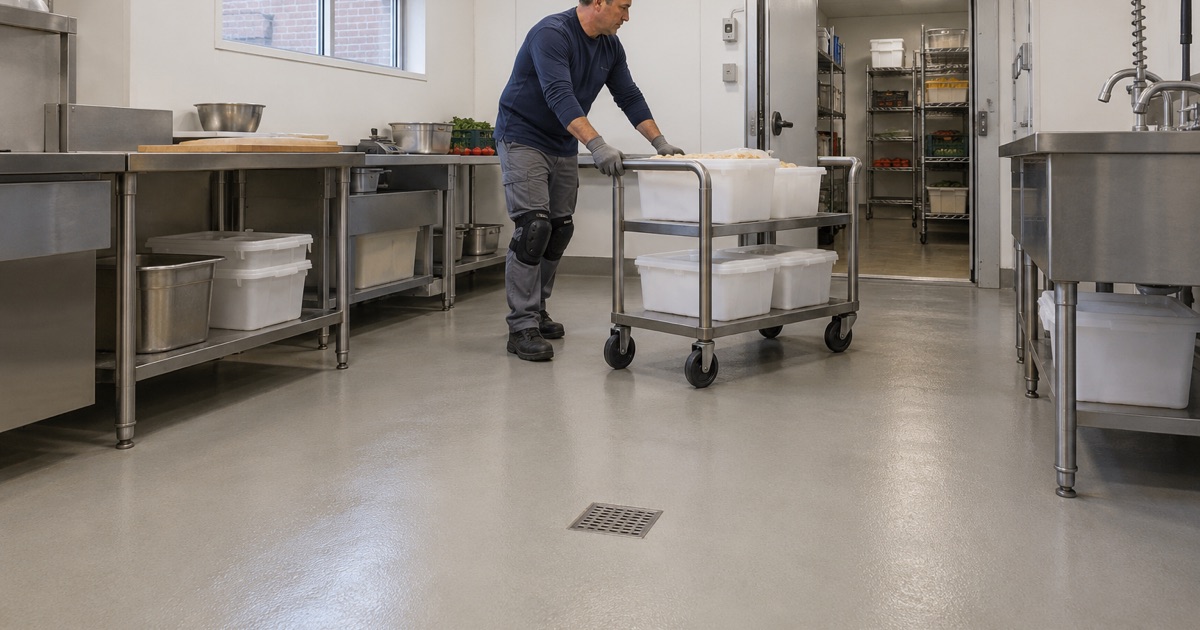
A bare or failing concrete floor rarely looks like a pest problem. It looks like wear: a crack that opened along a control joint, a spall near a doorway, a strip of old coating peeling back from the wall. Each defect is a sheltered space that holds crumbs and stays damp after mopping, and it sits low enough that routine cleaning passes right over it.
Cracks and Open Joints
Concrete shrinks as it cures and moves with temperature, so almost every slab carries cracks and sawcut joints. Left open, a joint fills with grease and grit that no mop head reaches. In a kitchen or along a serving line, that strip of debris becomes a food source running the length of the room.
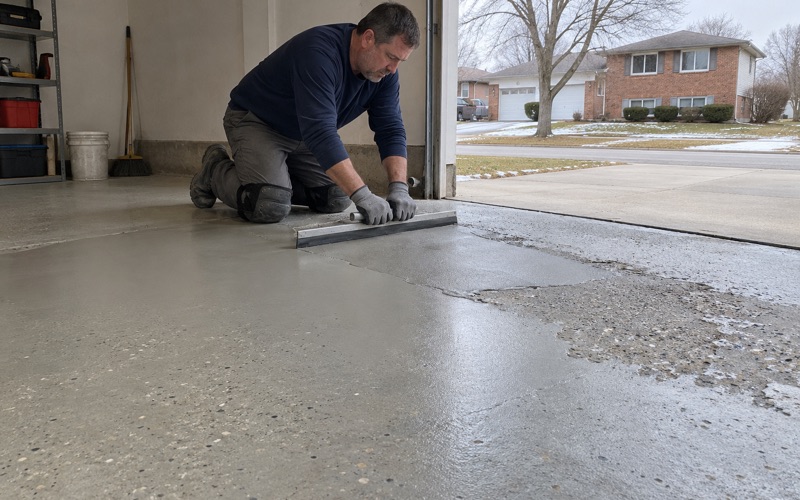
We map every crack and joint before we bid, noting which are still moving and which are dormant. Dormant cracks are filled flush with a rigid repair material, while working joints get a flexible filler so the coating above them does not simply split again in the same place.
The Floor-Wall Seam
The joint where a slab meets a wall is the gap the guideline points at most directly. It leads toward wall voids, it collects water from every mopping and it is nearly impossible to clean with a flat mop. A floor that stops short of the wall leaves that seam open no matter how good the rest of the coating is.
A coved base carries the resin up the wall in a smooth radius, so floor and wall become one continuous surface. The FDA Food Code calls for coved floor and wall junctures in food establishments under 6-201.13, and the same detail closes the kind of harborage the IDPH guideline describes.
Why Children Raise the Stakes
The IDPH document notes that children ‘spend more time on or near the ground than adults.’ That is part of why the guideline leans on sanitation and physical barriers before chemical treatment. Taking away the places pests hide gives a school one less reason to reach for another application in a room full of students.
Seamless, Crack-Filled and Coved: How We Build It
Once the defects are mapped, the build follows a sequence that matters as much as the product. Skipping a step does not just shorten the life of the floor; it leaves fresh gaps for the same problem to return to.
Preparation and Moisture Testing
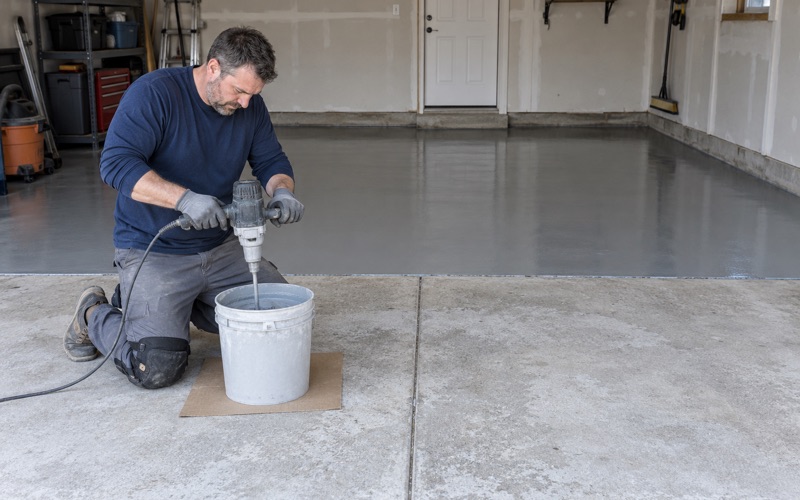
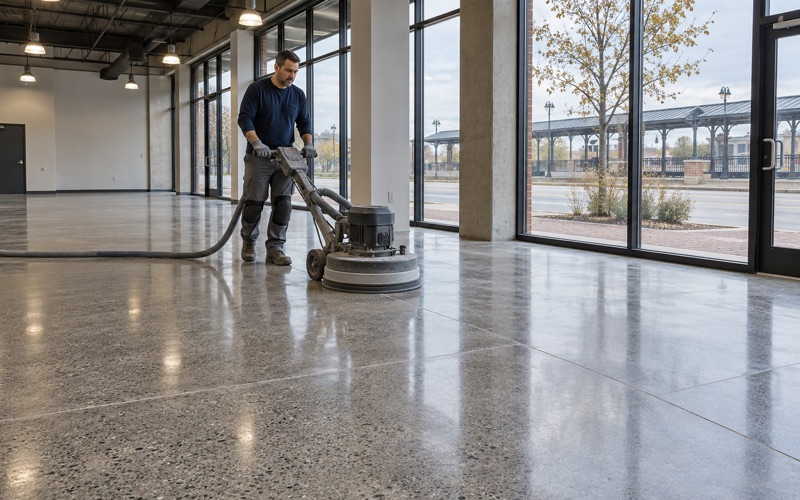
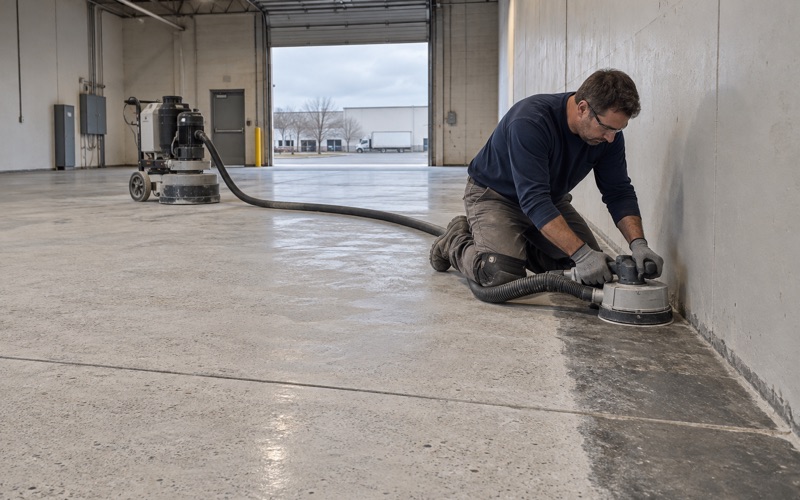
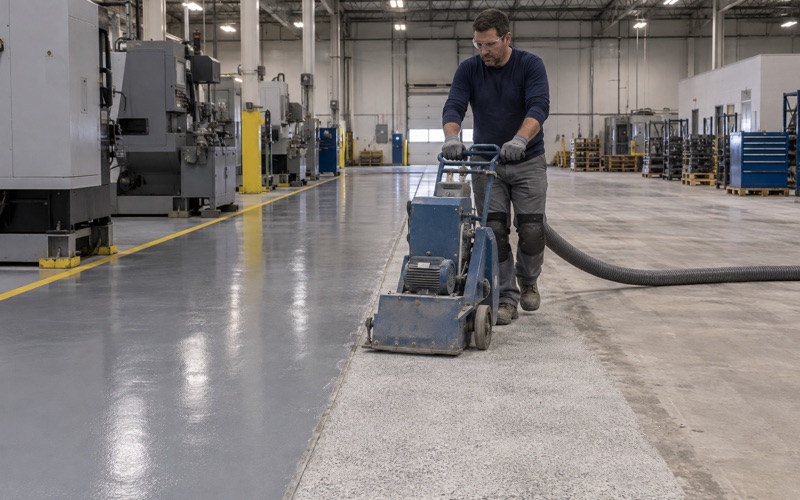
Every slab is opened mechanically with diamond grinding or shot blasting to an ICRI concrete surface profile the coating can grip; we never acid etch. Dust is captured at the machine by a vacuum rather than rinsed toward a floor drain. Before the price is final, the slab is tested for moisture with ASTM F2170 in-situ relative humidity probes or ASTM F1869 calcium chloride testing, depending on the job.
Moisture matters twice over in a wet room. A slab pushing vapor up from below will blister a coating and reopen the very gaps the work was meant to close. Where readings run high, a moisture-mitigation primer goes down first, and we explain before the job is sold that moisture is the first thing a coating warranty excludes.
Drains, Slopes and the Body Coat
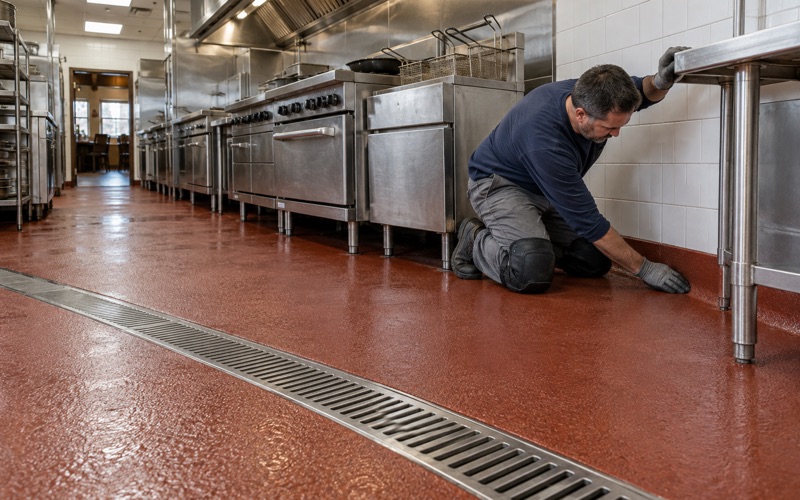
Drains are where a seamless floor most often fails. We carry the resin into the drain body so there is no lip for water to sit behind, and when an owner decides to retire an unused drain, it is permanently sealed before the coating covers it, coordinated with the owner’s plumber where the line needs capping. Low spots are corrected during preparation so water runs to the active drain instead of pooling.
In kitchens and serving areas we usually specify urethane cement, which tolerates hot water, fats and thermal shock better than a standard epoxy. In mop rooms and storage spaces, a 100% solids epoxy body coat under a polyaspartic or polyurea topcoat is common. The written proposal names the product line, the number of coats and the finished thickness, so the installed floor can be checked against it.
Texture, Cure and Scheduling
A floor that is wet through the day needs grip, and we specify slip resistance by the quartz aggregate broadcast and the topcoat that locks it in, not by a promise. Cure schedules follow slab temperature and the dew point spread at the surface, which is why we never rush a topcoat onto a cold slab.
Food and assembly rooms rarely can close for a week. We phase the work around operating hours and use overnight and weekend windows when a space has to stay open, finishing one zone before starting the next.
Cracks, Unused Drains and Damp Corners at Home
The same logic applies to houses. Census figures show that more than half of the housing in Hickory Hills was built between 1960 and 1979, and a basement or garage slab from that era generally predates under-slab vapor retarder practice. Those floors have had decades to crack, settle and hold moisture at the edges.
Basement Floors
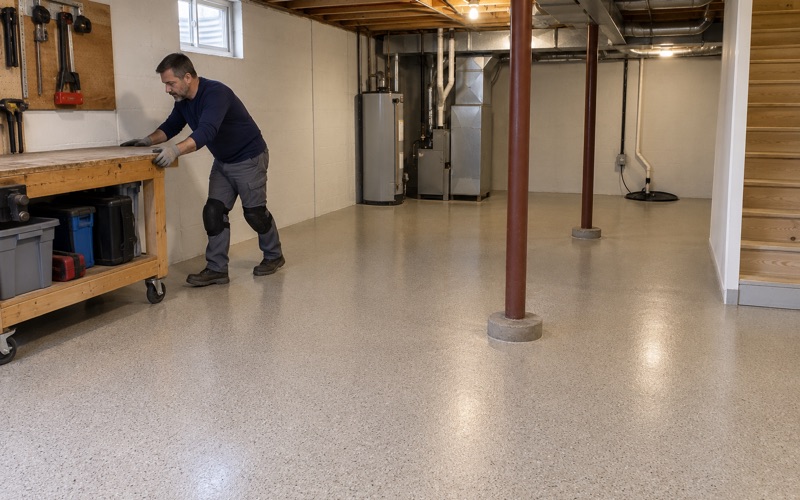
A basement floor drain that no longer carries water can dry out and leave an open path from below, and a crack along the foundation wall stays damp and dark. Before coating, we fill those cracks, keep any active drain clear with water in it, and test the slab for moisture. A floor coating does not reduce radon, and we never present it that way; in Illinois that is licensed mitigation work.
Older basements often show efflorescence, the white mineral crust left when water moves through concrete and evaporates. We treat it as a reading, not a cosmetic issue, because it tells us where moisture is reaching the surface and where a moisture-mitigation primer may be needed.
Garage Floors
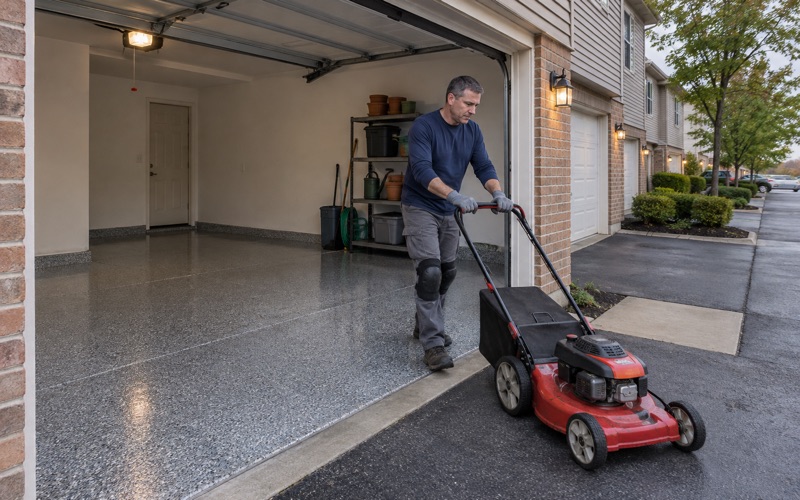
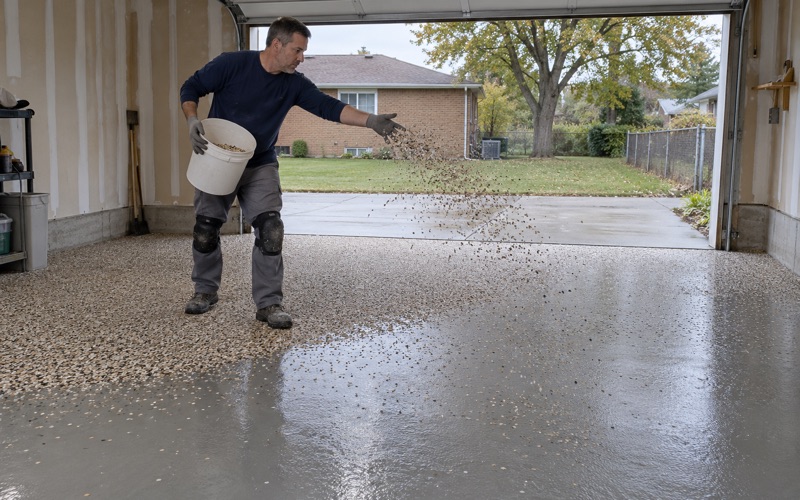
Garage slabs here take rock salt and brine off tires every winter, and the salt works into cracks and the gap along the foundation. A system with a full vinyl flake broadcast and a polyaspartic topcoat seals the surface and resists hot tire pickup. In an unheated garage in deep winter, we will tell you to wait for warmer slab temperatures rather than coat on a calendar date.
City License and Paperwork
Illinois licenses no general or flooring contractor, so the City of Hickory Hills contractor license is the one that binds us. It runs January 1 to December 31 for $100 a year, with no half-year licenses, and the application needs a certificate of insurance naming the city; the owner also gets a copy before work begins. The city requires no bond, and contractors haul their own debris.
Home jobs above the state threshold get a written contract and the Home Repair: Know Your Consumer Rights pamphlet before any grinding starts. We choose products within the Illinois VOC limits for floor coatings, which bind whoever applies them, not only the manufacturer.
- 20+ Years Coating Floors
- Moisture Test in Every Scope
- Free Written Estimates