Tinley Park Epoxy Flooring has handled epoxy flooring in Harvey for more than 20 years, and the work that decides most of our warehouse and shop jobs here happens before any resin is opened. We walk the slab, map what it is doing, and write down what it can and cannot carry under a coating. Only then do we put a price on paper.
That order matters wherever older industrial buildings change hands. A floor coating is a thin wear and chemical layer bonded to concrete, and it inherits every flaw underneath. When a buyer skips the survey, the coating quote looks cheap and the real costs arrive later as cracks reflecting through, joints breaking open and soft spots under heavy loads.
This page walks through how we survey a reused building’s floor, what we look for under racking and heavy storage, and the questions worth asking before you buy or lease. It also covers how we open and test a slab once the survey says it is ready, so the proposal you sign matches the floor you get.
A Furniture Warehouse on Halsted Street Becomes a Metra Storehouse
Harvey is a city and south suburb of Chicago in Cook County, built as an industrial town, and plenty of its larger buildings have outlived their first owners. One of the best-documented examples sits at 17010 S. Halsted Street, just northwest of the Interstate 80 interchange. We had no part in that project, but its public record is a useful lesson for anyone eyeing an older Harvey building.
From Showroom to Staging Yard
The Chicago Tribune reported in September 2023 that the building once housed a Wickes Furniture warehouse and showroom, with 153,934 square feet under roof on 455,773 square feet of property. Metra, the region’s commuter railroad, bought it to store and stage materials for its capital projects and equipment overhauls. A furniture floor and a rail-parts floor are asked to do very different jobs.
Furniture storage is bulky but relatively light for its footprint, moved by hand trucks and the occasional lift. Rail materials, overhaul components and racked stock put far more weight on far smaller areas. The building stayed the same while the demands on its concrete changed, and a change of use is exactly when a floor deserves a fresh look.
Bought As Is
ABC7 reported that Metra approved the purchase on May 20, 2020 for nearly $6.8 million and later told its board that $17.9 million had been spent on the project, including replacing the roof, building office space and installing storage racks. A July 2024 follow-up said costs rose partly because the property was bought as is, without anticipating how many repairs were necessary.
Metra’s own June 2024 oversight report noted that no inspections or evaluations had been performed, so the cost of improvements to meet user needs, local codes and a state of good repair was not known. The City of Harvey also required rezoning for warehouse use, and Light Manufacturing zoning was requested in April 2024.
What the Record Does Not Say
What was done to that slab, if anything, is not in the reporting we have read, and we make no claim about its condition. The lesson we take is about sequence. A buyer who learns about a building’s problems after closing pays for every one of them, and the floor is one of the easiest systems to check beforehand.
Looking for epoxy-flooring closer to Worth? See Epoxy-Flooring in Worth.
Survey the Slab Before You Price the Coating
A slab survey is the first line of every scope we write for a reused commercial building in Harvey. It takes hours, not days, and it tells us whether the floor is a coating job, a repair-then-coat job, or a slab that should not be coated at all. Pricing a coating before that walk is guessing, and guesses tend to land on the low side.
Cracks and Joints, Mapped to Scale
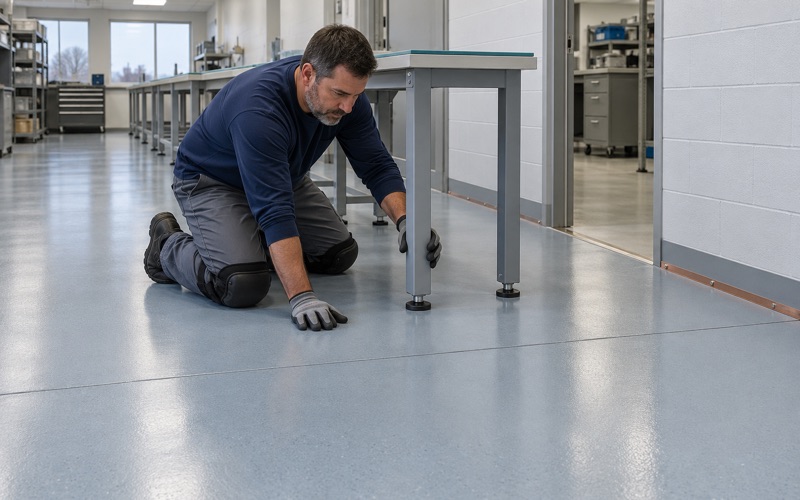
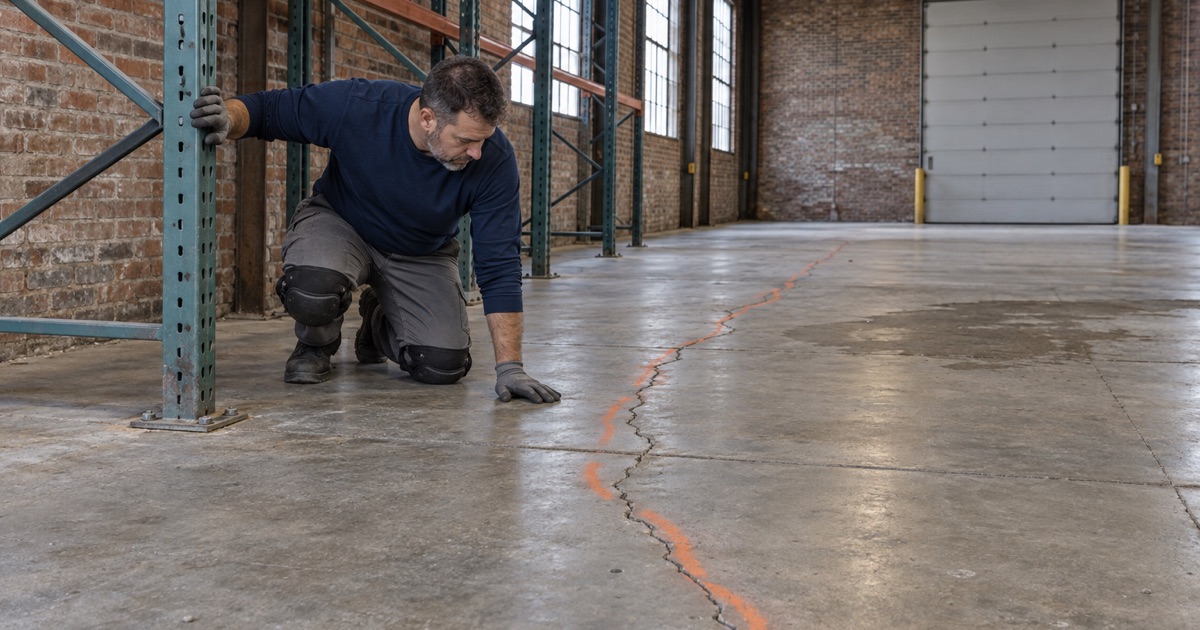
We draw the floor and mark every saw-cut joint, cold joint, shrinkage crack, spall and patch on it. Each crack gets a note on width, whether the two sides sit flush, and whether it looks active or settled. A coating follows every one of those lines, so the map decides where we route and fill, where we leave a joint open, and where we stop and recommend repair.
Joints that have spalled at the edges from years of wheel traffic are common in older warehouses. They need rebuilding with a semi-rigid filler or repair mortar before any coating, or the new floor chips along the same lines within months. The survey prices that work up front instead of discovering it with a grinder running.
Moisture and the Marks Old Water Leaves
Moisture testing is written into our scope before the price is final. Depending on the floor, that means an ASTM D4263 plastic sheet test as a first read, ASTM F1869 calcium chloride kits, or ASTM F2170 in-situ relative humidity probes set into the slab. High readings change the system, often to a moisture-mitigation primer, and they change the warranty discussion.
In a building with a replaced roof, we also look for what the old one left behind. Tide lines, efflorescence, stained patches and soft or dusting concrete under former leak points tell us where water sat on the slab and for how long. Those zones get extra testing and sometimes extra grinding, because contamination soaked into concrete can stop a coating from bonding.
Old Coatings and What Is Stuck to the Surface
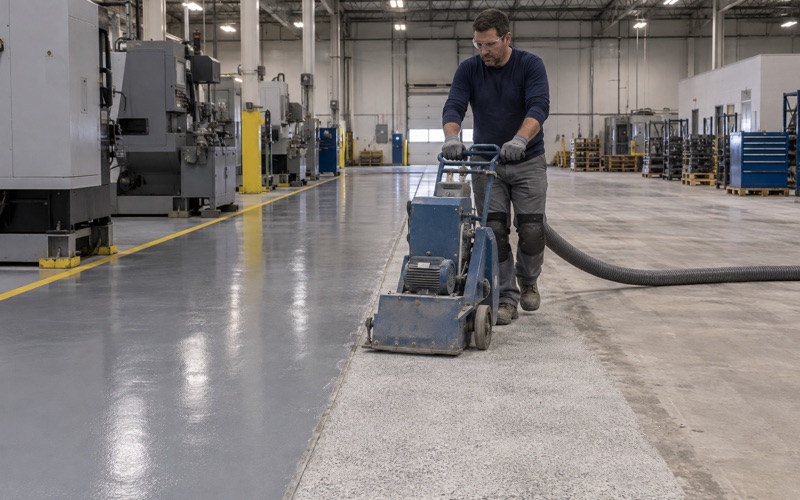
Reused buildings rarely arrive bare. We identify prior paint, sealers, adhesives and curing compounds, and we test how well they hold, because a new coating is only as anchored as the layer beneath it. Most of the time the answer is to remove them with diamond grinding or shot blasting down to sound concrete, which also cuts the ICRI CSP profile the new system needs.
Racks, Heavy Storage and the Thickness Under Them
Storage racks concentrate weight onto small base plates, and forklifts and pallet jacks roll heavy wheel loads across the same aisles thousands of times. Neither of those is something a floor coating can help the concrete carry. An epoxy or urethane cement system adds wear, chemical and cleaning performance at the surface, but it adds no load capacity and does not repair a slab that is too thin.
Finding Out What Is Actually There
Before a coating is priced for a rack or heavy-storage zone, we want to know the slab thickness in that zone. Original drawings are the best source when they exist; when they do not, cores taken at representative points give a real number. In a building that has changed owners several times, assuming the thickness is the same everywhere is a common and expensive mistake.
Thickness alone does not settle capacity, and we do not pretend it does. Reinforcement, subgrade and concrete strength all matter, and judging whether a slab carries a given rack load is a question for a structural engineer, not a coatings contractor. What we provide is the map and the measurements that make that engineer’s job faster.
Anchors, Base Plates and Coating Order
Rack anchors drill through whatever coating is on the floor, so the order of work matters. In most warehouses we coat first and install racks after full cure, which keeps the system continuous under the base plates. Where racks are already standing, we plan around them and detail the edges so the coating does not peel back from every plate.
Striped aisles and marked rack bays go down after the topcoat, in colors the operator chooses, so staff and drivers read the floor at a glance. Those lines are part of the proposal, not an afterthought added once the coating has cured.
Aisles That Take the Wheel Traffic
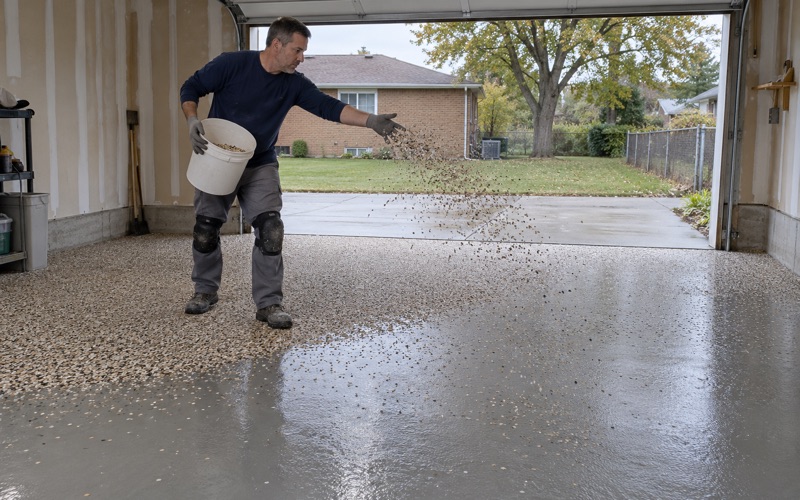
Forklift aisles see the hardest wear on any warehouse floor, and hard polyurethane wheels pick out any weakness in a joint. We specify thicker systems in those lanes, often 100% solids epoxy or urethane cement, and use a quartz aggregate broadcast where grip matters. Slip resistance is set by the broadcast and topcoat we name, not by a promise in a brochure.
Buying or Leasing an Older Harvey Building: Questions for the Floor
Harvey still has a working industrial vacancy market. A 50,102-square-foot warehouse and distribution building at 16701 Center Street, zoned light manufacturing with 14 dock-high doors, is listed for sale or lease across from CN’s rail yard. Anyone weighing a building like that is weighing its floor too, whether the listing mentions it or not.
Ask Before You Sign
We suggest every buyer or tenant ask a few plain questions before committing: what the last tenant stored and where, whether the roof or drains have leaked, and whether slab drawings or core results exist. It also helps to know if the floor was ever coated or sealed, and with what. Those answers shape the survey and often the price.
If the building is changing use, as the Halsted Street warehouse did, the answers matter even more. A floor that served light storage well can be the wrong floor for heavy racking or a parts operation. Finding that out in a due-diligence walk costs far less than finding it after the lease is signed.
Permits, Registration and the City
The City of Harvey requires a contractor to be registered and licensed with the city before starting work, and Illinois has no state flooring license, so we confirm Harvey’s own requirements before a job is booked. The city lists concrete pouring among work that needs a permit. A coating over existing concrete is not on that list as quoted, so we confirm with Harvey Planning, Building and Inspectional Services.
Permits are applied for in person at the Planning Department at 15320 Broadway Avenue, and the city asks owners to allow 7 to 10 days. A building permit is also required for construction or rehab work on transferred property, which catches many as-is purchases. We build that lead time into the schedule rather than discovering it on start day.
What Our Proposal Puts in Writing
Once the survey is done, the proposal names the product line, the number of coats and the finished thickness, so the floor can be checked against the quote. It lists the repairs the survey found, and it says plainly when a section needs patching or replacement before coating. What the warranty leaves out is explained before you sign, and moisture is the first exclusion on that list.
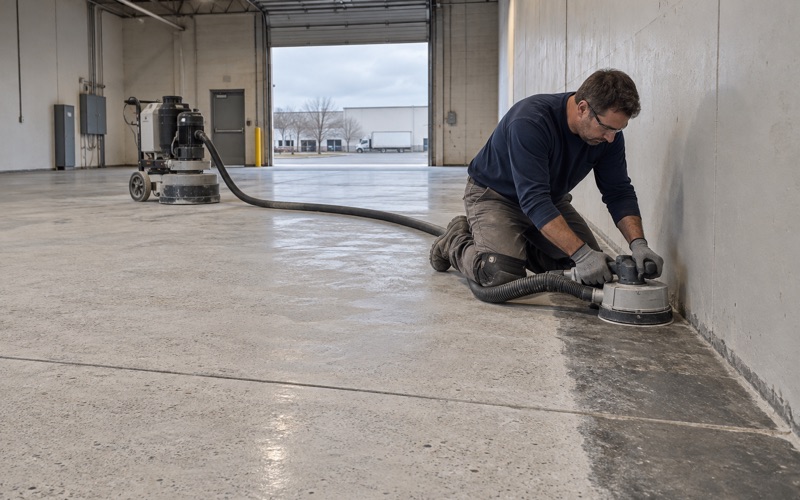
Grinding dust is captured at the machine with a vacuum rather than washed toward a floor drain. Products are chosen within the Illinois VOC limits for floor and industrial coatings, and cure schedules follow slab temperature and dew point rather than the calendar. Where a building cannot close, we phase the work around operating hours with overnight and weekend windows.
- 20+ Years Coating Floors
- Moisture Test in Every Scope
- Free Written Estimates