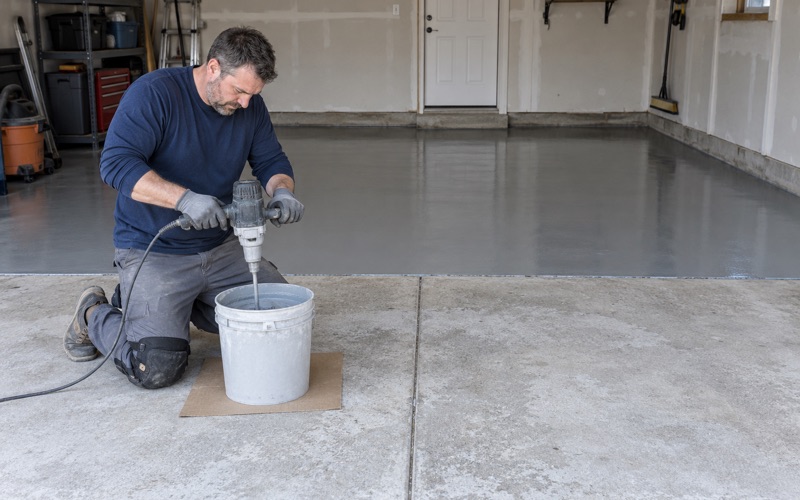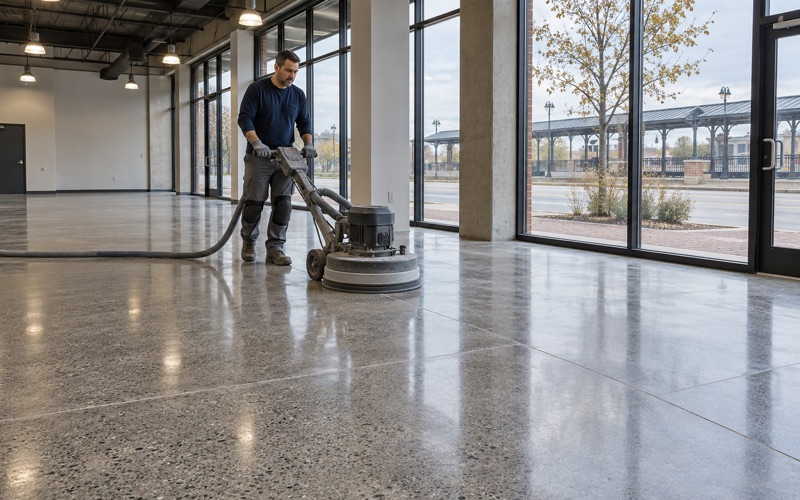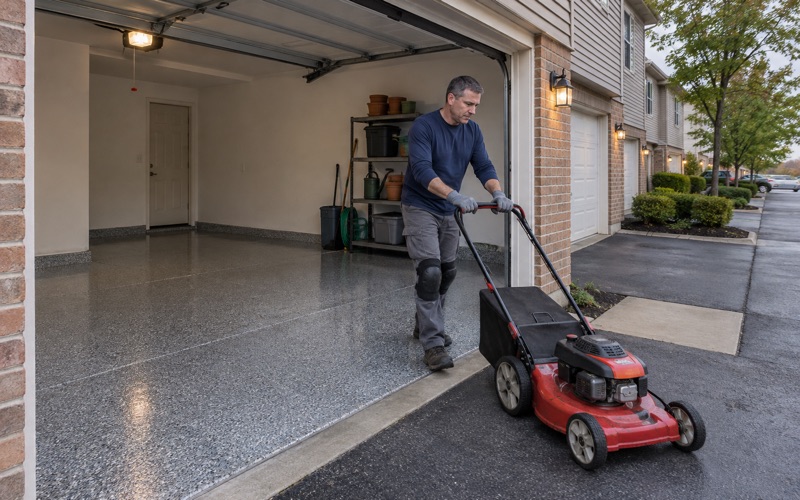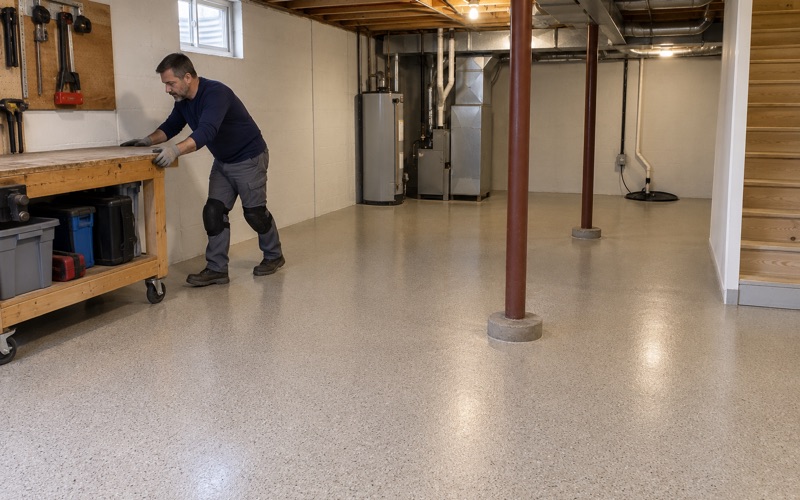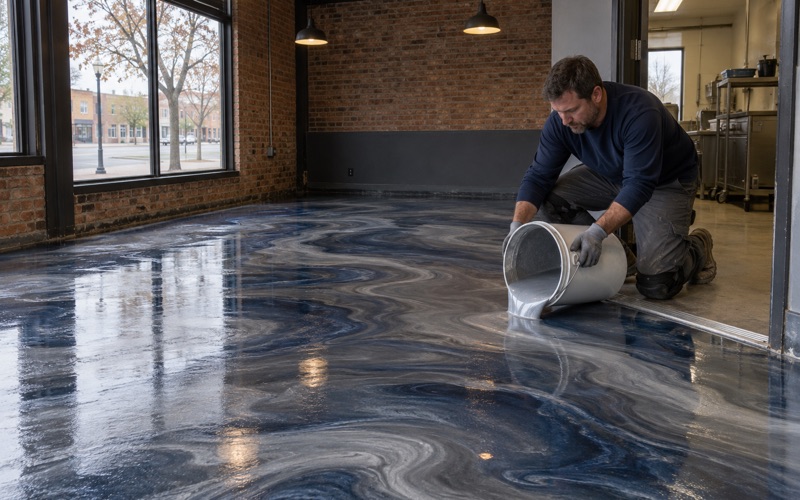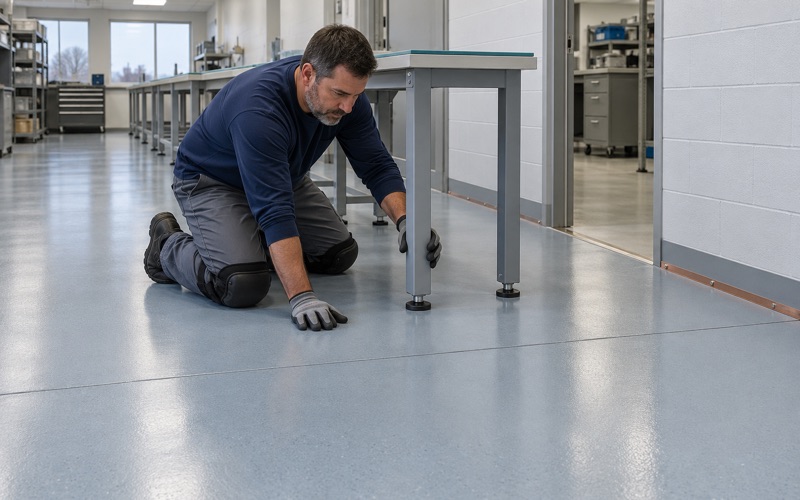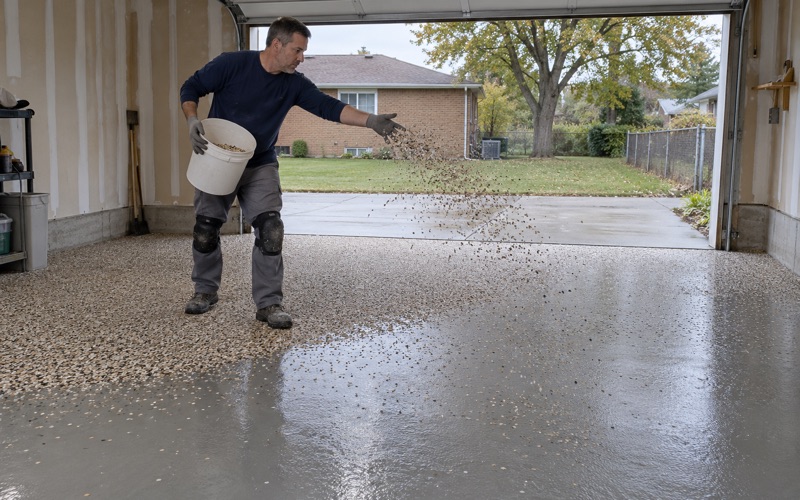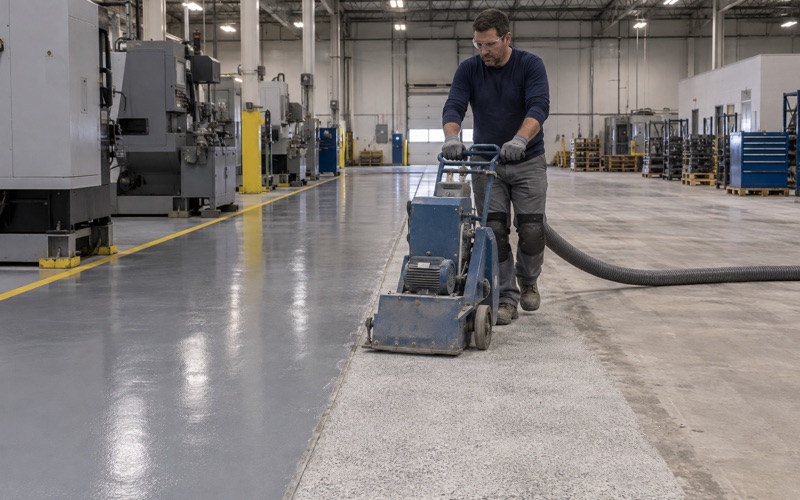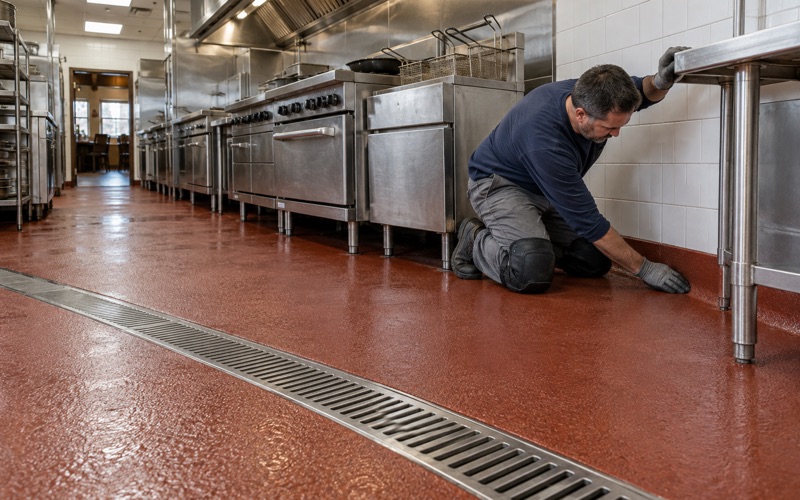
Tinley Park Epoxy Flooring has spent more than 20 years on epoxy flooring in Griffith and across the region, and on this side of the state line we start most conversations with a question about light. What do you need to see on this floor once it is finished? For a hangar, a maintenance bay or a home workshop, the answer shapes the color, the gloss and the broadcast as much as the resin does.
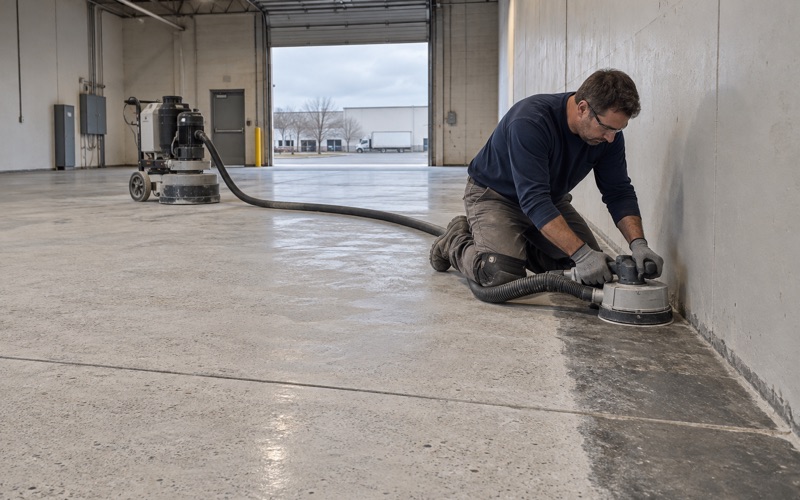
The coating itself still has to hold, so the work begins below the surface. We open every slab with a diamond grinder or a shot blaster rather than an acid etch, map cracks, spalls and old coatings before pricing, and put a moisture test into the written scope. If a slab needs repair or replacement before it should be coated, we say so then.
Our proposal names the product line, the coat count and the finished thickness, so you can check the floor against the quote. It also spells out what the warranty does not cover before you sign, and moisture is the first exclusion on that list. The sections below cover why light floors matter around aircraft and how that thinking carries into a Griffith garage.
A Working Airport on East Main Street

Griffith is a town in Lake County, Indiana, part of the Chicago metropolitan area, with a population of 16,420 in 2020. It also keeps a working airfield inside its limits. The Griffith-Merrillville Airport sits at the east end of Main Street, and its manager’s address, 1705 E. Main St., geocodes inside the town even though FAA data describe the field as 2 miles east of Griffith.
Hangars, tiedowns and major repair
FAA information effective October 1, 2026 lists hangars and tiedowns, 100LL, Jet-A and UL94 fuel, and major airframe and powerplant service on the field. The Gary/Chicago International Airport Authority has owned it since buying it in December 2023. That makes the airport a place where aircraft are inspected, opened up and put back together, not only parked.
We want to be plain about our relationship to it: there is none. We have not coated a hangar at the field, we have not seen its floors, and no FAA or aviation approval exists for a floor coating or its installer. What the airport offers this page is a useful lens on what a light floor does.
Light thrown up under the wing
Hangar floor coatings are marketed in light colors and high gloss for a practical reason. Overhead fixtures light the top of a wing well and leave the underside, the gear bays and the belly in shadow. A bright, reflective floor bounces part of that light back up, which is where a mechanic lying on a creeper is actually looking.
Sherwin-Williams, for one, markets reflective hangar floors for illumination beneath aircraft. Those are vendor claims rather than independent test data, and we do not put a percentage on the gain. What we can say is that a white or pale gray floor reads brighter than a dark one under the same lamps, and a dim bay is a harder place to work.
Looking for epoxy-flooring closer to Country Club Hills? See Epoxy-Flooring in Country Club Hills.
What a Light-Reflective Floor Lets You See
Light is only half of it. The other half is contrast: a floor that is pale and smooth makes small, dark or wet things stand out, and in a maintenance space those small things matter.
Dropped hardware before it becomes damage
A screw, a nut, a length of safety wire or a cotter pin that falls during an inspection can end up where it should not be. Around aircraft that loose part is called foreign-object debris, and finding it on the floor is far easier than finding it later in an engine intake or a control linkage.
One coatings contractor described a hangar job where a gray epoxy floor left work areas dim and a dropped screw or nut hard to find. The fix was a white-pigmented polyaspartic topcoat over a white quartz broadcast, chosen for reflectivity. That is one trade-press account, not a study, but the reasoning holds: a small dark part shows best against a bright field.
A fresh leak you can read
Trade press makes the same point about fluids: a smooth, bright surface shows a leak sooner. A drop of oil, fuel or hydraulic fluid under a parked aircraft is a maintenance clue, and on a light floor it shows up as a dark spot or a sheen the next morning. On a dark or stained floor, the same drip can go unnoticed.
This is about seeing a leak, not about a floor shrugging one off. Resistance to fuel and other fluids is a line on the product data sheet, and color does nothing for it. We pick the color for visibility and the chemistry for exposure, and we keep those two decisions separate on the proposal.
Smooth enough to sweep, textured enough to stand on
A floor that hides nothing still has to be safe underfoot when it is wet. We specify slip resistance by the broadcast and topcoat we use, such as a fine quartz aggregate locked under a clear polyaspartic, rather than promising it as a slogan. The finer the texture, the easier a dropped washer is to sweep up and the less it hides.
Smoothness also helps the cleanup that follows a find. A loose part or a puddle on a dense, sealed topcoat can be picked up or wiped without soaking in, and the floor goes back to a clean, bright field.
Gloss, Color and Broadcast: What Changes How a Floor Reads
Three choices decide how bright and how readable a finished floor is, and they interact. We walk through them with you before anything is ground, because changing them afterward means another coat.
Base color
White and light gray are the usual hangar choices because they reflect the most light and give the strongest contrast against dark hardware and fluids. Pure white shows everything, including the dust and rubber you would rather not see, so many owners land on a pale gray that still brightens the room but forgives a little more.
Color also has to suit the room’s lighting. Under warm fixtures a bright white can look slightly yellow, and under cool LEDs a pale gray can read almost blue, so it is worth looking at a cured color chip under your own lights before deciding.
Gloss level
A high-gloss topcoat throws the most light back, while a satin finish cuts glare under strong fixtures and hides fine scratches. Gloss also fades with wear in the traffic lanes, so a floor that starts mirror-bright will settle into something softer where carts and tires run. We tell you that up front instead of letting the first year surprise you.
Broadcast and topcoat
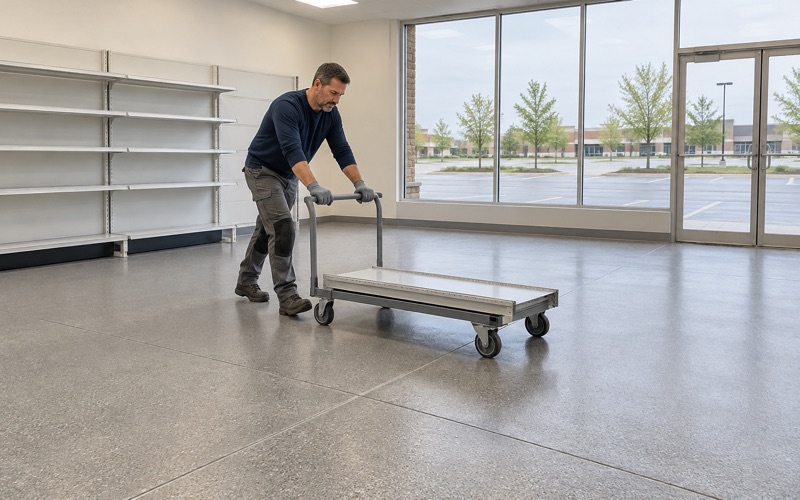
A solid pigmented system with a fine quartz broadcast keeps the field bright and even, while a dense vinyl flake broadcast adds depth and disguises scuffs. Over either, a polyaspartic or polyurea topcoat is the usual finish where hot tire pickup and abrasion are concerns. The broadcast also sets the texture, so this is where brightness and footing get balanced.
Whatever goes on top, the system rests on the profile underneath. We grind or shot blast to the ICRI concrete surface profile the primer’s data sheet names, and use 100% solids epoxy where film build matters. That is what keeps a bright finish from peeling up in sheets.
A Griffith Garage or Workshop Floor That Shows the Drip
The hangar logic travels well. Owners hold 71.7 percent of occupied homes in Griffith, and 94.0 percent of owner households live in detached houses. Where one of those houses has a garage that doubles as a workshop, a light floor earns its keep for the same reasons it does under a wing.
The dropped socket and the slow drip
A 10 mm socket that rolls under a bench is easy to find on a pale floor and nearly invisible on a dark one. A slow weep from a car, a mower or a snowblower shows as a spot you notice the next time you open the door, which is often the earliest warning you get that something needs a look.
The same visibility helps with housekeeping. A bright floor tells you when a spill needs wiping, when grit has built up near the door and when a cleaning pass missed a corner. That matters, because grit left in place is what dulls a topcoat in the traffic lanes.
The trade-off: it shows tire marks too
A light floor is honest in both directions. It shows every tire mark, every track of road grime and every patch of winter salt residue, so it asks for more sweeping and an occasional mop. Owners who want the garage to look clean between washes often pick a mid-gray or add flake, accepting a little less brightness in return.
Tire marks are also where system choice shows. Hot tires can lift a weak coating, so for a garage we lean on a hard-wearing topcoat over a properly ground slab, and we pick systems meant to stand up to the brine and rock salt that come in on tires through the winter.
Paperwork for a Griffith job
Griffith’s Building Department lists residential floor coverings among work that needs no permit, while driveways, aprons and pads do. Its contractor rules are stricter: every contractor working for hire in town must hold a Griffith contractor license, even for permit-free work, with a recorded bond and insurance naming the town. We found no Indiana state flooring license, so we check those town requirements before a job is booked.
Indiana’s coating rule caps floor coatings at 250 g/L of VOC and binds the applicator, so we choose products inside it. We also capture grinding dust at the machine with a vacuum instead of washing it toward a floor drain, and we never sell a floor coating as radon reduction, since radon mitigation in Indiana requires a license from the Indiana Department of Health.
Timing the cure
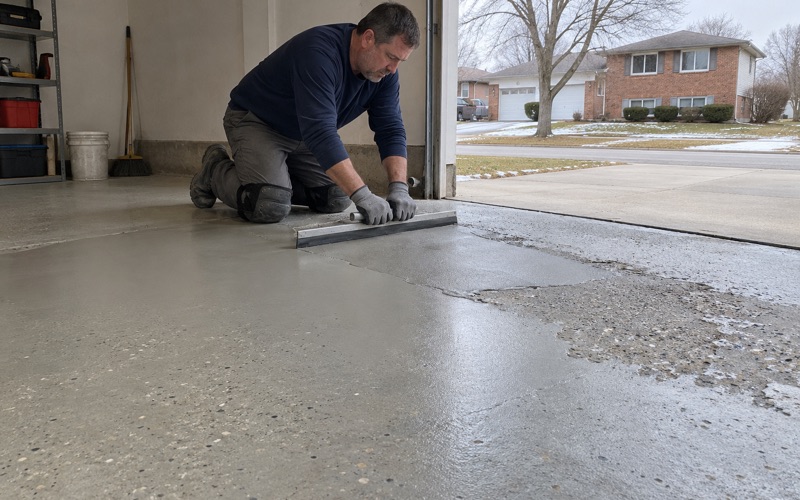
Cure schedules follow slab temperature and the dew point at the surface, not the calendar. An unheated Griffith garage in deep winter is one we will tell you to wait on, because a cold slab can blush or cure soft and lose the clean, bright finish you chose it for.
Before any of that, the moisture test sets the plan. On a garage slab we may use an ASTM F2170 in-situ relative humidity probe or an ASTM F1869 calcium chloride test, and if the numbers call for it, a moisture-mitigation primer goes into the scope rather than being discovered as a failure later.
- 20+ Years Coating Floors
- Moisture Test in Every Scope
- Free Written Estimates