Tinley Park Epoxy Flooring installs epoxy flooring in Dyer with more than 20 years in the trade behind every garage, basement and shop floor we coat. Each slab is opened with a diamond grinder or a shot blaster, never an acid etch, so the coating has a true profile to grip. That choice also decides what leaves the property while we work, and in this town that matters as much as the finish.
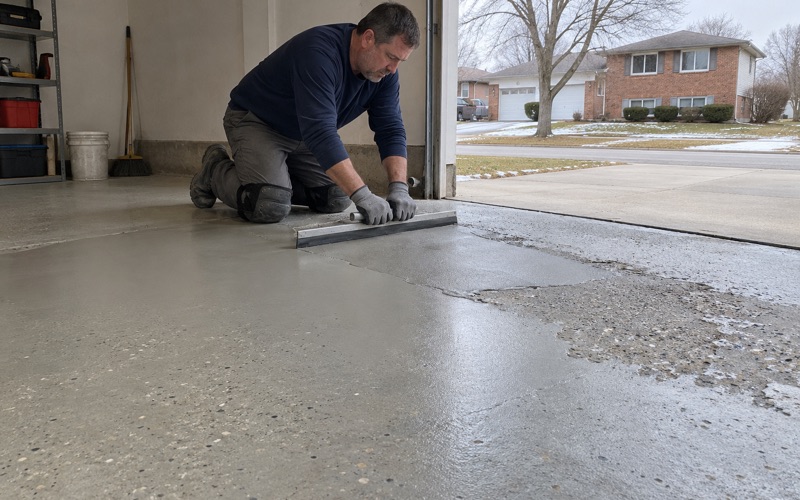
Before a price is final, a moisture test goes into the written scope, whether the slab sits under a basement or a two-car garage. We also map cracks, spalls and any old coating first, and we tell you plainly when a floor needs repair or replacement before it should be coated at all.
The proposal names the product line, the number of coats and the finished thickness, so you can hold the finished floor up against the quote. It also spells out what the coating warranty does not cover, starting with moisture, before anything is signed.
Dyer’s Storm Drains Take Rain, and a Short List of Exceptions
Dyer is a town in St. John Township, Lake County, Indiana, a southeastern suburb of Chicago with 16,517 residents at the 2020 census. Its storm sewers are governed by the Town of Dyer Stormwater Management Ordinance, now in its second edition from 2021 and administered by the town’s Stormwater Management Board. Chapter Two of that ordinance is the part that touches a floor job.
The rule in one sentence
Chapter Two applies to every discharge entering the drainage system in town, and its core line is short: no person may put anything into a stormwater conveyance other than stormwater or an exempted discharge. Single-family houses are not carved out of it. Water that runs down a driveway into the gutter at the curb ends up at the street inlet, and that inlet is exactly what the rule protects.
Its findings also note that property within and downstream of the town is at times subjected to flooding, so what goes into those pipes is not a small question. We read it as a plain instruction for our crews, not as fine print to work around.
Car washing is on the list; floor-prep water is not
Section 3 of Chapter Two lists the flows that are allowed, and it runs from lawn watering and air conditioning condensation to dechlorinated pool water and street wash water. Individual residential car washing is on it, which is why a neighbor rinsing a sedan in the driveway is within the rule. Nothing on the list covers water used to prepare a concrete floor for a coating.
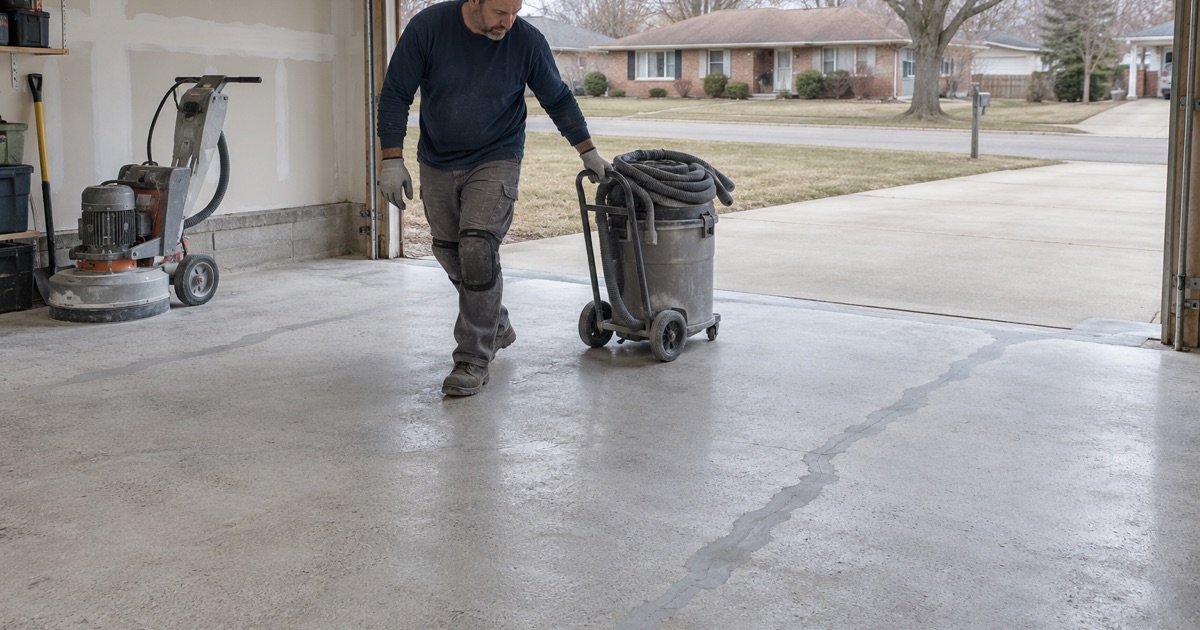
That gap matters because the old way of prepping a garage makes exactly that kind of water. An acid etch leaves an acidic rinse, a degreasing pass leaves detergent and oil in the wash water, and wet grinding leaves a gray cementitious slurry. Hosed out the garage door, all three head down the driveway toward the inlet, and none of them is stormwater.
Shops, showrooms and clinics too
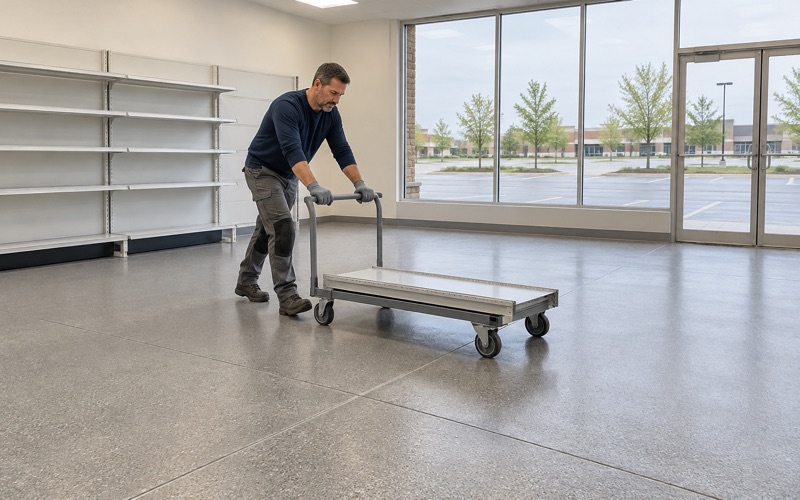
The ordinance does not stop at the residential line. A shop, showroom or clinic floor in Dyer falls under the same Chapter Two prohibition, and commercial slabs often sit near a parking lot inlet. We phase those jobs around opening hours, with overnight and weekend windows when a space cannot close, and the dust still goes into the vacuum rather than out the service door.
Looking for epoxy-flooring closer to Lyons? See Epoxy-Flooring Services in Lyons.
Dry Grinding With a Vacuum Shroud Instead of Acid and a Hose
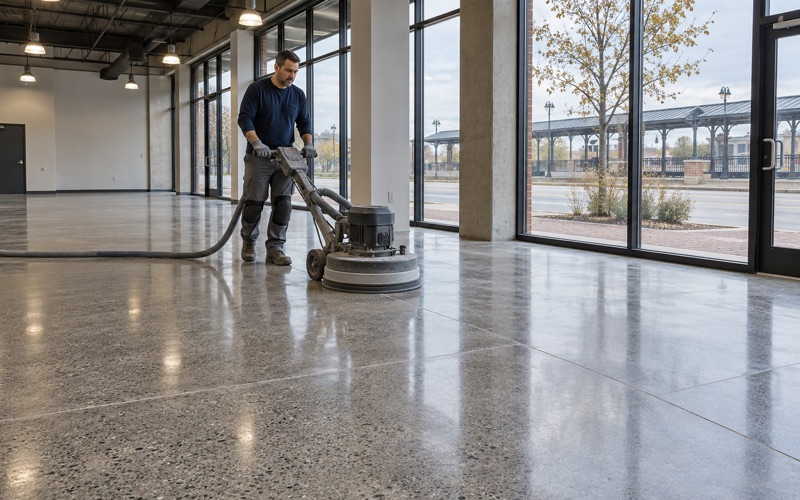
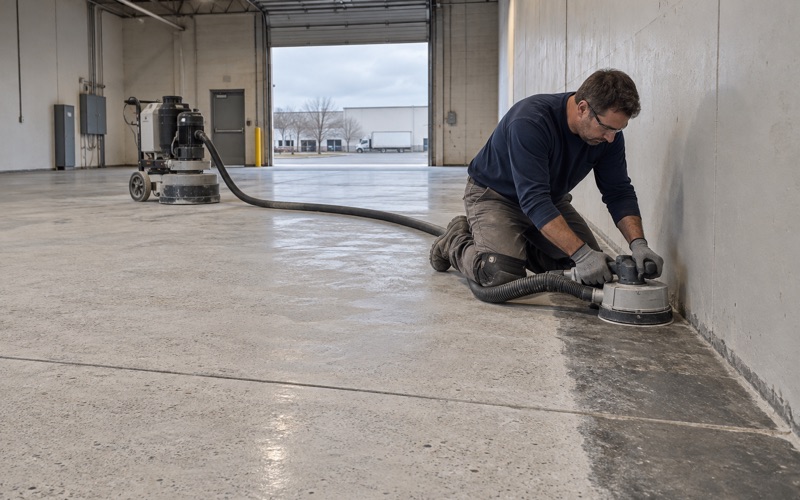
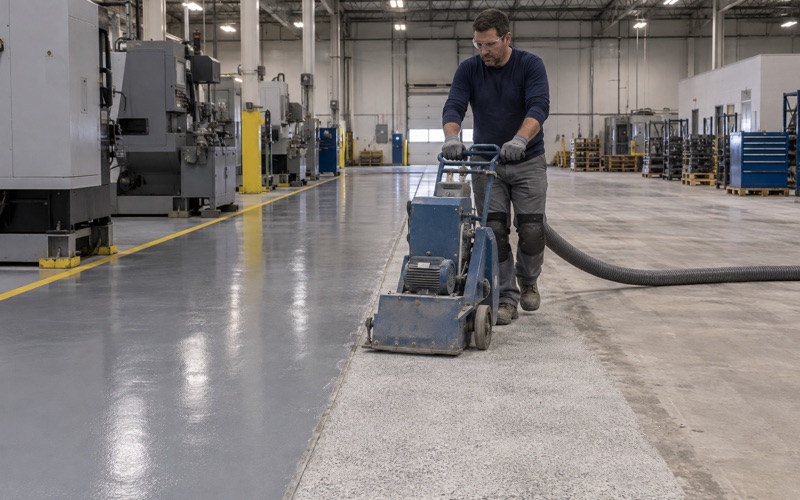
Our prep in Dyer is dry from start to finish. The grinder or shot blaster cuts the surface, a shroud around the head pulls the dust into a vacuum at the machine, and nothing is rinsed toward the floor drain, the driveway or the street. It is the same way we open a slab everywhere, but here it is also how the job stays inside the ordinance.
Profile without a rinse
Diamond grinding and shot blasting leave a measurable texture, which installers describe on the ICRI CSP 1-10 concrete surface profile scale. A garage coating built on 100% solids epoxy needs that tooth to hold, and an etched slab often comes up smoother and less even than the product sheet asks for. Mechanical prep gets a better profile and makes no wash water at all.
Dust from a dry grind is fine and silica-bearing, which is another reason the shroud and vacuum stay on the machine the whole time. The garage is left swept and vacuumed, ready for the primer.
Oil spots and old coatings
A typical garage carries a few years of drips under the engine bay, and some have a peeling paint job from a previous owner. We grind through old coatings and contaminated concrete rather than scrubbing them out with degreaser and a hose. Where a stain has soaked deep, we tell you before the job is priced whether it can be ground out or needs a repair first.
If a small amount of wash water is ever unavoidable, such as a spot clean after grinding, we collect it in the garage with a wet vacuum and take it with us. It does not go out the door.
Moisture testing before the price is final
Because nothing is hosed down, the slab stays dry for the moisture test that is already part of our written scope. Depending on the floor, that means an ASTM F1869 calcium chloride test, ASTM F2170 in-situ relative humidity probes, or an ASTM D4263 plastic sheet check as a first read. A high result changes the system, often to a moisture-mitigation primer, and it changes the price before you agree to it.
Drying conditions matter on coating day too. Cure schedules follow slab temperature and the dew point spread at the surface, and an unheated garage in the depth of winter is told to wait for warmer weather.
Choosing the system after prep
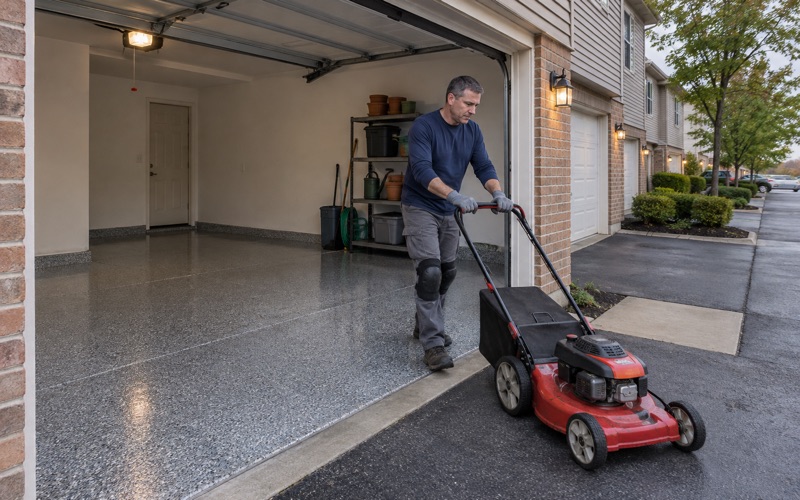
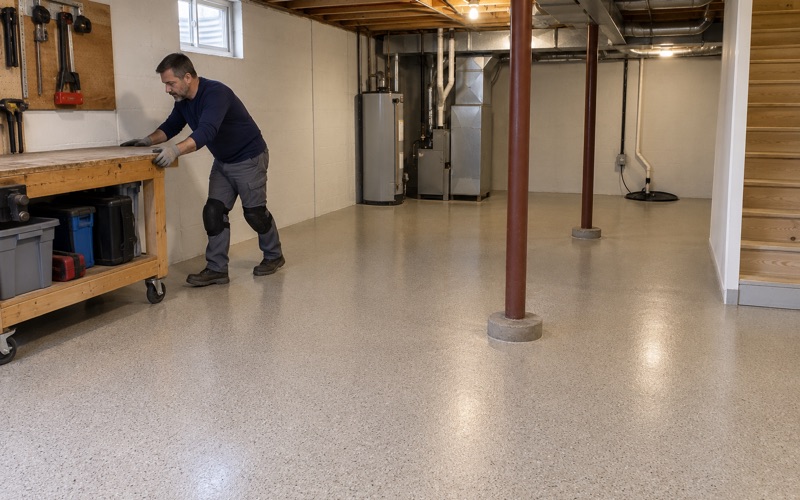
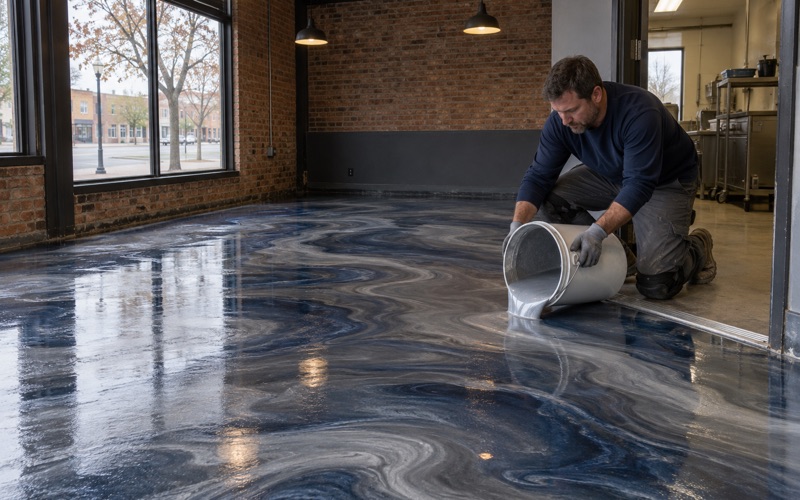
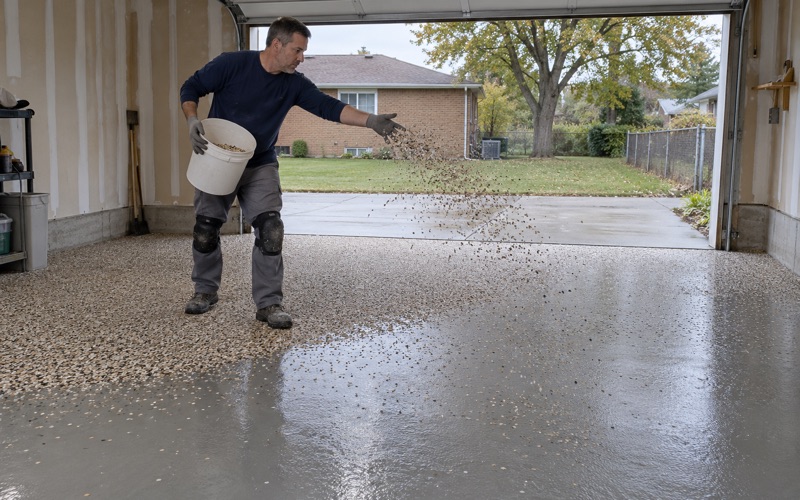
Once the slab is open and tested, the system is chosen for the space. A garage usually gets a 100% solids epoxy base with a vinyl flake broadcast and a polyaspartic topcoat, which resists hot tire pickup better than a thin roll-on kit. Basements and shops may suit a quartz aggregate broadcast or a urethane cement where heat and heavy cleaning are part of the day.
Slip resistance comes from the broadcast and the topcoat we specify, not from a promise on a brochure. Tell us how the space is used and the texture is chosen to match, then written into the proposal with the rest of the system.
If Something Reaches the Street Inlet: Who Dyer Wants Told
Dry prep makes a spill unlikely, but a coating job still involves liquids: resin, hardener, solvent for tool cleanup and the occasional bucket that tips. Chapter Two has a reporting rule for that moment, and we plan around it before the first kit is opened.
The call and the written report
Under Section 6, whoever causes a discharge must tell the Dyer Fire Department immediately. A written report follows within five days to the Fire Department, the Public Works Department and the Indiana Department of Environmental Management. That is the sequence our crew lead follows if anything from the job ever reaches the gutter or the inlet.
The point of the reporting rule is speed: the people who run the drains hear about a problem while it can still be contained. Telling them late, or not at all, turns a small cleanup into a larger one for everyone downstream.
Keeping liquids off the driveway
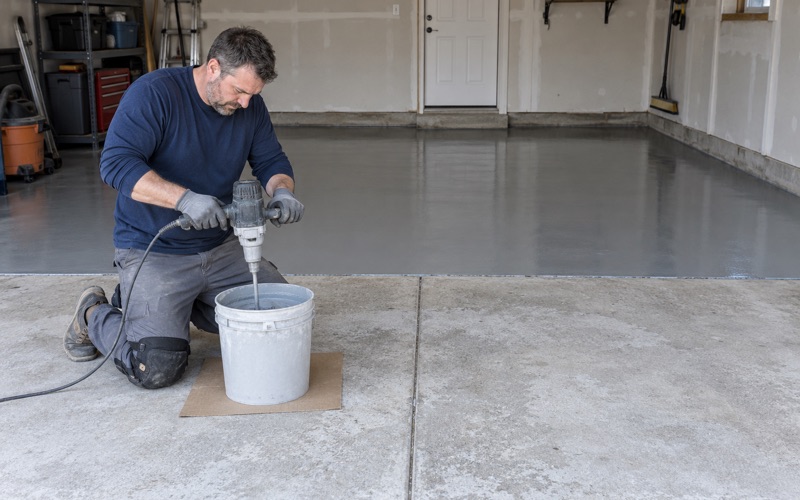
Resin is mixed inside the garage on a drop cloth, not on the apron, and empty kits go back on our truck. Rags and tool cleanup stay in sealed containers until they leave with us. When we work near an open garage door, the mixing station sits at the back wall, as far from the slope to the street as the space allows.
Coatings within Indiana’s VOC limits
What goes into the air has its own rule, because St. John Township, Dyer’s part of Lake County, sits inside the Chicago 2015 ozone nonattainment area, and Indiana’s AIM coatings rule, 326 IAC 8-14, caps floor coatings at 250 grams per liter and industrial maintenance coatings at 340. Those are the same limits Illinois uses, and the Indiana rule binds the person applying the coating, not just the seller. Crossing the state line changes nothing about the products we choose.
Registered With the Town Before the First Pass
Indiana has no state license for flooring or coating contractors, and the Attorney General’s office tells consumers that requirements vary from community to community. In Dyer, the rule comes from the Town of Dyer Building Department at One Town Square, and we check it before a job is booked.
The certificate of registration
Contractors and subcontractors doing construction or remodeling work in Dyer need a Certificate of Registration from the town, renewed each year and expiring December 31. It carries a $50 fee, a $5,000 bond recorded at the Lake County Government Center in Crown Point, and a certificate of insurance of at least $500,000 single limit that shows the Town of Dyer as certificate holder. Since 2020 the town has also asked for proof of workers’ compensation coverage.
Registration is not a license, and we do not describe it as one. It is the town’s way of knowing who is working inside its limits and that a bond and insurance stand behind the work.
Ask any contractor quoting a Dyer floor whether they hold a current certificate for the year. It is a quick question for the Building Department at (219) 865-4228, and a contractor who works here regularly will already have one on file.
Permits, timing and the written contract
Where a job needs a permit, it lapses if work has not begun within 90 days, so we schedule the start date before the paperwork goes in. Indiana also requires home improvement contracts over $150 to be in writing, and ours lists the price, payment schedule, materials, start and finish dates, and who to call. The contract is signed before any grinding starts.
What Dyer’s housing means for the floor
Dyer’s housing is young for the region: 56.0 percent of its units were built from 1990 on, and 87.7 percent are owner occupied. A newer slab is not automatically a sound or dry one, so the crack map and moisture test apply whether the garage was poured in 1995 or 2015. Townhouse-type attached buildings make up 13.9 percent of units, and on those we confirm where a shared drive drains before prep day.
- 20+ Years Coating Floors
- Moisture Test in Every Scope
- Free Written Estimates