
Tinley Park Epoxy Flooring handles concrete floor repair in Tinley Park, IL, serving surrounding cities including Country Club Hills, Mokena, Matteson, Midlothian and Hazel Crest. In more than 20 years of preparing floors, we have learned that a coating is only as good as the slab underneath it, so cracks, spalls and old coatings are mapped before any price is final.
Most of the repair work we do happens on floors we are about to coat or polish: garage slabs pitted by road salt, basement floors with old patches and cracks, and commercial floors with broken joints at forklift lanes. Repair is listed line by line in the proposal so you see exactly what the slab needs.
We also say plainly when a slab should not be coated as it stands. When concrete has heaved, settled or broken into loose sections, the honest recommendation is repair or replacement first, because a coating cannot hold a moving slab together.
Cracks in Concrete Floors
Hairline Shrinkage Cracks
Nearly every slab develops fine shrinkage cracks as the concrete cures and dries. These are usually stable and cosmetic, and we route them open slightly, fill them with a rigid epoxy or polyurea filler and grind them flush so the coating lies flat over them.
The village’s own contractor guarantee rules list small cracks in slabs among their exclusions, which reflects how common they are. We explain how a repaired hairline crack may appear in the finished floor before you choose a system.
Wider and Moving Cracks
Cracks that are wider, uneven across their faces, or that open and close with the seasons need more than a surface fill. We clean them out, use a flexible or semi-rigid filler where movement is expected, and note in the scope that a moving crack can telegraph through the coating over time.
Where a crack runs across a garage or basement floor in a line, it is often a control joint that never got cut or one that was cut too late. We discuss whether to honor it as a joint in the finished floor or fill and bridge it, because each choice looks and behaves differently over the years.
Cracks That Leak Water
In basements, a crack that weeps water is a moisture problem first and a cosmetic one second. Leaks need to be stopped at the source, and the village code calls for leaking foundation-wall cracks to be cut out and filled with epoxy cement grout, which is the kind of repair that must come before any floor coating.
Spalls, Pitting and Salt Damage
What Brine Does to Garage Slabs
Calcium chloride brine and rock salt ride into garages on tires from December through March. On bare concrete, that meltwater soaks into the surface, freezes and expands, popping off flakes and leaving pits, especially near the door and under the parked tires.
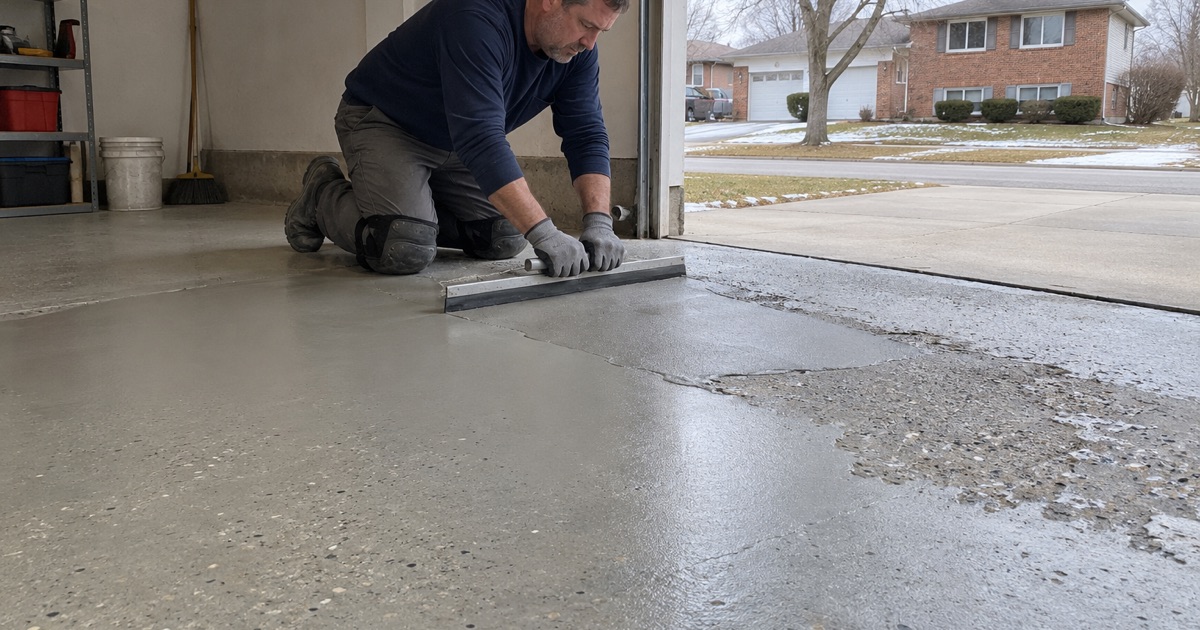
We grind away the loose, scaled concrete until we reach a sound surface, then fill the pits with a repair mortar or epoxy filler. A protective coating afterward keeps the brine on top of the floor, where it can be squeegeed out instead of soaking in again.
Spalled Edges and Chipped Areas
Spalls are pieces of concrete that have broken away at edges, joints or impact points. We cut back to solid concrete, square up the edges and rebuild the area with a polymer-modified or epoxy repair material, so the patch bonds well and does not chip out again under traffic.
Feathered patches that taper to nothing at the edges are the most common repair failure we see on old floors. A squared, full-depth edge gives the repair material something to lock against, which is why we take the extra step even on small spalls.
Air-Entrained Concrete and Older Slabs
Tinley Park’s own concrete spec calls for air-entrained concrete at 6 percent air, plus or minus one, which helps slabs resist freeze-thaw damage. Older slabs or slabs that were poured differently may not have that protection, and they tend to scale faster under winter salt.
The same village spec also allows a calcium chloride accelerator in the mix. Knowing how a slab was likely poured helps us choose repair materials and primers that bond well to it, rather than assuming every garage floor in the area behaves the same way.
Control Joints and Commercial Floor Repair
Joint Repair in Garages and Basements
Control joints are cut into slabs to guide cracking, and their edges often chip over time. We clean out old fillers, repair broken edges and refill the joints, either honoring them through the coating or bridging them, depending on the slab and the system chosen.
Forklift Lanes and Dock Areas
In warehouses and light manufacturing floors, forklift and pallet jack wheel loads break down joint edges and wear ruts into the slab. We repair those areas with high-strength epoxy or polyurea joint fillers and rebuild damaged sections, so the new floor coating is not laid over a weak spot.
Phasing Repair Around Operations
Commercial floor repair is phased around business hours, with overnight and weekend work when a space cannot close. Fast-setting repair materials let us return sections to service quickly, and the order of work is written into the scope.
When a Slab Needs More Than Repair
Heaved, Settled and Broken Slabs
A slab that has lifted, sunk or broken into separate pieces usually has a problem below it, such as poor drainage, soft subgrade or frost movement. Surface repair cannot correct that, and we recommend a concrete contractor evaluate replacement or leveling before any coating is considered.
We would rather lose a coating job than install a floor that we know will crack or lift within a season. Saying so up front, in writing, is part of the scope we hand every owner, and it is the reason the slab check comes before the price.
Moisture and Coating Failures
Sometimes a floor that looks like it needs repair actually has a moisture problem, shown by peeling coatings, white efflorescence or damp patches. We test with a plastic sheet check under ASTM D4263 or a calcium chloride test under ASTM F1869, and when vapor is the cause, the fix includes a moisture-mitigation primer rather than patching alone.
What Repair Does and Does Not Cover
Most coating warranties exclude cracks that open after installation and failures caused by moisture from below. We explain those exclusions before the job is sold, along with how each repair is expected to perform, so you know which issues the floor will hold up to and which it will not.
- 20+ Years Coating Floors
- Moisture Test in Every Scope
- Free Written Estimates