Tinley Park Epoxy Flooring installs commercial epoxy flooring in Tinley Park, IL, serving surrounding cities including Country Club Hills, Mokena, Matteson, Midlothian and Hazel Crest. Over more than 20 years of floor coating work, we have learned that a commercial floor is judged by two things: how it holds up to the traffic and chemicals of the business, and how little the business had to close to get it.
Every commercial job starts with a walk-through of the space, a look at the slab, and a conversation about what crosses the floor each day. The written proposal then names the product line, the number of coats, the finished thickness and the phasing plan, so a facility manager can check the finished floor against the quote.
The local economy leans on auto dealers, hospitality, healthcare and light industry, and each of those floors asks for something different. We size the system to the actual use rather than selling one coating to every building.
Commercial Floors by Business Type
Dealership Service Bays and Showrooms
Auto dealers and filling stations make up a large share of local sales tax, and their floors take some of the hardest use in the area. Service bays see hot tires, motor oil, antifreeze and winter brine, so we build them with a chemical-resistant topcoat and a texture that stays safe under dripping cars.
Showroom floors face a different test: they must look sharp under bright lighting and reopen fast. Polyaspartic topcoats and phased installation let us coat a showroom in sections after hours without moving the whole inventory at once.
Many dealerships pair a coated service area with a polished or coated showroom, and the two systems meet at a doorway or a saw-cut line. We plan that transition so the edge is clean and protected, rather than leaving a seam that chips under tire traffic.
Banquet Halls, Hotels and Event Spaces
The village’s convention center, amphitheater and hotel district are surrounded by banquet halls and event venues, and their back-of-house floors carry catering carts, spills and constant cleaning. We use durable, easy-clean systems with enough texture for wet service corridors, scheduled around the event calendar.
Back-of-house kitchens in those buildings often need urethane cement and a coved base, while corridors and storage rooms can take a lighter epoxy system. Splitting the scope by zone keeps the cost where the hard use actually is.
Clinics, Offices and Fitness Centers
Medical offices and clinics need floors that clean easily and hold up to rolling equipment. Gyms need impact resistance under dropped weights and a finish that stays grippy after daily disinfecting, so we build those floors thicker and texture the topcoat.
Clinic and gym owners usually cannot shut down for days, so these floors are a common case for weekend phasing. We set the order of rooms with the owner so patients, members and staff always have a working route through the building.
Retail Stores and Back Rooms
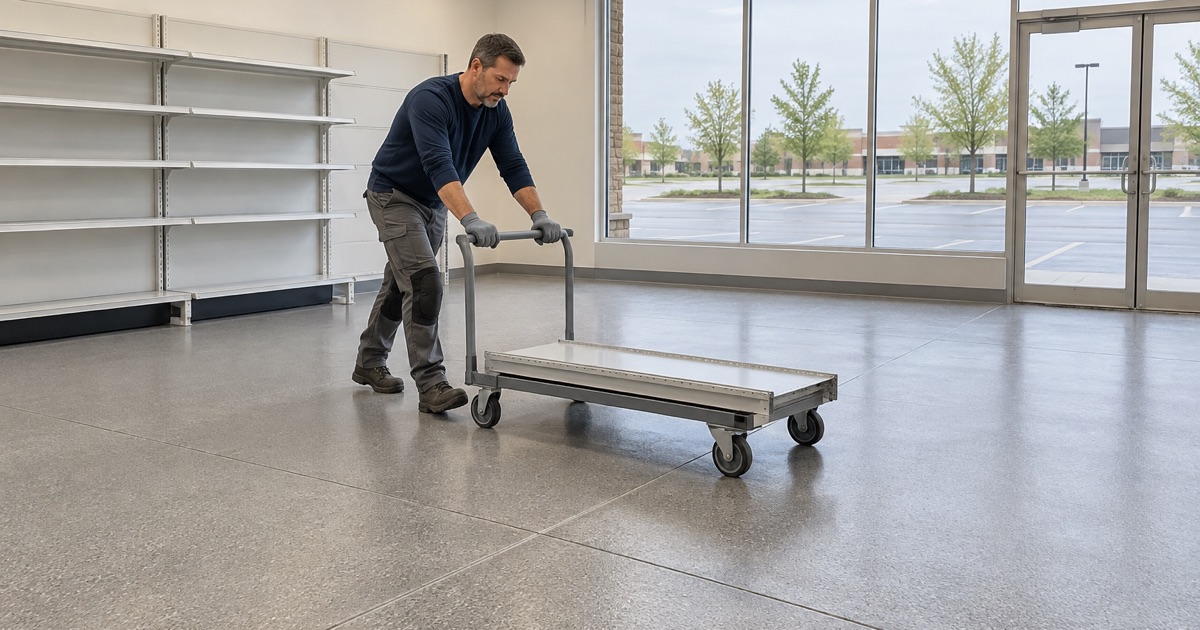
Retail sales floors, stock rooms and receiving areas take pallet jacks, hand trucks and foot traffic tracked in from the parking lot. A solid color epoxy or a flake system brightens the space, resists scuffing and makes cleanup simple.
Choosing the Right Commercial System
100% Solids Epoxy Systems
A 100% solids epoxy builds real thickness with each coat and bonds strongly to a ground slab. It is the base of most commercial systems we install, topped with a more abrasion-resistant or UV-stable coat where the floor needs one.
Polyaspartic and Polyurea Topcoats
Polyaspartic and polyurea topcoats cure quickly, resist scuffing and hold their color under sunlight from storefront windows. Their fast cure is what makes next-morning reopening possible on many commercial floors.
Urethane Cement for Heat and Wash-Down
Where hot water, steam and strong cleaners hit the floor every day, urethane cement outperforms standard epoxy. It tolerates thermal shock and is the usual choice for commercial kitchens, breweries and wash-down areas.
Broadcast Textures and Slip Resistance
Grip is specified by the broadcast and the topcoat, not promised as a slogan. A quartz aggregate broadcast or a vinyl flake with a texture additive gives traction in wet areas, and the level of texture is written into the scope.
Preparation, Moisture and Code Requirements
Surface Preparation for Commercial Slabs
Large commercial floors are usually shot blasted in the open areas and diamond ground at edges, joints and high spots. Both leave a measured profile on the ICRI CSP scale, and both run with vacuums attached so dust is captured at the machine rather than spread through an occupied building.
Moisture Testing Before Coating
Commercial slabs can carry moisture from below, especially on-grade slabs without an intact vapor retarder. We test with calcium chloride kits under ASTM F1869 or relative humidity probes under ASTM F2170, and a high reading means a moisture-mitigation primer goes into the system before the price is final.
Striped Egress Aisles
The Tinley Park building code amends IBC 1014.2 to require that an egress path through an intervening space have a 44-inch aisle striped in a contrasting color for its full length. We lay those stripes into the coating system, so the marking lasts as long as the floor rather than wearing off like paint or tape.
VOC Limits on Commercial Coatings
The Chicago area falls within the 2015 ozone nonattainment area, and 35 Ill. Adm. Code Part 223 sets VOC limits for floor and industrial maintenance coatings, alongside the national rule in 40 CFR 59 Subpart D. Those limits bind the applicator, so we choose compliant products and keep the documentation with the job.
Scheduling Around a Business That Stays Open
Phased, Overnight and Weekend Work
Showrooms, banquet halls, gyms and clinics usually cannot close for a week. We divide the floor into sections, work overnight and on weekends, and plan cure times so each section is ready for staff and customers when the doors open.
Licensing, Bonding and Insurance
Illinois has no state flooring license, so we check each village’s contractor license, bond and insurance requirements before booking. In Tinley Park that means a village contractor license and a 20,000-dollar surety bond, handled before the first day on site.
Warranty Terms for Commercial Floors
Commercial coating warranties generally exclude moisture from below, chemical exposure beyond the product’s rating and impact damage. We explain those exclusions before the contract is signed, starting with moisture, so the facility knows what the floor is built to handle.
- 20+ Years Coating Floors
- Moisture Test in Every Scope
- Free Written Estimates