Tinley Park Epoxy Flooring has spent more than 20 years on epoxy-flooring in Chicago Ridge and across the southwest suburbs, and one question keeps coming up that most floor brochures skip. What happens to a coated floor when something soft, heavy and made of vinyl sits on it for a month? The answer matters to a store operator hosting a pop-up attraction and to a homeowner whose garage holds the summer pool gear.
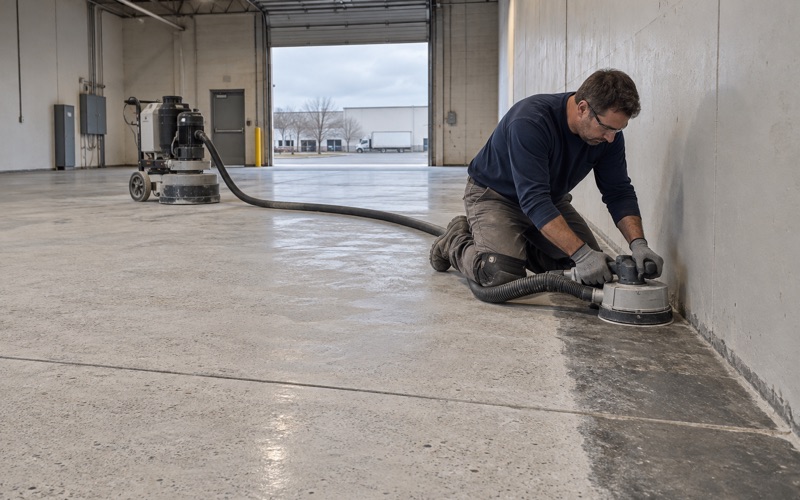
We answer it the same way we answer every floor question: by testing before we promise. Every slab we coat is opened with a diamond grinder or a shot blaster rather than an acid etch, and a moisture test sits in the written scope before the price is final. Moisture turns out to matter for vinyl contact too, which is part of why we take it seriously here.
This page covers how plasticizers move out of PVC, why a barrier underlay belongs under any long-stay vinyl setup, how to move heavy inflatables without scuffing the topcoat, and what homeowners should do with bounce houses and pool floats stored on a coated slab. Nothing here claims a coating is untouchable. The honest position is that some finishes can discolor under vinyl, so we test and plan around it.
Inflatables Move Into Chicago Ridge Retail Space
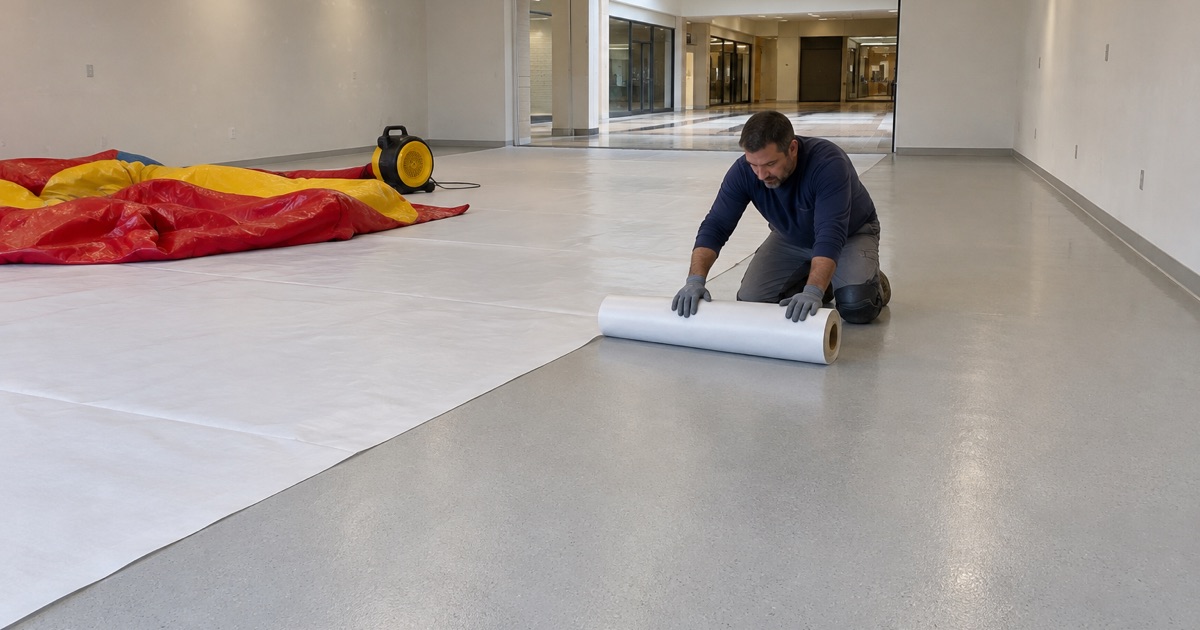
On September 22, 2026, the Village of Chicago Ridge board agenda carried a business license for Royal Duck Inflatables Inc., listed as Royal Duck Group at 444 Ridgeland. Royal Duck describes itself as a traveling pop-up bounce park with giant inflatables, and its stops elsewhere have run for weeks in shopping-center space. The Chicago Ridge Mall directory already lists FunFlatables and Bungy Bounce among its tenants.
That puts inflatable attractions in the village’s retail floor space as a recurring use, not a one-off. We have not seen Royal Duck’s Chicago Ridge setup, its dates or the floor under it, and we have no relationship with the operator or the mall. What we can speak to is what weeks of vinyl contact asks of a coated concrete floor, wherever the attraction lands.
What a Long-Stay Setup Puts on the Floor
A pop-up bounce park is more than the inflatables themselves. Blowers run continuously, ballast holds the structures down indoors where stakes cannot go, and vinyl tarps or mats often cover the walkways between attractions. Each of those items sits in one spot for the length of the stay, pressed down by its own weight and by the people moving across it.
Weeks of steady contact is the difference between a weekend party rental and a long-stay installation. A short rental gives the vinyl little time to work on the surface. A month of PVC pressed flat against the same patch of floor is long enough for chemistry, not just abrasion, to become the concern.
Blowers, Ballast and Point Loads
Blower housings and ballast weights concentrate load on small footprints, and a blower vibrates against the floor for as long as the attraction is open. On a well-bonded coating, that is usually a scuffing issue rather than a structural one. On a floor with a weak bond, an old sealer underneath or an unrepaired crack, steady vibration and point load can find the weak spot first.
That is why we map cracks, spalls and earlier coatings before quoting a retail floor. If a slab needs repair before it should carry a coating, the proposal says so rather than burying it.
Looking for epoxy-flooring closer to Riverdale? See Epoxy-Flooring in Riverdale.
Plasticizer Migration: Why Vinyl Marks What It Sits On
Flexible vinyl gets its flexibility from plasticizers, additives blended into the PVC compound. Shaw Contract’s trade bulletin on the subject puts it plainly: plasticizer migration happens when these chemicals move out of plastic compounds like vinyl and rubber. Its own example is a rubber mat placed on a vinyl floor, leaving a stain where the mat made contact.
The bulletin adds two details that matter on a concrete floor. Migration can occur in a liquid or a gas phase, so the plasticizer does not need visible wetness to travel, and it can be accelerated by the presence of moisture and moisture vapor. Then comes the line we quote to every customer who asks about this: there is no known way to stop this phenomenon.
What the Research Does and Does Not Say
That bulletin concerns vinyl flooring, not resin coatings. We have not found a published test of epoxy or polyaspartic floor coatings under PVC inflatables, and we will not pretend one exists. Some coatings may hold up well and some may discolor; the chemistry gives no reason to assume either outcome across the board.
The practical answer is a test patch. Before a long-stay vinyl installation goes down on a coated floor, a small piece of the same material can sit on an out-of-the-way area for several days and be checked. A mark there costs little; a mark under a full attraction can mean a recoat.
Why Moisture Raises the Stakes
Because migration speeds up with moisture vapor, a slab that is pushing vapor up through the coating can be a worse host for long-stay vinyl than a dry one. That is one more reason our moisture testing is not optional. We use ASTM F1869 calcium chloride testing or ASTM F2170 in-situ relative humidity probes, depending on the slab, and the result goes in the written scope.
Moisture is also the first exclusion we name when we walk through what a coating warranty does not cover. A store manager planning to host an attraction should hear that before the job is sold, not after.
Barrier Underlays and Drag Paths on a Coated Floor
If a coated floor is going to carry vinyl for weeks, the vinyl goes on a barrier underlay, not straight onto the topcoat. Since there is no way to stop plasticizers leaving the PVC, the job is to give them something other than the floor to move into. The underlay is sacrificial; the coating is not.
Choosing an Underlay
What works is a layer that does not itself contain plasticizers and that will not trap moisture against the floor. Protection boards and non-vinyl sheet goods are the usual candidates, laid with taped seams so no edge of the inflatable touches bare coating. Whatever goes down should be tested on the same floor first, because the underlay can carry its own chemistry too.
For a store that expects to host attractions regularly, it can be worth keeping a set of protection boards on hand. Using the same tested material each time takes the guesswork out of every new setup.
Dragging Heavy Vinyl Into Place
Moving the attraction is a second wear test. A rolled inflatable is heavy, and pulling it across a floor drags grit trapped in the vinyl over the topcoat like sandpaper. Plan a drag path, sweep it first, and lay protection boards along it so the bundle slides over board rather than coating.
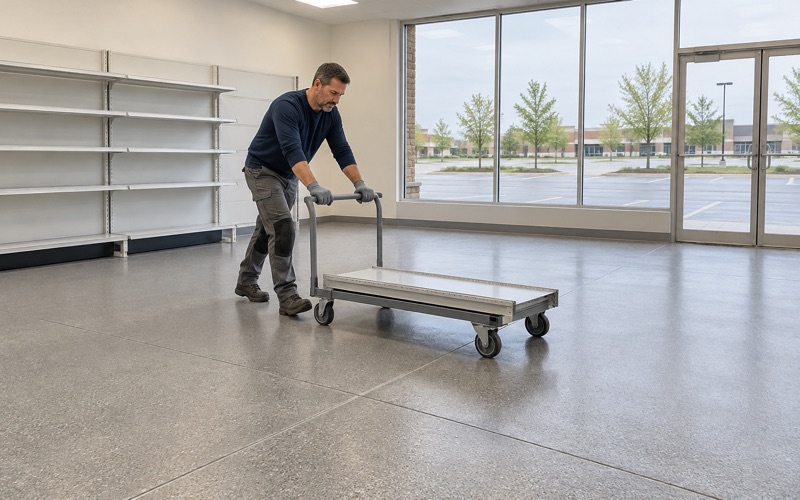
A dolly or a pallet jack on clean wheels beats dragging wherever the bundle allows it. Teardown deserves the same care as setup, since the vinyl comes out after weeks of collecting dust and debris.
When the Attraction Leaves
Once the setup is gone, inspect the footprint in good light before the space is re-let or reopened. Any discoloration is easier to judge against the surrounding floor right away, before traffic and cleaning blur the edge. If a topcoat has marked, a light sand and recoat of the topcoat layer may be possible without going back to bare concrete, but that call depends on what the inspection finds.
Specifying the Floor With Contact in Mind
When we coat a retail floor that may host attractions, the proposal names the product line, the number of coats and the finished thickness, so the owner can check what went down against what was quoted. A thicker, harder topcoat such as a polyaspartic gives more margin against scuffing, and the slip-resistant texture comes from a specified broadcast and topcoat rather than a promise.
Where a space cannot close, we phase the work around opening hours with overnight and weekend windows. That matters at a retail site where the floor is earning rent every day it is open.
Bounce Houses, Pool Floats and Vinyl Mats at Home
The same chemistry follows inflatables home. Chicago Ridge counts 1,833 owner-occupied detached houses, and a coated garage slab in one of them is exactly where a deflated bounce house, a stack of pool floats or a vinyl exercise mat tends to sit from one season to the next. Months of storage is a longer contact time than any pop-up stay.
Storing Kids’ Inflatables and Pool Gear
Store vinyl off the coating: on a shelf, in a hard plastic tote, or on a sheet of plywood or a protection board. Let pool gear dry completely before it goes away, since moisture is one of the conditions that speeds migration. A damp float folded onto a garage floor in September is the worst combination of contact, time and wetness.
Bounce houses rented for a backyard party usually spend only a day or two in a garage. The ones families own are the bigger concern, because they live in the same corner for years.
Vinyl Play Mats in Basements
Basement playrooms often use vinyl play mats or foam puzzle tiles, and flexible vinyl is the material the Shaw bulletin names as a plasticizer source. A basement slab is also the floor most likely to carry moisture vapor up from below. Before we coat one, the moisture test tells us how much vapor is moving, and a moisture-mitigation primer goes in the scope when the numbers call for it.
Swapping a vinyl mat for one labeled plasticizer-free, or putting a breathable layer under it, is cheap insurance. Lift mats now and then to check the floor and let the slab breathe.
Before a Home Coating Job in Chicago Ridge
Chicago Ridge requires every contractor to register at Village Hall, with a certificate of insurance and a $10,000 surety or performance bond, before a building permit is issued. Illinois licenses no flooring or coatings contractor, so that village registration is the requirement we confirm before booking. Home jobs over the state threshold also get a written contract and the Illinois Home Repair: Know Your Consumer Rights pamphlet before any grinding starts.
Grinding dust is captured at the machine by vacuum, never rinsed toward a floor drain. And if the garage is unheated in deep winter, we will tell you to wait, because cure follows slab temperature and dew point rather than the calendar.
- 20+ Years Coating Floors
- Moisture Test in Every Scope
- Free Written Estimates