Tinley Park Epoxy Flooring has spent more than 20 years on epoxy flooring in Burr Ridge and across the southwest suburbs, and the first thing we do on any slab is find out what it will actually face. A garage floor that sees hot tires, a basement that sees damp, and a production room that sees extreme cold each call for a different system. Picking the coating before reading the floor is how a job fails early.
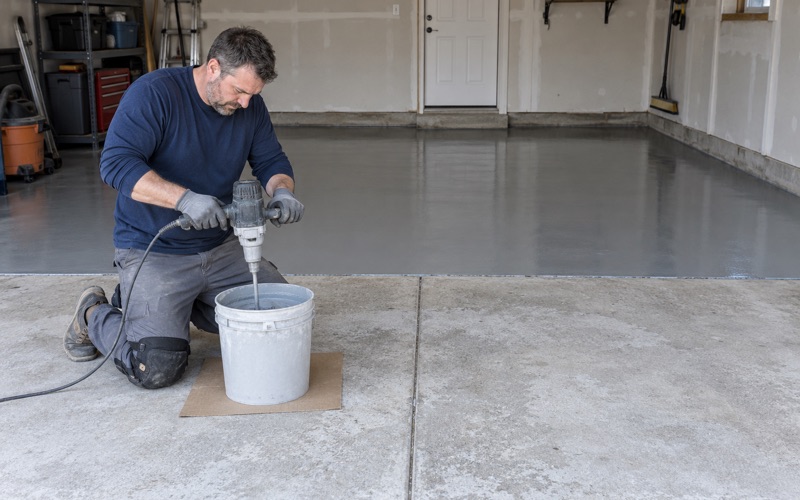
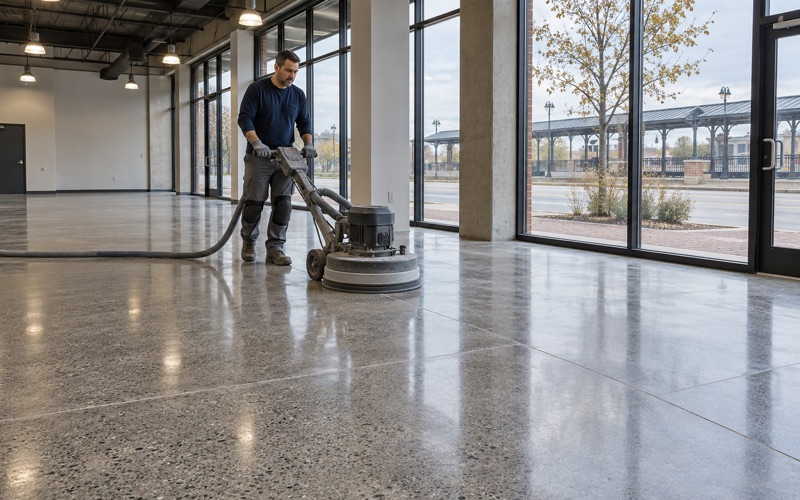
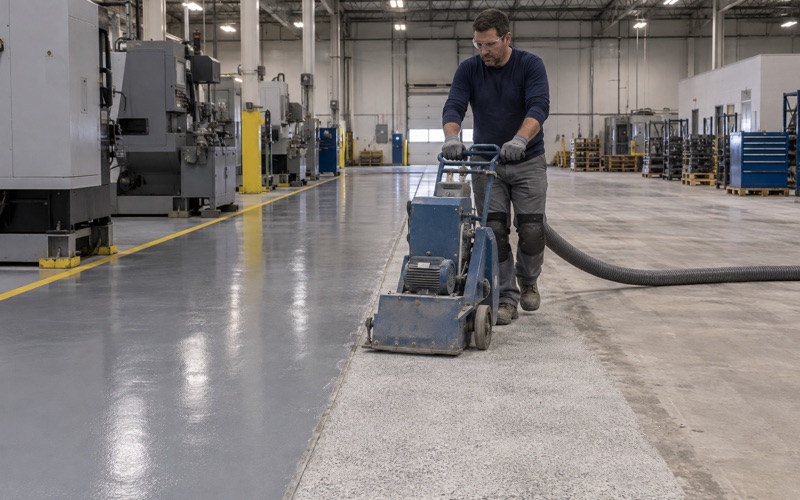
Every slab we take on is opened with a diamond grinder or a shot blaster rather than an acid etch, so the coating bonds to a real profile. Cracks, spalls and old coatings get mapped before we price anything, and when a slab needs repair or replacement first, we tell you that instead of coating over it. A moisture test is written into the scope before the number is final.
Our proposals name the product line, the coat count and the finished thickness, which gives you something to measure the installed floor against. That matters most on the unusual floors, where the wrong material does not wear out slowly but fails the first time the room does what it was built to do.
A Cryogenic Food Lab on High Grove Boulevard
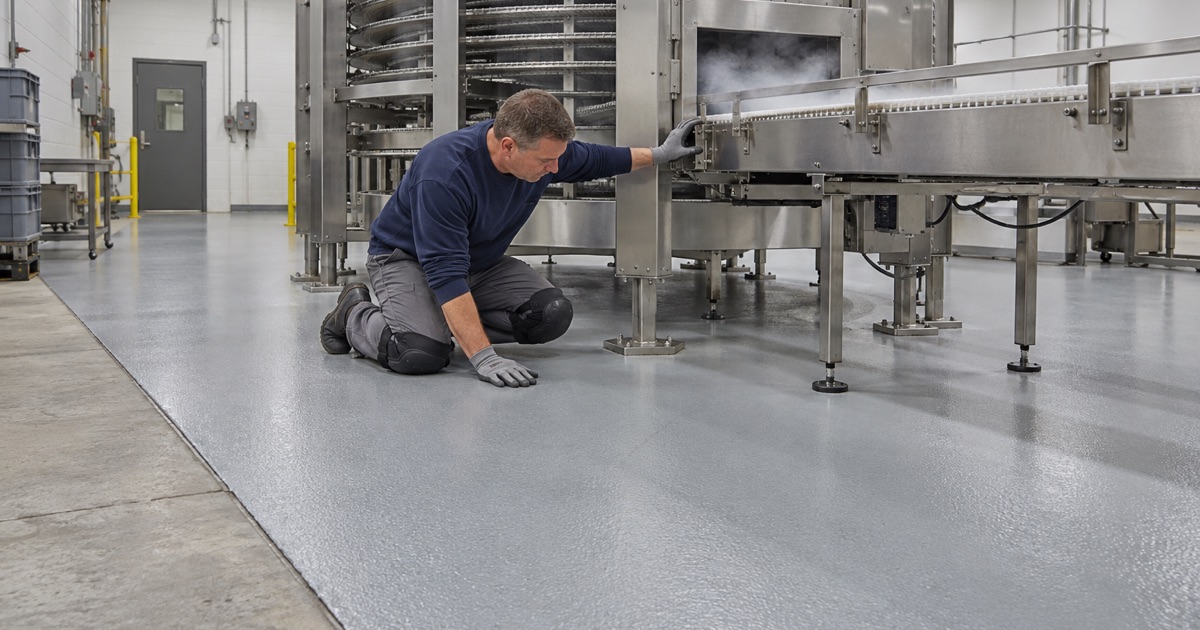
Burr Ridge is a village in Cook and DuPage counties, home to 11,192 people at the 2020 census, and on the DuPage County side, at 7000 High Grove Boulevard, Linde runs its Chicago Center and Food Technology Laboratory. Linde describes the lab as a place where it tests customers’ products using full-size production equipment, including spiral equipment and flighted-belt systems for individually quick-frozen production. The work there includes thermal analysis, freezing and chilling parameters, and freezing rate curves used to size equipment.
A 2016 trade report described a production-sized tunnel freezer being added to the lab on what was then Praxair’s Burr Ridge campus, with systems that chill food using liquid nitrogen or liquid carbon dioxide. We have not seen the lab’s current equipment list, and we have never seen its floor. We use it here because it is the clearest local example of a room where a floor meets cryogens.
Minus 320 Degrees at the Floor
Liquid nitrogen boils near minus 320 degrees Fahrenheit, so any splash that reaches the floor is colder than almost anything a coating is designed around. The surface it lands on contracts sharply while the slab beneath stays warm, and that difference is what opens cracks. Research on concrete under repeated liquid nitrogen shock reports more internal micro-cracks and strength loss as the shocks repeat.
A thin epoxy film bonded to that surface has nowhere to go. It is stiff, it is only a few mils thick, and it is locked to concrete that is moving at a different rate, so it tends to crack, curl or let go at the bond line.
Carbon Dioxide Is Cold, Too
Liquid carbon dioxide systems are less extreme than nitrogen but still far colder than a freezer room, and dry ice that sits on a floor chills one spot hard. Either way, the floor in a cryogenic area has to be chosen for the coldest thing that can land on it, not the room’s air temperature.
Cryogenic spiral and tunnel freezers can also leave frost and meltwater around their doors and conveyors as product moves in and out. A floor near them sees cold shock and standing water in the same shift, which is another reason the cold zone is treated as its own floor.
Looking for epoxy-flooring closer to Manhattan? See Epoxy-Flooring Services in Manhattan.
Thin Epoxy Versus Cementitious Urethane
Where cryogen splash is part of the work, the floor we would point you toward is not a decorative epoxy at all. It is a heavy cementitious urethane, also called urethane cement, troweled on at a quarter inch to a half inch. That thickness and its cement-based body let it ride through temperature swings that would crack a thin film.
What One Maker’s Data Sheet Says
One manufacturer’s current data sheet for a cementitious urethane mortar lists it as liquid nitrogen resistant for splash and spill, with a dry temperature range of minus 350 to 400 degrees Fahrenheit, and names cryogenic areas among its typical uses. The same sheet tells buyers to contact the maker for recommendations whenever liquid nitrogen exposure is involved. We read that line as part of the spec, not fine print.
Splash and spill is the operative phrase. No floor product shrugs off liquid nitrogen entirely, and none of them is meant to sit under a pool of it, so a rated floor is a plan for incidental contact, paired with good handling at the freezer.
Preparing the Slab for a Heavy Mortar
The data sheet calls for a surface profile of ICRI CSP 5, which is a shot-blasted or aggressively ground slab rather than a lightly sanded one. That fits how we already work, since we open every slab mechanically and never acid etch. Moisture is checked before the mortar goes down, with the ASTM D4263 plastic sheet test as the sheet’s own baseline and ASTM F2170 probes where the slab warrants it.
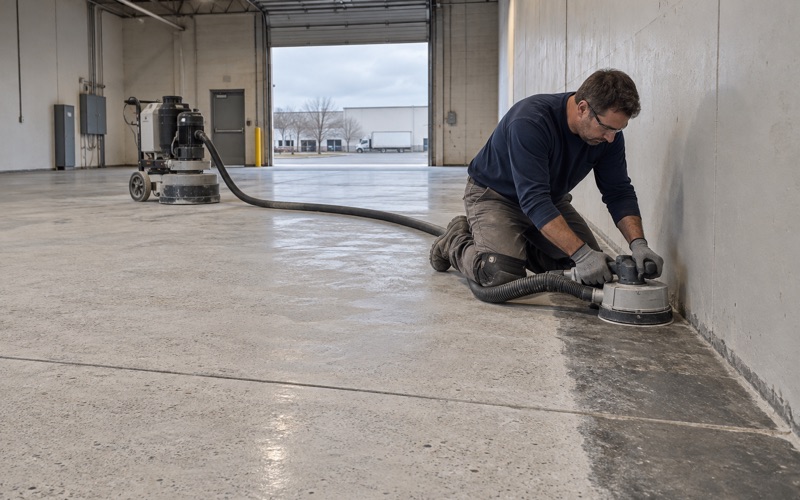
A grinder with its vacuum attached keeps the dust at the machine instead of in a food room’s floor drains. In a room where product is tested, that is not a courtesy but part of keeping the space usable while work goes on next door.
Where Epoxy Still Belongs
None of this rules out epoxy in a cold building. Office corridors, break rooms, dry storage and the walk paths that never see a cryogen can take a 100% solids epoxy or a quartz broadcast system at lower cost than a quarter inch of mortar. The line between the two systems is drawn on a floor plan, with the mortar running a margin past the farthest point a splash has been seen to reach.
Where the two systems meet, the transition is itself a termination, so it gets a keyed groove like any other edge. That seam is where we look first at every follow-up visit.
Keyed Edges, Honored Joints and Hairline Cracks
A thick mortar floor fails first where it ends. At a doorway, a drain, a wall or the edge of a freezer pad, the material has nothing on its far side to hold it, and cold shock pulls hardest right there.
Anchor Grooves at Every Termination
The data sheet we cited calls for anchor grooves at least a quarter inch wide and a quarter inch deep at terminations and transitions. We saw-cut those grooves into the slab so the mortar is keyed in at its edges, rather than feathered out to a thin lip that can peel back. Every stop line in the room gets the same treatment, including the ones under equipment.
Those keyed edges also make later repairs cleaner. A damaged section can be cut out back to a groove and patched without chasing a delamination across the room.
Joints Stay Where the Slab Put Them
Control joints in the slab are honored through the new floor, not buried. A slab will move at its joints whether or not the coating agrees, and a floor that bridges a joint simply cracks along it later, usually in a straight line that looks like a defect.
Planning for Hairline Cracks
The maker is candid that with sustained or frequent cyclic exposure, minimal discoloration and visible hairline cracks are possible. We put that in writing before the job is sold, alongside the usual warranty exclusions, so a hairline crack two years in reads as expected wear and not as a surprise.
An LNG-tank study found that thermal-shock surface hair cracks reduced tensile strength but not compressive strength. For a floor owner, that is a reason to inspect the cold zones on a schedule and seal fine cracks before they trap water or product.
Dry Ice, Cold Packs and Permits in Burr Ridge
Cryogen contact is not only a lab problem. In a garage, basement or small shop, it looks like dry ice left to sublimate on a slab after an event, a cooler of cold packs leaking across the floor, or a hobbyist working with a small flask of liquid nitrogen.
Homes and Garages
Burr Ridge is mostly owner-occupied houses, and much of that housing went up between 1980 and 2009. Whether a slab from that era sits on a vapor retarder is not recorded anywhere we can look up, so we test rather than assume. For a garage or basement that sees occasional dry ice, a ground and moisture-checked slab with a 100% solids epoxy base and a polyaspartic topcoat is usually enough, provided the ice goes on a board or mat instead of bare coating.
Home jobs above the state threshold get a written contract and the Illinois Home Repair: Know Your Consumer Rights pamphlet before any grinding starts. We also never pitch a floor coating as radon reduction, since in Illinois that is licensed mitigation work.
Labs, Kitchens and Production Rooms
Burr Ridge’s commercial base includes offices, a corporate park at I-55 and County Line Road, and a short list of manufacturing and warehouse employers. Where a business there runs cryogenic freezing, chills product with dry ice or keeps a liquid nitrogen dewar on the floor, we start by asking where the cold actually lands. The rated mortar goes where splash happens, and a lighter system can serve the walk areas around it.
Where a room cannot shut down, we phase the work around its hours with overnight and weekend windows. Slip resistance on a cold, wet floor comes from the broadcast and topcoat we specify, not from a promise.
Village License, Bond and Insurance
Illinois licenses no flooring or coatings contractor, so the village’s rules are the binding ones. On permitted work, Burr Ridge requires every contractor and subcontractor to hold a village contractor license, post a $10,000 surety bond naming the village and carry at least $1,000,000 in aggregate liability insurance with the village as additional insured. The village exempts finish work such as painting from permits, while work that impacts foundations, garages and patios needs one, so we confirm which side of that line a job falls on before it is booked.
Products are selected inside the Illinois VOC limits for floor and industrial coatings, which apply to whoever applies them. That holds for a heavy urethane mortar as much as for a garage topcoat.
Whatever the room, the first visit is the same: we look at the slab, map its cracks and old coatings, and measure moisture before we name a system. If cryogens are in the picture, the manufacturer of the rated mortar is part of that conversation from the start.
- 20+ Years Coating Floors
- Moisture Test in Every Scope
- Free Written Estimates