Tinley Park Epoxy Flooring brings more than 20 years of epoxy flooring in Bridgeview and the surrounding area to floors that carry real weight: service bays, shop aisles, parts rooms and the garages of people who drive diesels. Each of those floors fails in its own way. Our job is to find out which way before we quote, not after the topcoat lifts.
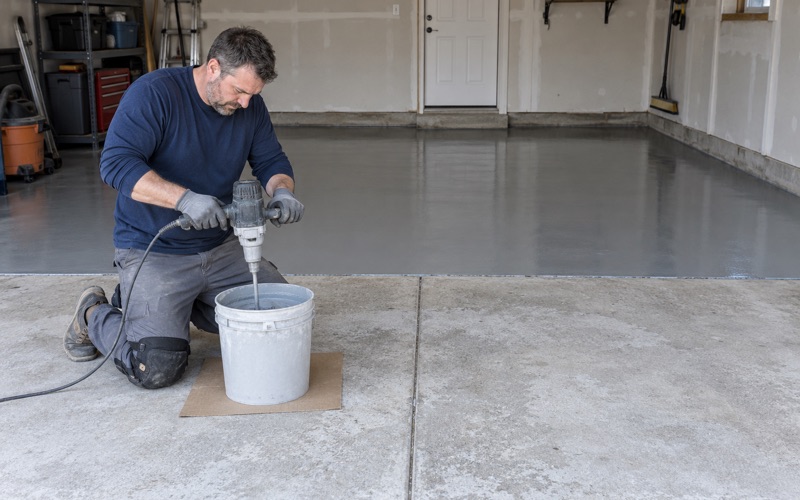
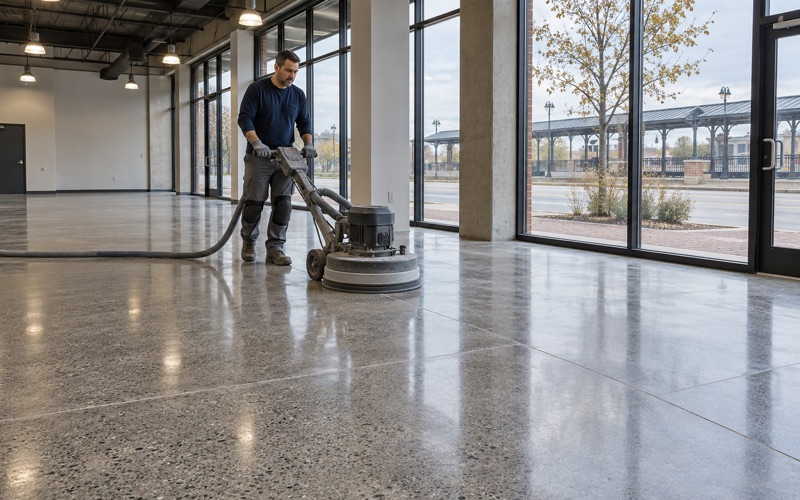
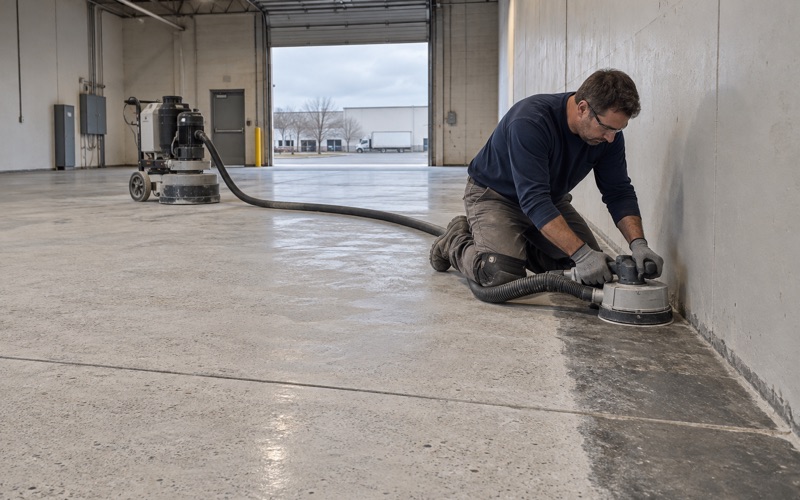
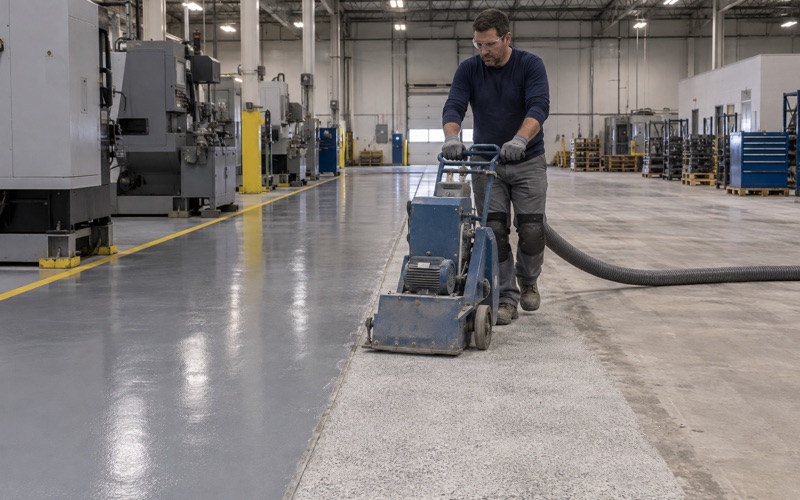
Every slab we take on is opened with a diamond grinder or a shot blaster rather than an acid etch, so the primer bites into a real profile. Before a price is final, a moisture test goes into the written scope, and the proposal names the product line, the number of coats and the finished thickness. That gives an owner something specific to hold the finished floor against.
This page is mostly about one problem that modern diesel trucks bring indoors: the heat of a parked filter regeneration. A coating cannot solve it, and we would rather say so up front than sell a floor that scorches in its first season. What follows explains where that heat comes from, what the engine maker says to do about it, and how a shop can be laid out so the epoxy never has to face it.
Heavy-Truck Repair Bays and the Parked Regeneration Problem
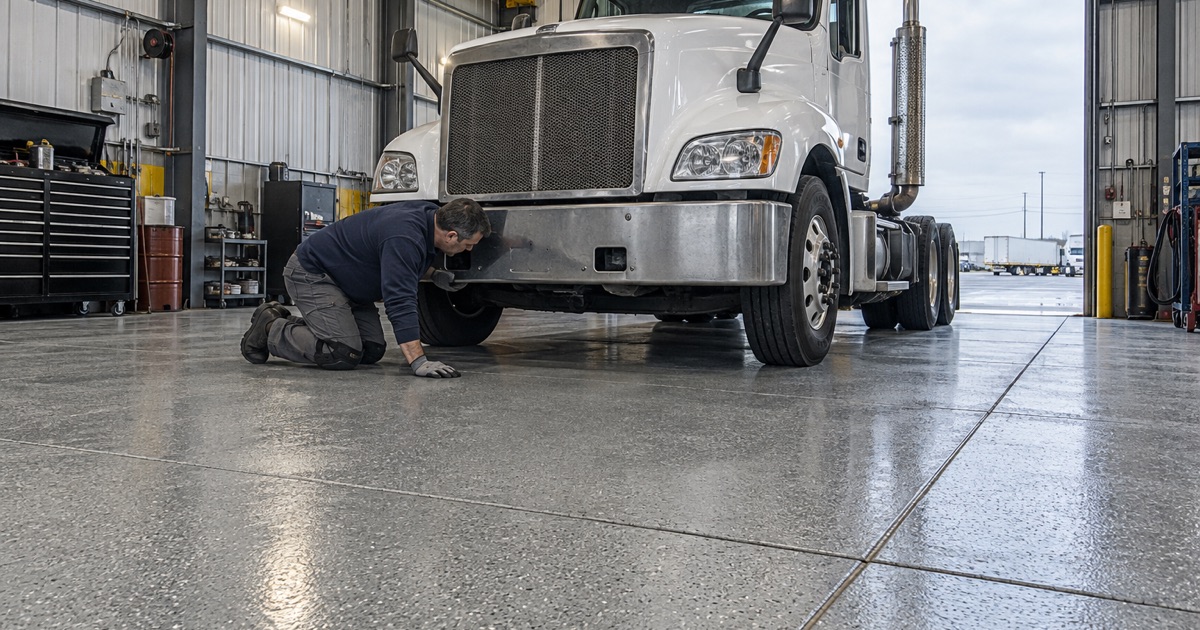
Bridgeview zones a large share of its land for industry, and the south end of the village along Industrial Drive still holds buildings made for heavy trucks. A shop floor there is judged by what rolls across it and what gets parked on it overnight. Those are the floors this page is written for.
A Truck Shop on Industrial Drive
9735 Industrial Drive, which geocodes inside the village in Palos Township, was offered for lease in October 2026. The listing describes about 25,000 square feet on 2.13 acres, with ‘truck maintenance and repair bays with a dedicated parts room’, a crane bay and overhead doors sized for ‘heavy fleet and over-the-road transport operations’. It is a clear example of the kind of building we mean, not a customer of ours.
Farther north, 8800 S. 77th Avenue is listed in a business directory as Bridgeview Truck Center, a heavy-duty repair shop. We have not seen either floor or how either shop handles its trucks. What these buildings share is the type of work: big diesels idling, parked and serviced indoors.
What a Parked Regeneration Is
A modern diesel traps soot in a diesel particulate filter, and the filter has to be cleaned by burning that soot off. Much of the time this happens while the truck drives, but when it cannot, the engine runs a parked, or stationary, regeneration with the truck sitting still. Exhaust temperatures climb well above normal while it runs.
Cummins describes a HEST lamp, for high exhaust system temperature, that warns ‘Higher-than-normal exhaust temperatures may exist due to active DPF regeneration’. A Mack service bulletin puts that lamp on solid when tailpipe temperature passes 525 C, about 977 degrees F, on its trucks. Cummins adds that exhaust surfaces stay hot for 3 to 5 minutes after the regeneration ends.
Why the Floor Rating Matters
Resin floors carry heat ratings too, at a far lower level. Sika rates its MultiDur epoxy systems for about 122 degrees F permanent dry heat, 176 degrees short term for up to seven days and 212 degrees for up to 12 hours. Those figures belong to one product line, but they show the gap between a floor’s rating and a tailpipe’s output.
No epoxy, urethane cement or polyaspartic topcoat closes a gap that size, and we do not sell any of them as if it could. A downturned or side outlet aimed at a coated slab can soften or scorch the finish. The fix lives in where the truck parks.
Looking for epoxy-flooring closer to Evergreen Park? See Epoxy-Flooring Services in Evergreen Park.
Never Aim the Tailpipe at the Floor
Cummins Bulletin 4087187, its Tier 4 operating tips, is plain about the parked regeneration. It tells operators to ‘Park machine in an appropriate location, making sure the exhaust pipe outlet is not directed at any surface or material that may become hazardous’. A coated floor directly under a downturned outlet is exactly that kind of surface.
Watch the Whole Regeneration
The same bulletin tells operators to ‘Monitor the machine and surrounding area throughout the process’. In a busy shop that means someone stays with the truck, not that the cycle runs while the crew goes to lunch. It also mentions an inhibit switch that ‘Should be used only when high exhaust temperatures present a hazard’.
For a floor owner, the inhibit switch is a short-term tool, not a plan. A truck that keeps putting off its regeneration still has to run one eventually. The better answer is a spot in the building, or outside it, where the cycle can finish safely.
Where the Heat Actually Lands
Exhaust outlets come in several orientations, and the floor sees the heat differently with each. A vertical stack sends it up toward the roof, while an outlet turned down or out the side can put a hot jet onto the slab beside the tire. A crane bay or a door lane is not automatically a safe place for it.
When we walk a truck shop, we ask which units in the fleet run parked regenerations indoors and where they usually sit. That answer shapes the floor plan more than any coating choice does. We mark the spot on the same map where we record cracks, spalls and old coatings, so the proposal reflects it.
A Designated Regen Bay With Extraction
Our view, reasoned from those numbers rather than from any Bridgeview shop’s practice, is that a coated truck shop decides where regenerations happen. Either the trucks run them outdoors, or one bay is set up for them with a high-temperature exhaust extraction hose and the tailpipe aimed up or away from the floor. The rest of the shop can then be coated without that risk hanging over it.
Fitting an Extraction Hose
A high-temperature exhaust extraction hose clamps over the tailpipe and carries the gas out of the building. It has to be rated for regeneration temperatures, which is a question for the extraction supplier and the mechanical contractor, not for us. The village has adopted the 2021 International Mechanical Code, so anyone adding ductwork or a fan for that hose should ask the Bridgeview Building Department about permits first.
Treating the Regen Bay Floor Differently
In the designated bay, we can leave the area under the exhaust point as bare concrete densified with lithium silicate, or stop the coating short of it with a clean edge. Elsewhere, a 100% solids epoxy with a quartz aggregate broadcast gives mechanics grip around jacks and creepers. The texture comes from the broadcast and topcoat we specify, not from a slogan.
Hot tire pickup is a separate issue from exhaust heat, and it matters in a truck shop too. Tires that come in off a summer highway can lift a weak topcoat, so we choose the system with that in mind. A floor that handles warm tires is still not a floor that handles a tailpipe.
Permits, Bonds and Paperwork
Illinois licenses no flooring contractor, so the binding credential here is the village’s. Bridgeview requires drawings, a contractor’s license, a $10,000 surety bond and a certificate of insurance before it issues a permit. We check those requirements before a shop job is booked, not after the grinder arrives.
Diesel Pickups and Plows in a Bridgeview Home Garage
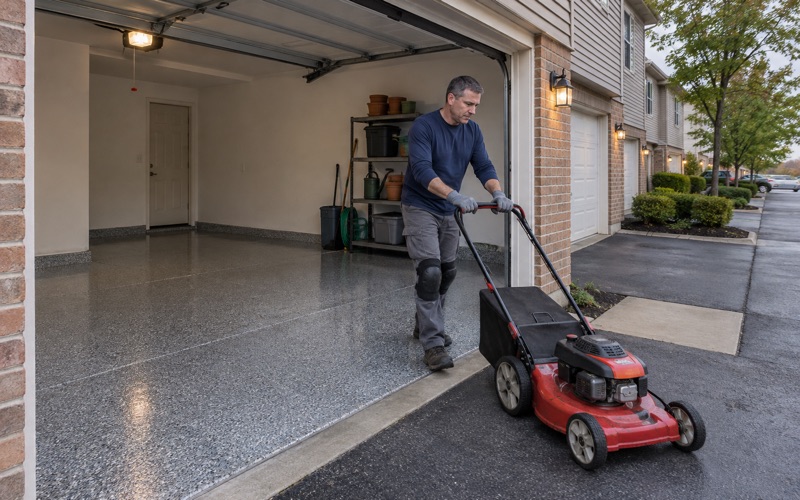
Regeneration is not only a fleet problem. Diesel pickups carry particulate filters too, and a short-trip routine can leave one mid-regeneration as it pulls into the garage. A homeowner who parks one in an attached garage faces the same question a truck shop does, at a smaller scale.
Garage Habits That Protect the Coating
If the dash shows a regeneration in progress, the safer move is to finish the drive or let it complete outdoors rather than shut the truck inside. Back-in parking with a side outlet can aim the exhaust at the slab or the wall, so it is worth checking where the pipe points. Those habits cost nothing and protect a floor in a way no coating can.
Bridgeview has 3,322 detached single-family homes, many built in the 1950s and 1960s, and their garage slabs vary widely in condition. We map cracks, spalls and old coatings first and tell the owner when a slab needs repair or replacement before it should be coated. A garage that floods or wicks moisture gets the same frank treatment.
Plows, Salt and Winter Cure Times
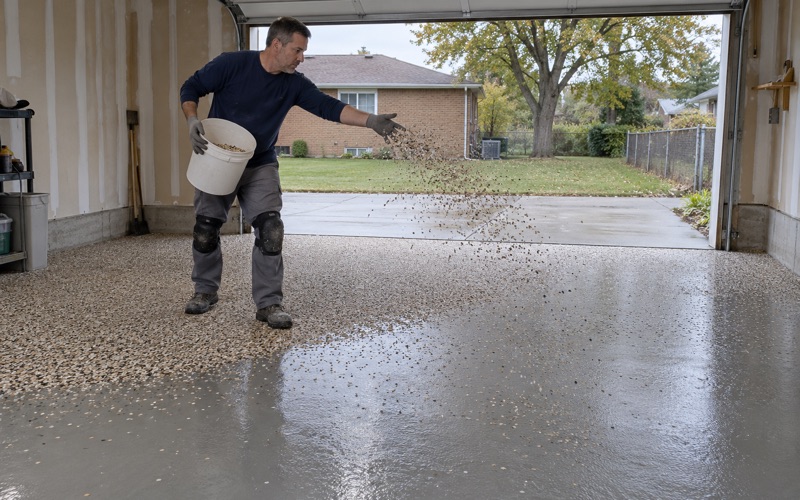
A diesel pickup that pushes snow brings in brine and rock salt on every run. We pick garage systems for that exposure, typically a 100% solids epoxy base with a polyaspartic topcoat over a vinyl flake broadcast. The flake hides salt residue between washes, and the topcoat takes the chemical hit.
Winter also limits when the work can happen. We set cure schedules by slab temperature and the dew point spread at the surface, and an unheated garage in deep winter is told to wait. For home jobs over the state threshold, we sign a written contract and hand over the Illinois consumer-rights pamphlet before any grinding starts.
Moisture and Flooding
Most of Bridgeview sits in a high urban flooding susceptibility zone, and the village reports repeated flood losses, including homes along Roberts Road and 100th Place. A moisture test goes into every written scope, using ASTM F1869 calcium chloride kits or ASTM F2170 relative humidity probes depending on the slab. Moisture is also the first exclusion we name when we explain what a coating warranty leaves out.
Grinding dust from a garage job is captured at the machine with a vacuum rather than rinsed toward a floor drain or the street. For a home along a flood-prone block, that keeps fine concrete dust out of the storm inlets the neighborhood depends on. It is one more part of the job that a homeowner can check on the day we work.
- 20+ Years Coating Floors
- Moisture Test in Every Scope
- Free Written Estimates