
Tinley Park Epoxy Flooring coats basements with basement floor epoxy in Tinley Park, IL, serving surrounding cities including Country Club Hills, Mokena, Matteson, Midlothian and Hazel Crest. In more than 20 years of floor coating work, the lesson we see most often is that a basement coating succeeds or fails on the moisture in the slab, not on the color picked from the sample board.
That is why every basement scope we write includes a moisture test before the price is final. The result decides whether a standard 100% solids epoxy will hold or whether the slab needs a moisture-mitigation primer first, and it is recorded in the proposal next to the product line, the number of coats and the finished thickness.
We also map what is already on the floor: paint, patching compound, tile adhesive, cracks and the fixtures set into the slab. Every one of those items appears in the written scope, so you can see what the floor needs and what each step adds before any grinding begins.
Basements in Tinley Park Homes
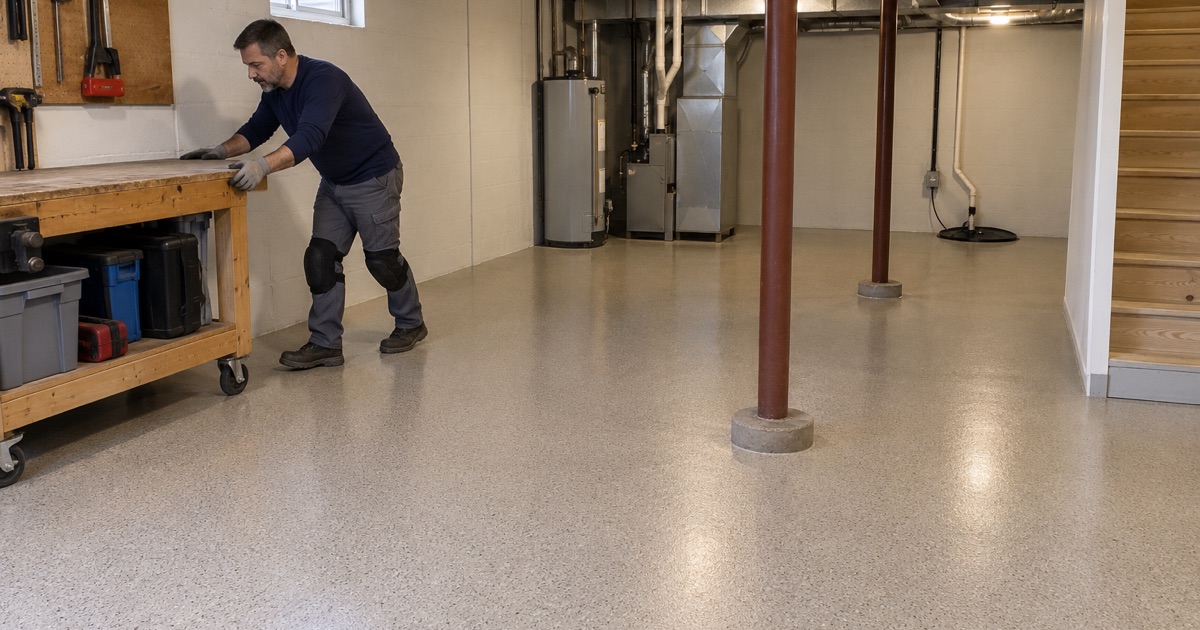
Full Basements, Partial Basements and Split-Levels
Basements are the norm here. In a Cook County Assessor sample covering most of the village’s Cook parcels, 87.6 percent of houses had a full or partial basement, and most partial basements are the lower level of a split-level home.
A split-level lower floor sits only partly below grade, often with a family room on one side and a laundry or utility area on the other. We read moisture in each section of slab rather than assuming one answer for the whole level, because the half-buried side and the exposed side can behave very differently.
Sump Pits, Ejector Pits and Floor Drains
The village code requires new basements to use overhead sewers with an ejector pump, routes basement floor drains to that ejector, and sends footing-drain water to a sump with a gas-tight cover. A typical basement here therefore has both pits set into the slab.
We coat neatly around those fixtures, keep every lid and cover removable for service, and leave drain grates open and working. The floor around a pit is also where water shows up first, so it gets a close look during the moisture check.
Leaking Cracks Come First
A floor coating is applied after any seepage or crack leak has been fixed, never instead of it. The village code itself calls for leaking foundation-wall cracks to be cut out and filled with epoxy cement grout, and we point out leaks we find so they can be repaired before the floor is coated.
Testing Moisture in a Basement Slab
Why Basement Slabs Carry Moisture
A basement slab sits in the ground, and moisture from the soil moves up through the concrete as vapor. Where groundwater rises against the slab, hydrostatic pressure can push liquid water through cracks and joints, which no coating is designed to hold back.
Older homes may also lack a vapor retarder under the slab, or have one that was torn during construction. Newer habitable-room slabs are typically poured over polyethylene sheeting, and products rated to ASTM E1745 are common today, but we never assume what is under a slab we did not pour; the test tells us instead.
The Three Tests and What They Show
The plastic sheet test under ASTM D4263 is a quick screen that shows whether moisture is collecting under a taped-down sheet. The calcium chloride test under ASTM F1869 measures how much vapor the surface emits over a set period, while ASTM F2170 places relative humidity probes in holes drilled to 40 percent of the slab depth to read conditions inside the concrete.
Those tests answer different questions and are not interchangeable. The pass and fail numbers contractors quote, 3 pounds per 1,000 square feet per 24 hours and 75 percent relative humidity, come from the ASTM F710 recommendation rather than from the test methods themselves, and the coating manufacturer’s own limits govern the final choice.
When a Moisture-Mitigation Primer Is Needed
When a reading is above what the chosen coating tolerates, a moisture-mitigation primer is installed first to hold the vapor back from the coating layers. It is a separate line in the proposal because it adds material and time, and leaving it out is the single most common reason basement coatings blister.
Moisture is also the first exclusion we name when we explain the warranty. If a slab tests high and an owner declines the primer, that choice is written down, because a failure caused by vapor from below would not be covered by any coating warranty we know of.
Preparing an Old Basement Floor
Paint, Patches and Tile Glue
Older basement floors often carry porch paint, patching compound, carpet tack strip and black mastic from vinyl tile. We grind all of it down to sound concrete with a diamond grinder, capturing the dust with a vacuum at the machine, because a coating is only as strong as the layer it is bonded to.
Very old black mastic can contain asbestos, so we ask about the age of any tile adhesive before grinding and recommend testing where it is in doubt. Cracks and spalls are mapped and filled during this stage, and we tell you when a section of slab is too damaged to coat as it stands.
Efflorescence and White Powder
White powder on a basement floor is usually efflorescence, salts carried up by moisture and left behind as it evaporates. We grind it away before testing and treat it as a sign that vapor is moving through the slab, which often points toward a mitigation primer.
Cleanup After Water Gets In
After a seepage or sewer backup, the floor is cleaned, the cause is fixed and the slab is given time to dry. We test again after cleanup, because a coating applied over a wet slab will lift as the trapped water tries to escape.
Where a basement sits in a flood-prone area, FEMA Technical Bulletin 2 describes flood damage-resistant materials, and bare or coated concrete is among them. A coated floor cleans up after an event, but it is not flood protection and we never describe it as such.
Choosing a Basement Coating System
Family Rooms and Finished Spaces
In finished lower levels, owners often choose a vinyl flake broadcast or a metallic epoxy for a decorative look, sealed with a clear topcoat. A satin sheen hides dust and footprints better than a high gloss in a room used every day.
If the lower level will later get carpet, a rug or furniture across most of it, a simpler solid color system often makes more sense than a decorative one. We talk through how the room will actually be used, so the money goes into the floor you will see rather than the part covered by a sectional.
Laundry Rooms, Workshops and Home Gyms
Utility areas need a floor that handles washer drips, dropped tools and rolling equipment. We use a thicker build for workshops, a textured topcoat near the laundry where floors get wet, and a resilient finish under weights, all named in the scope.
Basements stay cool most of the year, and a cold slab with humid air above it can push the surface close to the dew point. We check slab temperature and the dew point spread before each coat, because condensation during cure causes amine blush, a greasy film that weakens the bond to the next layer.
Cost, Contracts and Consumer Rights
Basement pricing moves with square footage, old-material removal, crack repair, the moisture result and any mitigation primer. Home jobs over the state threshold get a written contract and the Illinois Home Repair: Know Your Consumer Rights pamphlet before work begins, as the Home Repair and Remodeling Act requires.
The proposal also explains what the coating warranty excludes, starting with moisture, and confirms that the coating is not waterproofing or radon mitigation. Radon reduction in Illinois is licensed work under IEMA, separate from anything a floor contractor installs.
- 20+ Years Coating Floors
- Moisture Test in Every Scope
- Free Written Estimates