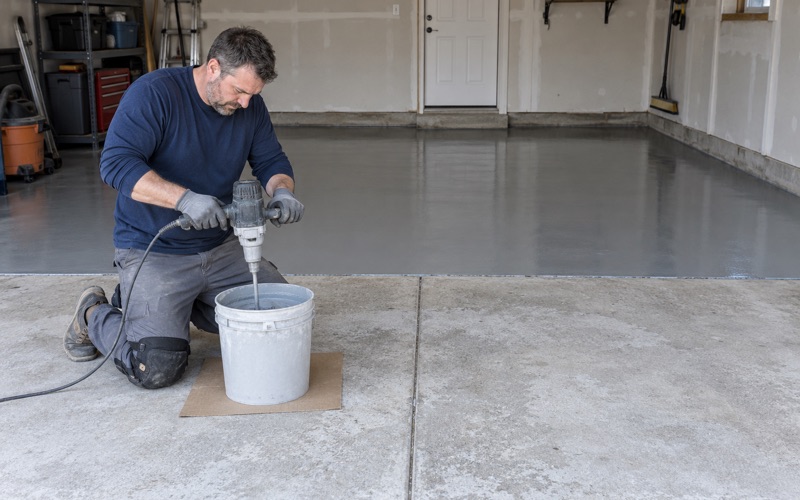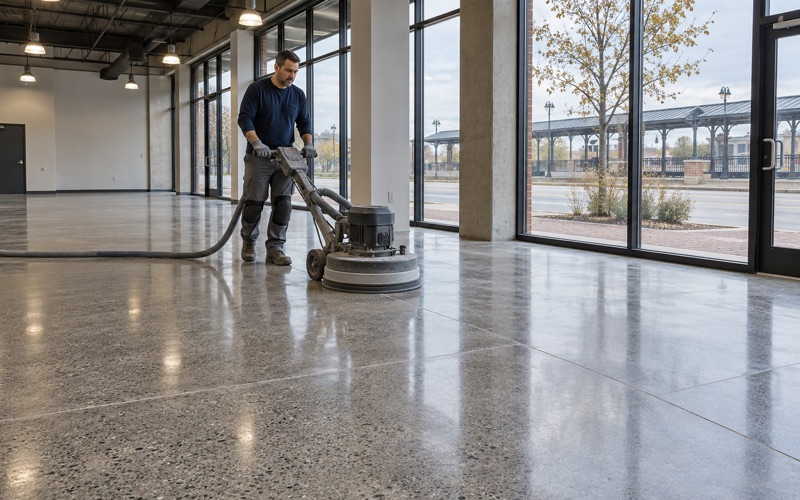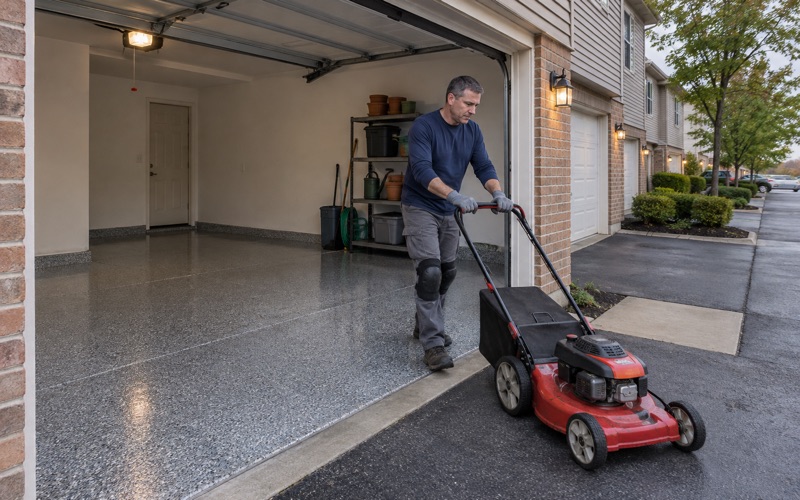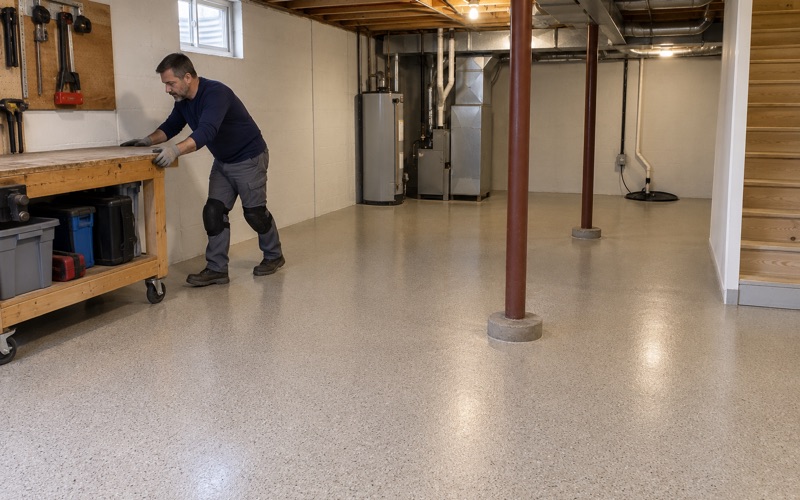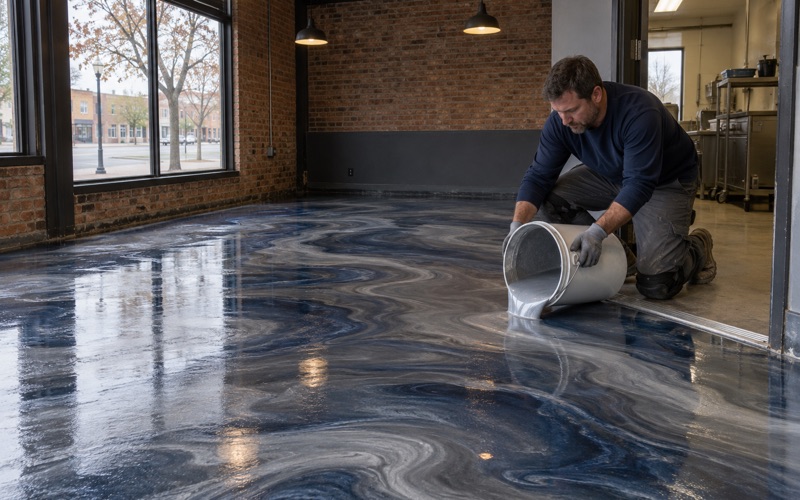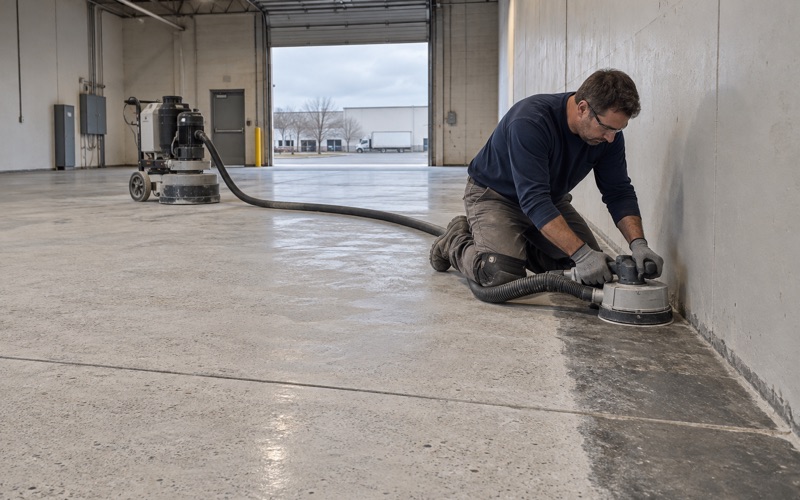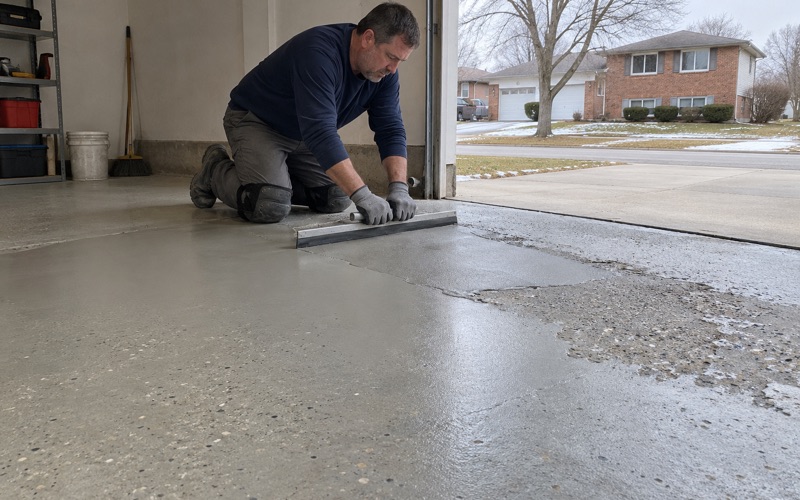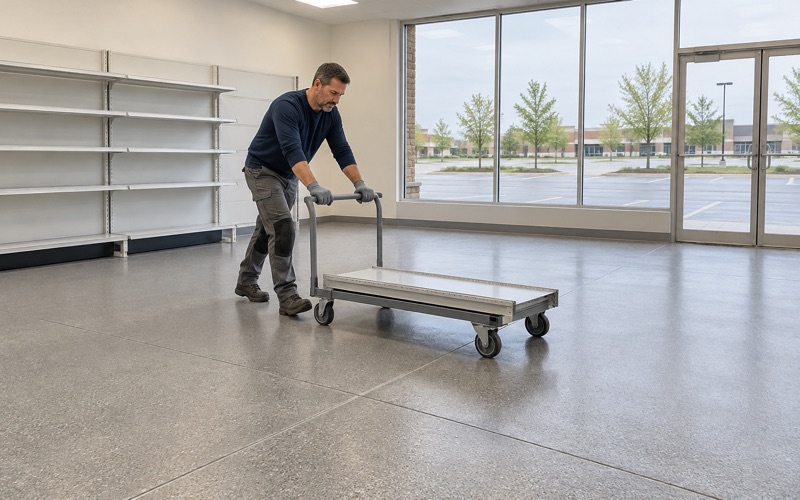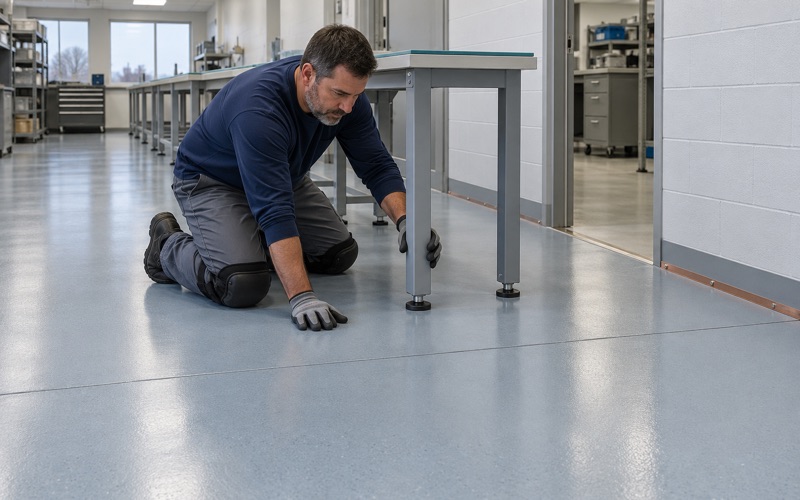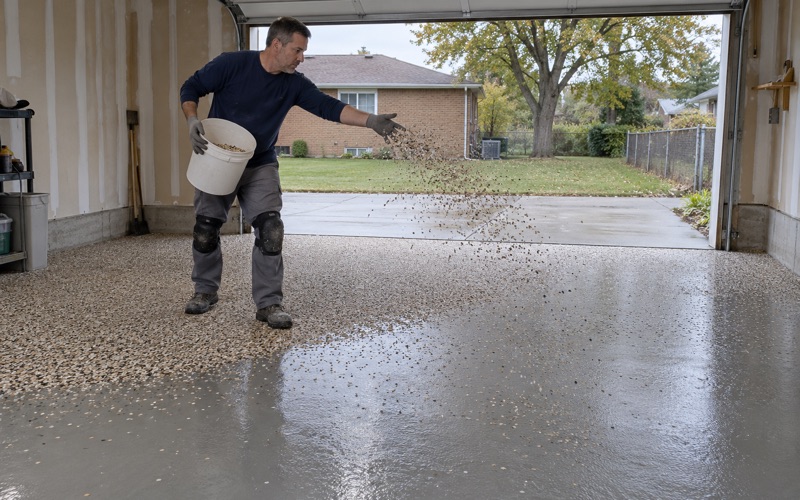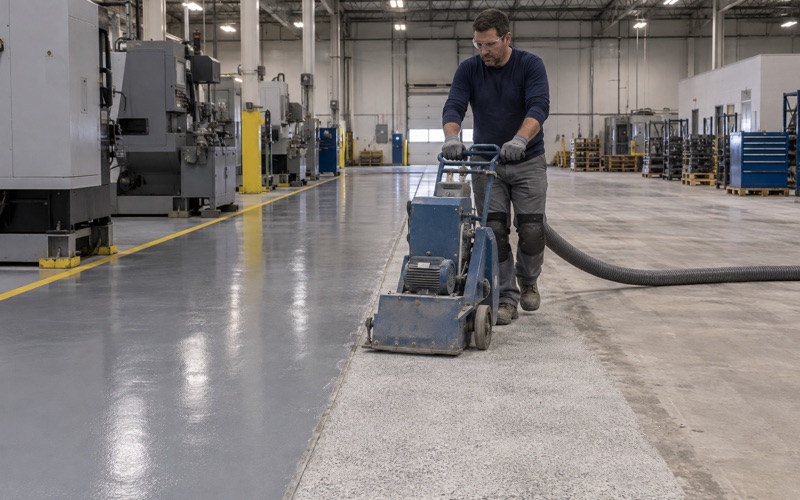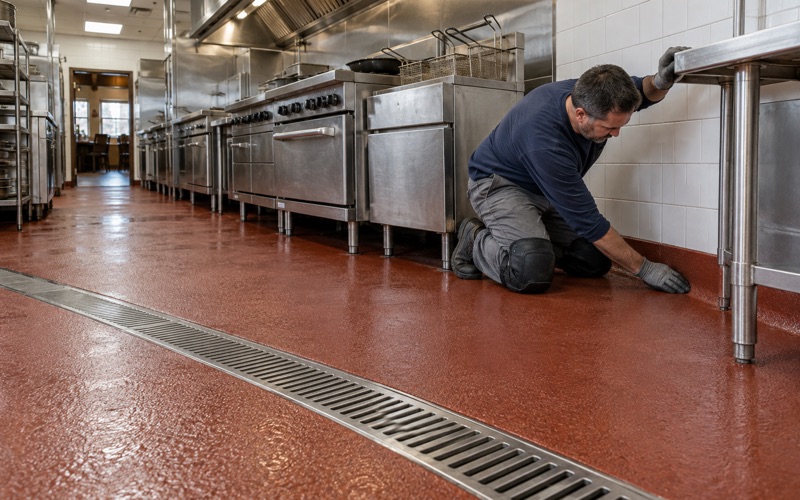
Tinley Park Epoxy Flooring has spent more than 20 years installing epoxy flooring in Alsip, and our work always starts with the slab rather than the color chart. Every floor is opened with a diamond grinder or a shot blaster, never an acid etch, so the coating bonds to a real profile instead of a washed surface. Garages, basements, shops and production floors all get that same first step.
Before a price is final, a moisture test goes into the written scope. Cracks, spalls and old coatings get mapped on the first visit, and when a slab needs repair or replacement before it should be coated, we say so plainly. The proposal then names the product line, the number of coats and the finished thickness, so you can check the floor against the quote once it is down.
Much of this page is about one demanding kind of floor: the one that sits next to abrasive blasting. Loose media, blast dust and the grit that boots carry out of a booth change what a coating has to survive, and they change how the floor should be cleaned. The same thinking scales down to a blast cabinet in a home garage.
A Blasting Job Shop on Austin Avenue and the Rule Around Its Floors
What Engineered Abrasives runs at 11631 S. Austin Avenue
Engineered Abrasives operates a shot peening and blasting job shop at 11631 S. Austin Avenue, an address that geocodes inside Alsip village in Worth Township. Its services page lists steel shot, ceramic, fine steel and glass bead peening, along with high-volume steel shot peening and shot blasting. Cut wire and cast steel are named among its media as well.
The company calls itself an IATF 16949, ISO 14001 and Ford Q1 certified job shop that designs and builds its blast machines in-house. Those credentials belong to the shop, not to us, and we have never coated its floors. How its floors are finished was not something we read, so we treat the shop only as the clearest local example of the work.
What 1910.94(a)(7) actually says about the floor
OSHA’s abrasive-blasting standard, 29 CFR 1910.94(a)(7), packs its floor language into a single paragraph. Dust may not accumulate on the floor or on ledges outside a blasting enclosure, and dust spills have to be cleaned up promptly. Aisles and walkways have to be kept clear of steel shot or similar abrasive that may create a slipping hazard.
Notice what that paragraph leaves out. It names no floor material and no coating, and it never treats texture as a substitute for cleanup. The duty is housekeeping, so no coating satisfies the rule by itself; what a floor can do is make that housekeeping faster, easier and more obvious.
Why the floor choice still matters
A shop that sweeps several times a shift still loses some media past the booth door, out of a parts bin or off a pallet. The floor decides how quickly a dropped handful is noticed and how completely it can be cleared. That is where coating selection earns its place in a blasting operation.
A blast area also changes the layout conversation. We ask where parts enter and leave the booth, where media is loaded and reclaimed, and which aisles carry foot traffic past the enclosure. Those paths get the cleanest, lightest and most even finish on the floor, because that is where a missed spill is most likely to meet a hurried step.
Looking for epoxy-flooring closer to Harvey? See Harvey Epoxy-Flooring.
Steel Shot Underfoot: Why Texture Does Not Stop a Rolling Ball
Round media behaves like ball bearings
Steel shot and glass bead are round. On a smooth floor, a scattering of either one rolls under a boot sole the way ball bearings would, and the foot goes with it. That is the plain mechanism behind OSHA’s wording about a slipping hazard.
Angular media such as cut wire behaves somewhat differently, but most peening relies on round shot and bead for a reason. The same shape that peens a part evenly is the shape that turns a spill on an aisle into a fall.
A heavy broadcast is not the answer
The usual instinct is to add aggregate and call the floor slip resistant. We specify texture by the broadcast and topcoat used, and around blasting we are honest about its limit: a quartz aggregate surface gives a shoe more grip on a clean or damp floor, but a loose steel ball still rolls right across it. Heavy texture also gives fine media and dust more places to lodge, which slows down the very sweep the rule requires.
For aisles that see spilled media, we usually lean toward a finer, even texture that a broom and squeegee clear in one pass. The goal is a surface where nothing hides, not one that claims to hold shot in place.
Sweep, magnet-sweep and see the spill
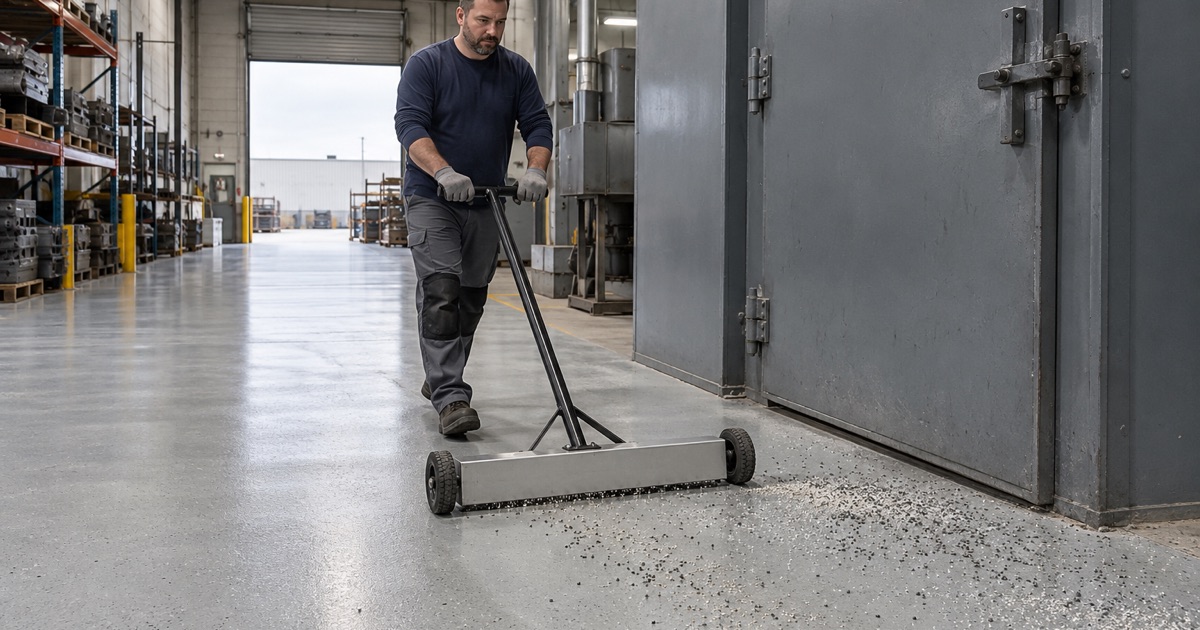
Steel shot is magnetic, so a rolling magnetic sweeper lifts it off a coated aisle quickly and without kicking up dust. Glass bead and ceramic media are not magnetic, which means they need a broom or vacuum pass, and the floor has to make them easy to spot.
That is the case for a light floor color in and around a blast area. Dark steel shot shows clearly against a pale gray or tan coating, while pale bead reads better against a mid-tone than against white. We talk through the media actually in use before picking a color, because the right shade depends on what is going to be spilled.
Keeping the cleanup routine simple
A floor around blasting only works if the crew actually cleans it the way it was designed to be cleaned. When we hand over a coated aisle, we go through which tools suit it: a magnetic sweeper for steel shot, a soft broom or vacuum for bead and ceramic, and a damp mop for fine dust. Harsh scraping tools are the quickest way to scar a topcoat.
Worn lanes are also easier to spot on a light floor, which turns recoating into a planned job rather than a surprise. Because the proposal records the product line and coat count, a later topcoat can match what is already there.
Blast Dust on Boots: Abrasion, Topcoats and Prep
Blast fines act like grit
The fines that come out of blasting are abrasive by design. Carried out of an enclosure on boots and pallet jack wheels, they work like sandpaper on a floor finish, wearing traffic lanes dull long before the rest of the slab. A coating chosen only for its looks shows that wear within months.
We answer it with a build and a topcoat chosen for abrasion. A 100% solids epoxy body coat supplies thickness, and a polyaspartic or polyurea topcoat over it takes the grinding wear of daily foot and wheel traffic. Where forklift and pallet jack wheel loads are part of the picture, the proposal states the finished thickness so it can be checked later.
A surface that gives up its dust
Because the rule calls for dust spills to be cleaned up promptly, the floor has to release dust to a vacuum or a damp mop rather than hold it in pores. A sealed, seamless coating does that far better than bare concrete, which drinks fines into its surface and dusts back up under traffic.
Transitions matter too. Where a booth floor meets an aisle, we look at how media and dust travel across the joint, and we finish the edge so a sweeper rolls over it without a lip catching debris.
Preparing a slab that has lived beside blasting
An older shop slab near blasting often carries embedded fines, old paint and worn patches. We grind or shot blast it to a measured ICRI concrete surface profile, map the cracks and spalls, and run moisture testing such as ASTM F2170 relative humidity probes before the price is set. Grinding dust is captured at the machine with a vacuum instead of being washed toward a floor drain.
Cure schedules follow slab temperature and dew point rather than the calendar. In a working shop that usually means sequencing aisles and bays so part of the floor stays in service while another section cures, with overnight or weekend windows when a line cannot stop.
Blast Cabinets and Media Blasting in an Alsip Home Garage
Hobby blasting brings the same problem home
Plenty of home garages hold a benchtop or floor-standing blast cabinet for restoring car parts, tools or bike frames. Cabinets leak media at the door seals, the reclaim hopper and the glove ports, and glass bead ends up on the floor around the unit. A glossy garage coating with a scatter of bead on it is the same rolling hazard as a shop aisle, only on a smaller scale.
We plan a garage floor around the cabinet the way we would plan an aisle. A light vinyl flake blend or a light solid color shows spilled media, the topcoat is picked for abrasion, and the texture stays fine enough that a shop broom and a magnet pick up whatever falls.
Testing the slab before the cabinet goes back
Before we quote a garage, we test the slab for moisture, using an ASTM F1869 calcium chloride test or an ASTM D4263 plastic sheet test where it fits the job. The residential code’s garage exception, IRC R506.2.3, means a garage slab may have no vapor retarder beneath it, and moisture moving up through the concrete is a common reason a coating lets go. If the readings call for it, a moisture-mitigation primer goes into the written scope instead of being discovered later.
The cabinet itself also needs a plan during the work. We move it out, coat the floor, and set it back only after the topcoat has cured enough to take its weight and the scuffing of its feet, so the first week of use does not mark a soft finish.
Older slabs and Illinois winters
Housing in Alsip peaked in the 1970s, and building all but stopped after 2000, so most residential floors here are retrofits over slabs roughly 25 to 65 years old. Those slabs often carry cracks, old sealers and spalling that need repair before any coating goes down. When a slab should be fixed or replaced first, you hear that from us before you hear a price.
Garage systems also have to hold up to the brine and rock salt that ride in on tires all winter. In an unheated garage during deep winter, we tell you to wait rather than coat a cold slab, because a proper cure depends on the slab temperature and the dew point spread at its surface.
Licensing, contracts and warranty terms
Illinois issues no state flooring license, so local rules carry the weight. The Village of Alsip collects a contractor license fee, and we check the village’s license, bond and insurance requirements before a job is booked. Home jobs over the state threshold get a written contract and the Home Repair: Know Your Consumer Rights pamphlet before any grinding starts.
We also explain what a coating warranty leaves out before the job is sold, and moisture is the first exclusion we name. Products are chosen inside the Illinois VOC limits for floor and industrial coatings, which bind the person applying them.
- 20+ Years Coating Floors
- Moisture Test in Every Scope
- Free Written Estimates